Полная версия:
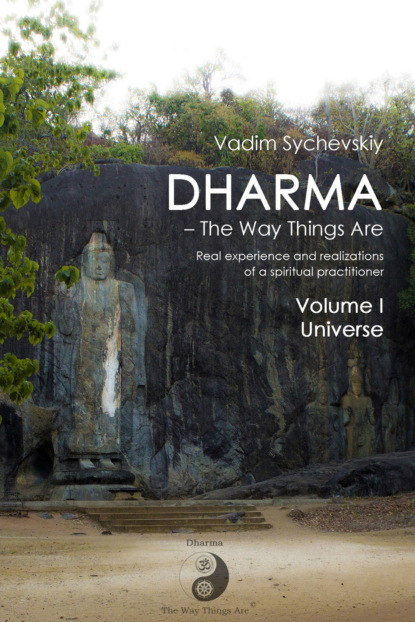
Dharma – The Way Things Are. The real experience and realizations of a spiritual practitioner. Volume I. The Universe
In all this searching for «places of power», I had completely forgotten that our translation team had emailed some of Venerable Ananda Maitreya's lectures for me to review and edit their translation.
I immersed myself in reading. Texts written by (or recorded from the words of) the Achievers have tremendous power because they have their own spiritual experiences of the highest level, which in turn confirms in the original ancient texts.
Venerable Ananda Maitreya's words made me literally shudder – in a few sentences, the Master explained the reason for my despair yesterday:
«In some Buddhist monasteries, some rituals were passed off as true religion. However, those were only ceremonies, not true Buddhism. If you want to see true Buddhism, it still exists – in remote villages but not in the cities. In my opinion, the uneducated are trapped in formal rituals that did not exist even some fifty years ago».
These simple words were the best support and encouragement for me during that moment. Along with this feeling came a sincere and strong determination to show people the True Dharma, using all the knowledge, discoveries, and spiritual experience I had gained over the many years of practicing Buddhism, yoga, and Taoism (confirmed by the Gurus and original texts).
Dharma in Our Days
The Buddha called his way of seeing the world and life «Dharma», a very clear and flexible word. He was not the first to use this word, for it had been used before him in the sense of ritual and law, but the Buddha gave it a deeper, spiritual meaning.
D.T. Suzuki.Have you heard of Bruce Lee? I would like to start with his example in explaining my experience of Dharma. Surely, as you have probably heard of this martial arts master with an incredibly bright destiny that was tragically cut short. Thanks to him, I started martial arts, eventually becoming a spiritual practice. Back then, it was very trivial, like how it is for many people who start practicing various kinds of martial arts: as a child (at the age of 10), I saw the movie «The Way of the Dragon» with Bruce Lee in the lead role and was shocked by what I saw – his lightning-fast blows, with prohibitive speed and precision of movements.
Later, I noticed that besides his fantastic technique and physical form, Bruce had something else that made him stand out from other masters. I think it was an awareness that was the result of empirical experience. Everything that Bruce Lee did and said, he had fully experienced and verified in his painstaking search for Truth. He tested and systematized all kinds of martial arts and all the spiritual teachings underlying them. That is why Bruce Lee and his style of Jeet Kune Do still today arouse such interest, trust, and desire to follow the path of self-discovery.
Bruce Lee was a fierce opponent of frozen forms, fixed ideas, ceremonies, and the like, calling them «organized hopelessness». For example, if an element was of no practical use, whether in training or actual combat, that element (exercise or technique) was discarded as unnecessary:
«Instead of considering combat as such, most martial arts systems accumulate impressive surrogates that confuse their followers and lead them away from the true reality of combat, which is simple and direct. Instead of going directly to the heart of things, streamlined forms (organized hopelessness) and imitative techniques are regularly and methodically practiced, replacing real combat with conventional combat. Thus, instead of „being” in combat, these practitioners are „doing something resembling combat”.
Even worse, the supramental and spiritual powers are ruinously degenerated while these practitioners delve deeper and deeper into mysteries and abstractions. All these things are vain attempts to catch and record the ever-changing movements of battle, dissect them, and study them like a corpse.
When you move away from this, real combat ceases to be frozen and comes alive. Surrogates (a form of paralysis) cement and frame what flows and changes. When you look at it realistically, it is nothing but blind devotion to the systematic futility of practicing routine techniques or acrobatic tricks that lead to nothing» (Bruce Lee. «The Tao of Jeet Kune Do»).
The vivid image of Bruce Lee will help us analyze the Dharma, but now I would like to explain my position on religion using his example.
It may seem strange, but Bruce Lee can be compared to Sakyamuni Buddha. Of course, comparing the spiritual levels of these two people is not accurate. The first is a genius of martial arts, and the second is a man who has reached the highest spiritual level, that is, who realized the state of Buddha (Tathagata[11]). Nevertheless, they have something similar in their approach to spiritual practice. Everything is tested in their own experience, systematized, removing the superfluous and unworkable, and only after that is handed down to people. The real question is how people (i.e., we) use these precious instructions now.
Imagine someone who decided to study martial arts after seeing Bruce Lee on the screen. In Buddhist terms, this person has «taken refuge» and has gained faith in Bruce Lee and his teachings. The man learned by heart everything written by Bruce and watched all the feature films and documentaries with his participation a thousand times. On the newsreel footage of Bruce Lee, we see that he used a heavy boxing bag to practice a sidekick. Also, in the feature films, since Bruce Lee played a Chinese martial arts master (i.e., himself), he wore a traditional Chinese costume, the «yifu» or «kunfuiku». Suppose the person in our example goes to a sports store and buys a similar boxing bag, roughly the same one Bruce used. Next – the person buys himself a kunfuiku. Then he puts the bag on a pedestal in his home, puts the kunfuiku on it, hangs a portrait of Bruce Lee over it, makes an offering of Chinese food (that Bruce loved), and then sits on his knees and begins to read aloud by heart the books written by Bruce Lee. He honors the punching bag as a relic. Of course, he does not practice his sidekick and hardly trains at all. Can he become a martial artist? Most importantly, does this man utilize the tremendous legacy that Bruce Lee left behind? In form – yes, he does, because he knows all of his books and movies by heart. But in practice? Now tell me: what is the difference between this exaggerated example and modern religious ceremonies? It is precisely this situation in martial arts, which also applies to religion, that Bruce Lee called «organized hopelessness».
Therefore, I am all for practicing the full-force sidekick, as taught by Bruce Lee. I am for meditation of Contemplation, sitting in the correct posture with a straight back for many hours, as taught by Sakyamuni Buddha. I am for consistent study, practice, and achievement, both in martial arts and in spiritual practice (to repeat: for me, martial arts are as much a spiritual practice as, for example, Taoism or yoga).
Thus, Dharma is not only a universal law but also an experiential way of knowing what that law says. The historical Buddha Sakyamuni was the chief reformer, systematizer, and practitioner of this Law. Dharma is, therefore, primarily associated with his Teaching. The Buddha himself called his teaching «Sachcha» (Pali: සච්ච, sacca), which means «Truth». He was not preaching Buddhism; he was explaining the Truth, the true Law, the Dharma, or the way things truly are. The Buddha was the living embodiment of this absolute Truth. Before his passing, the Buddha bequeathed to his disciples to «be their own light», and in his place, he left his teaching, the Dharma:
«Abide, monks, as your own light, as your own refuge, you need no other refuge. Let Dharma be your light, Dharma be your refuge, no other refuge is needed».
Chakkavatti Sihanada Sutta (DN 26), Sutra on «Lion Roar of the Worldlord».Dharma has existed since the beginningless past and appears to the world in many different forms, according to conditions and times. The first lines are from one of the foundational texts of yoga, «Shiva Samhita», which states:
«Knowledge is eternal, without beginning or end; no other real substance exists. Diversities we see in the world are results of sense-conditions; when the latter cease, then this knowledge alone, and nothing else, remains».
The knowledge referred to in this fragment is the same thorough knowledge mentioned at the very beginning of this introduction. It is realized through pure vision, which, in turn, is acquired after our consciousness has returned to its original state of Calmness and Contemplation.
The Whole Picture of the Dharma
Buddhism is a structure erected around the deep consciousness of its founder. The style and material of the outer structure may change over time, but the inner meaning of the Buddha state, upon which the whole structure rests, remains unchanged and always alive.
D.T. Suzuki.My spiritual journey began in 1991 by studying martial arts. I soon realized that martial arts have a very serious basis in spiritual practice (in those years, the phrase «Eastern philosophy» was used), and they are the same. Wishing to expand the boundaries of my knowledge, I began to study and practice Taoism and Zen Buddhism. This happened in 1992, the year in which I began my full-fledged spiritual practice. A little later, I added to my studies the study and practice of Hatha Yoga, which is the basis of one of the main directions of all yoga – Raja Yoga. After gaining some experience in Raja Yoga, I started practicing Kundalini Yoga. Finally, I began to study Buddhism, both original and Tantric. One must always remain a student – the study and practice of all the Teachings mentioned above I still continue up to this day. I will describe all these Teachings and my experiences in the further course of exposition.
I freely studied and practiced all these Great Teachings, and none of the Teachers «pulled» me in their direction (with rare, unfortunate for me, exceptions). For example, we could discuss the Mahayana Teachings for hours with the Raja Yoga Achiever. With a Meditation Master from Sri Lanka, we talked about Kensho (first Enlightenment) and Zen. With a Tibetan Lama, I talked about Yoga and Theravada. With a Zen Master, we discussed not only my «glimpse of the Buddha» but also Patanjali's Yoga Sutras and Vajrayana meditations. As I continued my practice and received invaluable advice from teachers of different traditions who had reached a high level, I saw that no true teachings contradict each other. In other words, every Teaching, let it be Buddhism (Southern or Northern), Yoga, or Taoism, contains in one form or another the whole Law, the whole Dharma – this I will try to show throughout the book.
However, in each of these Teachings, certain parts of the Law are described in more detail, and more attention is paid to them. Therefore, if you want to learn about energy and start practicing to awaken it, I recommend Taoism based on my experience. If you have safely awakened the energy and want to go further, it should be Yoga and Tantra at the highest levels. If you want to learn about Enlightenment and have a Kensho experience, It is Zen. If you want to expand your state (what I was talking about with the Zen Master), that would be Mahayana, and at the highest levels – Vajrayana and Mahamudra. However, if you do not do the basics, such as practicing goodness and merit, and if you do not keep the precepts, control your mind, study, and practice the Dharma, you will not achieve anything. All these fundamentals (and more) are described consistently and in as much detail as possible in the Theravada sutras.
Of course, this does not mean that, for example, a yoga practitioner will not realize Enlightenment; a Zen practitioner will not know anything about energy and supernatural forces; or a Theravada monk, having mastered the basics, will not awaken spiritual energy and enter Samadhi. Every authentic spiritual practice system has two unchanging components: energy and consciousness. However, as mentioned above, somewhere, the emphasis of practice is shifted more towards consciousness, somewhere more towards working with energy. The most important theme of the whole Teaching is the interrelation of energy and consciousness. This is what I will talk about in the other relevant chapters.
«Conventional Designation»
There is another very important aspect that is most often overlooked. In previous descriptions, I have used the names «Buddhism», «Taoism», and the like. However, we must realize that, for example, Sakyamuni Buddha never used the word «Buddhism». That is also why the sutras of the Pali Canon speak of the Dharma or Truth – they do not contain the word «Buddhism». Similarly, in the foundational treatise of Taoism called the Tao De Jing, you will not find the word «Taoism»: the text speaks of the Tao, our original and eternal state. In the Tibetan texts, there is no combination of the words «esoteric buddhism» or, even less, «lamaism».
What am I trying to say? This thought was brought to my mind by a conversation I once had with an Indian yogi. I asked him about Hinduism, officially considered India's main religion (it is practiced by 80.46 % of the population). The question about Hinduism seemed to surprise the yogi: «What is Hinduism?» – he asked. I was discouraged by such a counter—question. My interlocutor continued: «There is a part of the earth's landmass called India. Accordingly, the people who inhabit India are called Hindus. Hindus follow a certain Teaching. This Teaching has been called „Hinduism”, that is, „the religion practiced by Hindus”». The yogi explained that the ancient Sanskrit texts – the Vedas and the Upanishads – do not contain the word or name «Hinduism»: they speak of Yoga as a system of spiritual practice and way of life.
This example clearly illustrates that there is only one true Teaching, or Law, or Dharma – in this case, the names are unimportant – which, for various reasons, have been divided into all kinds of «schools», «directions», «official religions» and so on. Each «direction» or «school» was given a conventional designation: «esoteric Buddhism», «Early Buddhism», «Hinduism», and «Taoism» – this enumeration goes on for quite a long time. Again, these designations are not found in the original texts. However, we are forced to use them to understand what spiritual practice system we are discussing. From this viewpoint, such conventional designations may make sense, but from the point of view of the True Dharma…
Bruce Lee said, «Styles divide people. [Then] people cannot unite because styles have become law». In another interview, he said: «People cannot unite because styles have become „holy truth”».
Of course, I am not trying to put my head in the place of the reader's head. I do not believe, and therefore am not trying to prove, that some systems of spiritual practice are better, or are more effective, and so on. It should be emphasized here that the division into «better/worse» or «higher/lower» relates to whether or not the consciousness is immersed in ignorance and egoism. Therefore, these dual categories should not be operated by a spiritual practitioner.
I am not trying to «correct» the Teachings – it is foolish to think that the Dharma needs such dubious «services» of mine. All I want to do is to show the reader the one true Teaching, which through time has been divided into various «schools», «systems», «traditions», and so on. This division has occurred for various reasons, which I shall endeavor to clarify in further narration. However, I am convinced and want the reader to see, as I do, that no true teachings contradict each other.
The Dharma is like (and I believe it is) a unique learning project, which, for some reason, was divided into many parts – sometimes accidentally, sometimes deliberately. These reasons could be based on the historical era, the country where the teaching was spread, the spiritual level of the people practicing, and other reasons. For example, Sakyamuni Buddha, preaching the Dharma, used «skillful means» or «tricks» (upaya kaushala), where he divided the single Teaching (or One Chariot of the Buddha) into several parts, according to the spiritual levels of his disciples[12]. Partly and therefore now, the Teaching is «spread» in different schools and directions.
Suppose we want to see and, most importantly, to understand this unique Law. In that case, it is necessary to put together the previously separated parts, going beyond the limits of separate schools and directions. It is necessary to address the teaching of all four Chariots of Buddhism[13], uniting their teaching of Theravada and the teaching of Yoga. When this work is done, we see that the teachings of different traditions, be it the numerous schools of Yoga, Buddhism, or Taoism, not only do not contradict each other but also complement each other, allowing us to reveal, see, and understand the true deeper meaning of the Dharma. Like how one thread passes through one hundred and eight beads in the rosary, I set myself the task of assembling this Dharma into a whole.
For the reader to get the whole picture of the Dharma, the sections of the most difficult teachings will be explained gradually and described in different chapters and from different points of view until these sections are fully understood. Again, for me, Dharma is not a religion or the frozen forms of the past. Dharma is a living, practical teaching; by studying and practicing which, anyone can better understand the world around them and their inner world.
Further, although I divide the Teachings into volumes and chapters for better perception and understanding, we must realize that the True Dharma is a unified whole. For example, even the «esoteric and mystical» chakras, Kundalini, and the «simple» mindfulness and concentration do not exist separately: if you have only one thing – whether it be just awakened energy or mindfulness in daily life – you will not achieve perfection.
On a separate note, I would like to point out that it is impossible to present the entire Teaching, or Dharma, in one book. Therefore, I think Dharma experts will find parts missing from my book. My research on spiritual practice presented in this book cannot be considered complete and comprehensive. However, I hope my descriptions will provide the reader with a structural understanding of Dharma and the way, using which human beings may be able to realize their original state of freedom and happiness.
Great Teachers
Usually, such sections are placed at the very end of a book and are called «list of references». As a rule, not many people look through these lists. However, I want to do something different and provide the reader with a list of Teachers who I relied on, from whose texts I have gained knowledge about the spiritual world and inspiration, developed my spiritual practice, and gained various experiences. Quotations from the texts of the Teachers listed below will occasionally be included in my narrative.
However, not to divert and expand the reader's attention on too many topics, I have decided not to give too much information and detailed explanation about the Teachers. The reason for that is the following – Suppose I give explanations in the form of footnotes. In that case, first, the footnote will be larger than the main text, which will again cause problems with concentration on the main text, and second, I personally find it disrespectful to tell about the Great Teachers of the past and recent present using footnotes, so we are going to use this following, unusual to what is commonly utilized in books, approach.
Unfortunately, here I can only give the names of the main Teachers: in the past, there were many enlightened Gurus on Earth (now their number has sharply decreased), so it is not possible even to give a short reference about all the Teachers of the past.
Many ancient and modern texts are devoted to the life descriptions of the Teachers from the past. For example, there is even a book from the series «Lives of Remarkable People» devoted to the life of Sakyamuni Buddha. Of course, in this short description, I have no opportunity to familiarize the reader with the detailed biography of each Teacher – as the reader can research those things for himself. Therefore, I will only briefly touch upon the main aspects of their activities as Dharma Teachers. This is necessary so that when the reader sees a quote from a particular Teacher, he or she will already have an idea about him or her and will be able to understand why I am using the words of this particular Master as an illustration.
Also, the story about the Teachers of the past will give the reader an idea of how the spiritual Teachings (which will be discussed later in the book) appeared and spread throughout the Earth.
But most importantly, this conveys the reader to the key aspects of spiritual practice. The point is simple: throughout the book I try to show the necessity of consistent and deep study of the True Dharma. After these short stories about the Teachers, I think the main element of this study – one could even say its main secret – will become clearer.
Sakyamuni Buddha
It has been scientifically proven that this man actually lived on Earth.
In Pali, his name is written as Siddháttha (pronounced: «Siddátta») Gotama Sakyamuni (සිද්ධාත්ථ ගොතම සක්යමුනි, Siddhāttha Gotama Sakyamuni).
In Sanskrit, Siddhartha Gautama Shakyamuni (सिद्धार्थ गौतम शाक्यमुनि, Siddhārtha Gautama Śākyamuni).
The name Siddhartha (Siddhattha) can be translated as «successful in achieving goals» or «fulfillment of all desires». Gautama (Gotama) is a kind of patronymic if we speak in modern language; that is, he was a descendant of Gautama (Gotama). Therefore, the historical Buddha is sometimes called Gautama or Gautama Buddha. He belonged to the lineage of Shakya (Sanskrit: शाक्य, Śākya) or Sakya (Pali: සක්ය, Sakya). This is how the «surname» appears – Shakyamuni in Sanskrit or Sakyamuni in Pali. However, it is more logical to call the historical Buddha Shakyamuni Buddha or Sakyamuni Buddha, which means «Awakened sage of the Shakya (Sakya) lineage» in both languages.
The majority of researchers tend to believe that the Buddha lived around the end of the VI – beginning of the V century BC, which is about 2500 years ago. If we want to establish more precisely the years of Sakyamuni Buddha's life, then, in my opinion, we should refer to the dates officially accepted by the Buddhist tradition.
The first documented date is 250 BC, the year of the Third Buddhist Council. This Council was held at the insistence of Emperor Ashoka in 250 BC, or 294, according to Buddhist chronology. Buddhist chronology begins from the moment of Buddha Sakyamuni's departure to Parinirvana. Thus, the Third Buddhist Council was held 294 years after the departure of Buddha. By the simplest arithmetic calculations, it is possible to conclude that the Buddha left our world in 544 BC. According to all sources known today, the Buddha lived exactly 80 years. Thus, the years of Buddha's life: 624–544 BC.
When counting the dates of even well-documented historical events on the Buddhist and Gregorian calendars, there can be discrepancies of up to one year. This happens because, in the Buddhist and Gregorian calendars, years begin in different months, in May and January, accordingly. Thus, all dates, which will be discussed below, are approximate. For example, in some sources, the year of Buddha's birth may be 623 BC, and in some sources, 624.
So, Prince Siddhartha Gautama was born in 624 BC into a royal family from the Shakya lineage. In 595 BC, at the age of 29, Siddhartha Gautama realized the suffering of this world and renounced worldly life to embark on a path of spiritual practice. However, this definition is not quite correct: Siddhartha Gautama had been practicing spiritual practice for four asamkhyas and one hundred thousand kalpas before his final birth in the World of People. An asamkhya is an ancient Indian measurement of quantity, most commonly used for an amount of time. One asamkhya is 10 to the 52nd degree. A kalpa is a period during which the Small Universe's creation, existence, and destruction occur. I will discuss the cycles of the universe and the spiritual practice of Siddhartha Gautama in detail in Volume I, Chapter 3, and Volume II, Chapter 3, respectively. Thus, when we speak of the beginning of Siddhartha Gautama's spiritual practice, we must mean the beginning of full-fledged spiritual practice in the World of People, with the ultimate goal of realizing the state of Buddhahood in this last life.