Полная версия:
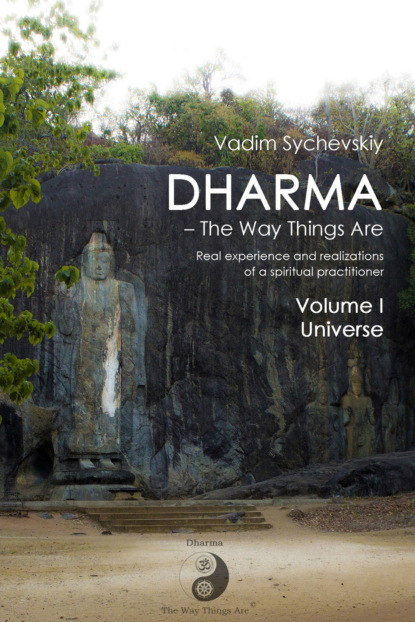
Dharma – The Way Things Are. The real experience and realizations of a spiritual practitioner. Volume I. The Universe
Chan (Chan-na) and Zen (Zen-na) are derivatives of the Sanskrit Dhyana, which means meditative concentration in a state of Calmness and Contemplation[32] leading to Enlightenment. D.T. Suzuki said the following about Bodhidharma, Zen, and the Truth of Enlightenment:
«The historicity of Bodhidharma is sometimes questioned, but as far as Zen is concerned, the question is not so important. In the field of historical research, Zen is content with the fact of its appearance in China, the connection of this appearance with a certain Indian teacher who had a special message for the Chinese Buddhists of the time, and this special message consisted in its non-transmissibility using oral or written signs. Everything that the chronicles of Zen Buddhism and the history of Chinese Buddhism, in general, say or write about Bodhidharma may or may not have happened. Let historians study the veracity of these facts; for those who study Zen, the only thing that matters is, „What was the message of the first Zen Master? ”.
…
The importance of self-realization in Buddhist life has been recognized by all faithful followers of the Buddha, regardless of their doctrinal differences and their adherence to Hinayana or Mahayana. However inexplicable and inexpressible the Truth of self-realization may be, it is the core of Buddhism. Zen, the inheritor of the innermost realizations of Buddhism, has cherished this tradition, contrasting Enlightenment with ritualism, intellectual erudition, and all forms of bare philosophizing. What did the Buddha come to earth for if not to establish this Truth? What, if not this, is the meaning and purpose of all discipline and moral and spiritual practices?».
Let us return to Bodhidharma's arrival in China and look at some interesting events from a Dharma perspective. The «Records of the Passing of the Lamp» states the following:
«Traveling by sea for three years, Bodhidharma finally arrived at the southern shores (of China) on September 21 of the 8th year of Pu-tung of the Liang Dynasty (527).
The governor of the Guangzhou region, Xiao Gao, received him with all due honors and sent a written report to the ruler Wu-di. When the ruler received this report, he immediately sent a special envoy with a special invitation to Bodhidharma to his court. Finally, on October 1, the Master arrived in Jilin.
Ruler Wu-di said:
– Since the earliest days of my accession to the throne, I have helped rebuild monasteries, transcribed sutras, and saved countless monks. Are my merit and virtues great?
– There is neither merit nor virtue, Bodhidharma replied.
– So why is there no merit or virtue?
– From these seeds, only small fruits will grow both in the World of People and the World of Heaven, and they will be the causes of further deaths and births. They are like shadows that follow things inexorably. They seem to exist, but they are not reality.
– So, what, then, are the true merit and virtues? – Exclaimed the ruler.
– Pure wisdom is absolutely whole, and the nature of its essence has no forms. Therefore, the essence of such merit and virtues cannot be expressed in words.
– So, what is the first principle of this Teaching?
– To transcend oneself with absolute emptiness.
– Then who is speaking to me?
– I do not know.
The Ruler could not understand the Preceptor's words. The Preceptor, realizing that the ruler's inner nature did not coincide with his thoughts, secretly left this place and crossed the areas south of the Yangtze on the 19th of the same month. On November 23, he reached the city of Luoyang».
Another version of the record of the ruler's conversation with Bodhidharma reads as follows:
«Ruler Wu-di asked:
– What is the holy nature of the Buddha?
Bodhidharma replied:
– Nothing can be said about it, for it is limitless, and remember: holy, unholy are concepts of the dual mind; there is no holy and unholy in nature. Nature simply is!».
As we can understand from this text, Buddhism existed in China even before Bodhidharma came. The first Buddhist sutras penetrated ancient China along the Great Silk Road from Central Asian states, approximately in the II–III centuries A.D. However, why exactly did the coming of the 28th Patriarch have such a significant impact? Here, we see Bodhidharma's similarity to Nagarjuna and Padmasambhava – all having realized the highest Enlightenment. Therefore, like Sakyamuni Buddha, they expounded the Dharma based not on texts (read dogma) but their own experience. That is why their names are forever preserved in the history of the development and dissemination of the true Dharma.
After his conversation with the ruler Wu-di, Bodhidharma arrived at the now world-famous Shaolin Monastery. According to legend, he spent nine years in meditation, sitting facing the wall. During and after this long meditation, Damo revealed the True Dharma to the monks of Shaolin.
A few comments should be made here regarding Bodhidharma's spiritual level.
First, it is obvious that he realized a very high level of Enlightenment before coming to China. If this were not the case, Bodhidharma would have been a simple missionary who would have easily and happily agreed with the ruler Wu-di rather than trying to impart to him the vision of Emptiness.
Second, Bodhidharma spent nine years in meditation while at Shaolin Monastery. Perhaps nine years is an approximate figure: Damo could have spent more or less time meditating. Another thing is important here. During his meditation, Bodhidharma clearly experienced even higher Enlightenments. Further, it is clear that he entered Samadhi and attained Liberation. Two facts indicate this.
1. Bodhidharma knew the ancient Indian system of Kalaripayattu practice.
2. He left China in a very unusual way, characteristically of those who have realized energetic Liberation.
Let us start from number 1; Kalaripayattu is an ancient system of practice that incorporates yoga, ayurveda, and martial arts teachings. Kalaripayattu means «fighting (payattu) in a sacred place (kalari)». In India, Kalaripayattu practices are traditionally performed in temples specially built for this purpose – Kalari Temples.
This system allows control not only of consciousness but also of energy. Here again, we see the two invariable companions of true spiritual practice – consciousness and energy. Therefore, Bodhidharma possessed Kalaripayattu, which suggests that he could fully control his energy and enter into complete Samadhi.
Related to the possession of Kalaripayattu by Bodhidharma is another equally significant fact. It is believed that modern martial arts originated from Kalaripayattu. For example, Bruce Lee said that martial arts originated in India over 5000 years ago, referring to Kalaripayattu. In addition, the main merit in the fact that China, and then the whole world, were acquainted with the martial arts system belongs to Bodhidharma. Separately, I will definitely note that probably every country had its own methods of hand-to-hand combat and fighting with weapons. For example, the techniques of Taoist hermits over time evolved into various styles of wushu[33] However, martial arts as a complete system, first as a system of spiritual practice and then self—defense, originated in those techniques Kalaripayattu, which Bodhidharma gave to the monks of Shaolin. This is how the external (hard) style of Wushu, which is now known all over the world as the Shaolin style («Shaolin-Si Quan-Fa»), came into being in China.
Bodhidharma's reasons for giving the techniques to Kalaripayattu are quite interesting. After completing his nine years of meditation, he set out to train monks. However, at that time, the Shaolin monks were so physically weak and lazy that they fell asleep during Bodhidharma's sermons. Then he realized it was necessary to take a yogic rather than Buddhist approach – starting not with mind control but with control of the physical body, as taught by yoga, which is an integral part of Kalaripayattu. The monks would not have been able to perform the meditation techniques because their bodies and minds were totally unprepared for it.
The techniques that Bodhidharma gave to the Shaolin monks can be roughly divided into two groups.
The first is techniques for increasing inner strength (both physical and spiritual) through cleansing the energy channels and transforming energy. These techniques are called «Qigong»[34]. «Qi» (氣) means «energy», and «Gong» (功) means «work» or effort to achieve perfection. Thus, Qigong is «energy work».
Bodhidharma compiled the treatise «Yi Jin Jing» – «Treatise on Changing Muscles and Tendons», which describes the method of controlling the movement of energy by tensing and relaxing the body. The «Preface to the Original Treatise of the Yi Jin Jing» describes the results brought about by prolonged practice:
«… I asked him what good it did. He said: the ability to ward off disease – one; to never be sick – two; to be strong all one's life – three; not to be afraid of hunger and cold – four; more manhood, intelligence, and beauty – five; the ability to retrieve a pearl from troubled waters – six; the ability to meet any attack without fear – seven; success in work without delay – this is eight.
However, these are all small benefits. The ultimate goal is to use them as the basis for entering the Tao of Buddhahood».
Thus, the first thing Bodhidharma taught his students was Qigong to control energy, which is one of the foundations for proper deep meditation. It should be emphasized here that the Qigong transmitted by Bodhidharma is based on the Teachings of Yoga.
The second group of techniques is martial arts. In those distant times when Shaolin monks, following the Buddhist tradition, went to beg for alms, robbers often attacked them. Sometimes, it came to killing or seriously injuring the weak monks who could not stand up for themselves. Of course, everything the monks collected went to the robbers.
Therefore, Bodhidharma gave the monks a set of movements, later known as the «18 Arhat Hand Movements». These movements were a kind of «block-punch» if you look at it from the point of view of modern martial arts. Gradually, the monks strengthened their physical bodies and were ready not only for the prolonged concentration of consciousness but also for self-defense against robbers, who, in time, became simply afraid of the monks of Shaolin Monastery, and robberies stopped.
When techniques for energy transformation were combined with martial arts techniques, it became apparent that their effectiveness had increased many times. This integration of techniques, accomplished by Bodhidharma and continued by subsequent generations of Shaolin monks, marked a new step in developing Chinese martial arts – the birth of the martial Qigong known today.
The following is said about Bodhidharma's return to India in the «Records of the Passing of the Lamp»:
«After nine years, the Preceptor decided to return to the western parts of India. He gathered his disciples and said:
– The time has come! Demonstrate to me your understanding.
One of his disciples, Daofu, said:
– I believe that we should not rely on writings, but we should also not deny the written tradition – this is the naturalness of the Way.
Bodhidharma said:
– You have my skin.
Nun Zongchi said:
– I believe that this is like the joy that Ananda experienced when he reached the Buddha Akshobhya's attic – this can only be seen by abiding in oneness, not duality.
Конец ознакомительного фрагмента.
Текст предоставлен ООО «Литрес».
Прочитайте эту книгу целиком, купив полную легальную версию на Литрес.
Безопасно оплатить книгу можно банковской картой Visa, MasterCard, Maestro, со счета мобильного телефона, с платежного терминала, в салоне МТС или Связной, через PayPal, WebMoney, Яндекс.Деньги, QIWI Кошелек, бонусными картами или другим удобным Вам способом.
Примечания
1
«Buddha-avatamsaka-sūtra» or «The Garland of Sutras Adorning the Enlightened One» (Sanskrit: महावैपुल्यबुद्धावतंसकसूत्र, Mahāvaipulya Buddhāvataṃsaka Sūtra). Translation by D.T. Suzuki.
2
Material World – The World of Passions, or the World of Phenomena. Subtle World – the World of Forms, or the Astral World. Supersubtle world – the World of Formless, or the Causal World. About the three worlds and their interaction – see Volume I, Chapter 1.
3
For details on the chakras, see Volume II, Chapter 2.
4
The greatest Guru of the 20th century who lived in Sri Lanka; see later in this introduction for details.
5
My full-fledged spiritual practice began in 1992; I am writing these lines in 2022.
6
Kensho, literally translated from Japanese, means «seeing one's [true] nature» (see Volume II, Chapter 1).
7
The famous Japanese Buddhist scholar Daisetsu Teitaro Suzuki is seen later in this introduction.
8
Master Hakuin Ekaku (1686–1768) was the greatest Zen Teacher and is one of the most notable figures of Japanese Zen Buddhism; see later in this introduction.
9
From Pali parittā, literally: «protection», an ancient compilation of Buddhist sutras, including refuge vows, taking precepts, etc.
10
On the three lower worlds, see Volume I, Chapter 2.
11
On the highest state of the Tathagata, see Volume II, Chapter 3.
12
See Volume II, Chapter 3.
13
Hinayana, Mahayana, Tantrayana and Vajrayana – see Volume II, Chapter 3.
14
On Parinirvana, see Volume I, Chapter 3, Volume II, Chapters 2 and 3.
15
For details of the Tripitaka, see Volume II, Chapter 3.
16
Now, Patna is a city in northern India, a port on the Ganges River, and the administrative center of Bihar state.
17
That is, personal Enlightenment and Liberation – see Volume II, Chapter 3.
18
In Volume II, Chapter 3, I will discuss Mahayana and its more «advanced version», Tantra-Vajrayana, in detail.
19
Vajracchedika Prajnaparamita sutra, Sanskrit: वज्रच्छेदिका प्रज्ञापारमितासूत्र, Vajracchedikā-prajñāpāramitā-sūtra, «Sūtra on perfect wisdom that cuts through [the darkness of ignorance] like a stroke of lightning».
20
I.e., the Tathagata, or Sakyamuni Buddha, see Volume II, Chapter 3.
21
Ancient Indian tribes living north of the Ganges valley.
22
This means India. For more on continents in Buddhist cosmology, see Volume I, Chapter 2.
23
The author is Goy-lotsava Shonnupel, abbot of Sarmalin Monastery.
24
The Vidyadharas (Sanskrit: विद्याधर, vidyādhara, «holder of thorough knowledge – Vidya») are a class of demigods (upadevas) of the Heavens of the material world.
25
Spouse of Padmasambhava, enlightened dakini goddess, Buddhist teacher of the Vajrayana tradition.
26
Bodhichitta – the Four Awakened States of Consciousness: Love, Compassion, Praise, and Equanimity – see Volume I, Chapter 3.
27
Mahakaruna – Great Compassion
28
About Naropa's Six Yogas, see Volume II, Chapter 2.
29
The Life and Teaching of Naropa. Translated from the Original Tibetan with Philosophical Commentary Based on the Oral Transmission by Herbert V. Guenther. Shambhala, Boston & London, 1995.
30
Rinpoche (also Rimpoche) (Tibetan: རིན་པོ་ཆེ་, rin po che) – literally means «precious». Rinpoche is a title for the highest Teachers (Lamas), added to the Lama's name.
31
According to the generally accepted list of Patriarchs in Zen Buddhism, cited from the text of D.T. Suzuki.
32
On Dhyana, see Volume III, Chapters 2 and 3.
33
Wushu (武术) is the common name for all martial arts existing in China. It consists of two characters: 武, wu («wu»), «military, martial», and 术 shu («shu»), «art, technique». Other names: kun-fu (in Cantonese), gong-fu (in official Chinese) – literally «working on oneself or training», a variant of the name kung-fu is also used, it was used by Bruce Lee.
34
For details on Qigong, see Volume III, Chapter 2.
Вы ознакомились с фрагментом книги.
Для бесплатного чтения открыта только часть текста.
Приобретайте полный текст книги у нашего партнера:
Полная версия книги
Всего 9 форматов