Полная версия:
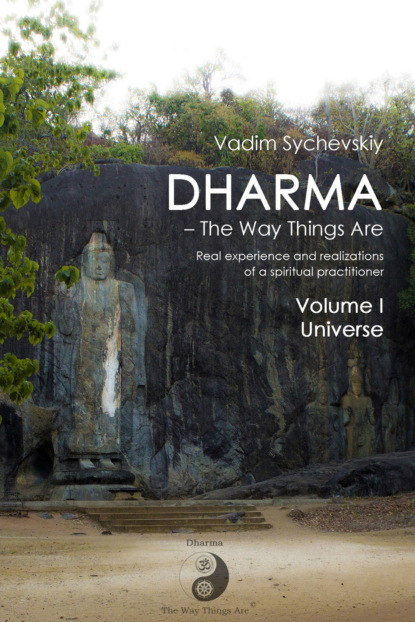
Dharma – The Way Things Are. The real experience and realizations of a spiritual practitioner. Volume I. The Universe

Vadim Sychevskiy
Dharma – The Way Things Are. The Real Experience and Realizations of a Spiritual Practitioner. Volume I. The Universe
Translated from Russian by
Nikolai Gnezdilov
Yana Tsiarentsyeva
Daniil Zragus
Edited by
Jonathan Wiltshire
© V. Sychevskiy, 2026
© AEGITAS Publishing House, 2026
Preface to the Second Edition
In 2021, I completed the book «Dharma – The Way Things Are. The Real Experiences and Realizations of a Spiritual Practitioner», which had been going on for over six years. An electronic version of the book was published that year, and a printed version the following year.
During this time, I tirelessly continued my personal practice, as well as teaching the True Dharma to others. As a result, first, I gained deeper and more detailed meditative experience, and second, I answered many clarifying questions about the text of the book. Therefore, when the idea of a second edition arose, I had the opportunity to add new details about True Dharma theory and practice to the updated text.
So, the second revised and expanded edition contains, first of all, a more detailed and better structured description of the process of meditation (Dhyana and Samadhi), as well as the worlds of the universe experienced along the way.
In meditation, we first move away from the material World of Phenomena (World of Passions) and experience the subtle Astral World (World of Forms). Then we immerse ourselves in the world of our soul's essence, the Causal World (World of Formless). Having transcended the transparent light of the Causal World, we experience the state of Nirvana (True «Self» or Atman) – the state of Absolute Freedom and Happiness in which we all originally resided. It is this original state that is the goal of true spiritual practice.
A big problem may arise on this path. The Astral World is divided into two parts: lower and higher. The lower Astral World, which is the other side of our material world, is formed by the images of our worldly desires – hatred, ignorance and greed. Unfortunately, nowadays immersion in the Lower Astral is most often considered as a spiritual practice: it is here that such phenomena as «contact with entities», «harm of evil spirits», «connection to the flows of cosmic energy», etc. originate. However, if we turn to the original texts of Buddhism and Yoga, we will see that the Great Teachers of the past, for example, Sakyamuni Buddha, said that true meditation is entering the Higher World of Forms (pure Astral World), which is formed by Love, Compassion, mood of joy for another and impartial attitude to one's own suffering. The Higher World of Forms consists of 17 levels that we go through in meditation. These 17 levels and the states of our consciousness as we move through them are described in detail in the new edition of the book.
Having completed the experience of the Astral World, we enter the Causal World. If we follow the True Dharma, we are immersed in an ocean of transparent light where we experience happiness and infinite expansion of consciousness. If one follows distorted systems of practice, then from the Lower Astral one sinks into the pitch blackness of Nonexistence in the Lower Causal World, which one confuses with Nirvana due to the immaturity of one's soul. However, Nirvana is that which completely transcends the three worlds of the universe; it is a state of perfect Liberation from suffering, but not a state in which everything disappears into darkness. These and other essential aspects of the Teaching I have endeavoured to show in more detail in the new edition.
In response to readers' questions, I have also included in the second edition a fuller explanation of the Law of Karma and the structure of the material world in which we now live to the second edition. The story of the Law of Interdependent Origination, which explains the processes of the fall and rise of our souls, has also been added. Important nuances of meditation practice, which are of great practical importance, have been added. In addition, I have tried to realize once again the experience of the cessation of the dual work of consciousness and have made a new attempt to tell the reader about the feeling left by this experience.
The purpose of this description is to show the reader, as consistently, clearly, and concisely as possible, the path of authentic spiritual practice based on the True Dharma, so that those who follow the Path will avoid mistakes and truly Attain Great Awakening.
Vadim Sychevskiy (Dhamma Gaveshi), February 2023.Translator’s Preface
This unique book, which I have been fortunate to work with, is imbued with the living experience of our time. For this reason, the translation from Russian was undertaken with respect for the original work and with the hope that it may help English-speaking readers approach these ancient teachings with greater clarity.
Particular attention was given to the translation of terminology from Russian into English. Some terms have been rendered in classical forms familiar to English-speaking readers, while others have been translated according to context, in the hope of preserving their living meaning. Each term will be presented in Sanskrit and Pali so that the reader may easily understand precisely what is being referred to. Certain expressive constructions and stylistic features of the Russian text have been preserved where this was important for conveying the author’s voice.
May this book bring readers not only knowledge, but also a deeper experience of the Truth toward which these teachings lead.
Gnezdilov Nikolai, March 2026Introduction
It is necessary to make one's heart utterly impartial and stay calm. Then, all things will change by themselves, and we have only to contemplate their return. There is a great variety of things in the world, but they all return to their beginning. Return to the beginning is called calm, and calm is called return to essence. The return to essence is called constancy. Knowledge of constancy is called attaining clarity, and ignorance leads to disorder and, consequently, evil.
Lao Tzu. «Tao De Jing».All of us are spiritual beings. There is no doubt in that. The essence of a spiritual being is generally called consciousness. The narrowness of the conventional world outlook is that we view our consciousness as something limited, or something that has an endpoint. However, the True Dharma, or the Teachings, that point us to the true reality tell us that our true original essence is the True «Self», which transcends our consciousness and at the same time stands for it. In Buddhism and Yoga, the True «Self» is described as the complete inner destruction of harmful passions, driven from personality, complete cessation of suffering, and realization of self-awareness leading to freedom and happiness in the true sense, without losing identity. In Sanskrit, the True «Self» is originally denoted as «The Atman», and the state of the True «Self» is originally denoted «Nirvana».
If we try to realize the condition of Nirvana, that is hidden deep inside of us and is our true nature by origin, throughout our spiritual practice, our destiny will greatly change. Why is it so? Because the authentic spiritual practice is based upon three major aspects.
Firstly, spiritual practice that leads to self-awareness begins with accumulating virtues and merit. When we speak good words to others, do nice things for our loved ones, hold correct judgments, and think about all other people, we naturally radiate light. Then, we become capable of experiencing joy in this Human World equal to the light we radiate.
Secondly, we study the Laws of the Universe (such as the Law of Karma) revealed to us by the great Gurus of the past and follow them in our lives. The Laws of the Universe are the aforementioned True Dharma, or Teachings, which we will discuss later.
Suppose we choose the wrong approach and absorb information reinforcing passions and selfishness. In that case, our lives will deteriorate because we will get on the path of degeneration and degradation of our consciousness. The fact is that the objects and phenomena we see around us are the same for everyone. For example, our physical body, current events, or the planet Earth – these are all things that are seen in the same way; in other words, we all see the same things. Only the methods of analyzing and distinguishing what is perceived differ; if they are different, our actions and their results will be different. The analysis and distinction of objects and phenomena are carried out solely based on information along with the experiences we have accumulated before.
Thirdly, by studying Dharma, we acquire a correct view of the surrounding world and our inner world. We stop catching up on current events or emotions and become calm and mindful. Attentiveness and mindfulness in daily life lead us to the next step, the practice of meditation. In meditation, we focus on internal objects – images, breathing, and energy movement, or the subject of our meditation. This leads us away from all external information and towards information within us.
External information is what we see with our eyes, hear with our ears, smell with our nose, taste with our tongue, and feel with our body. That is, in meditation, external sensations stop.
Moving away from inner information is a complete cessation of the work of consciousness generated by accumulated experiences.
As a result of correct meditation, two states arise that represent a unified whole – Calmness and Contemplation. As I mentioned, this is the original state of our consciousness or the consciousness of all spiritual beings. In this primordial state of Calmness and Contemplation, we see for the first time our true nature, or Atman, which cannot be expressed with words because Atman is us in the true sense. The state of the Atman is cognizable only empirically:
«The truth of self-realization [and reality itself] are not one and not two. Because of the power of this self-realization, [reality] can bestow on others as much as it can on itself; it is absolutely impartial, it lacks the ideas of «this» and «that»; it is like the ground from which everything grows. Reality itself has neither form nor non-form; like space, it is beyond [ordinary] knowledge and understanding; it is so elusively subtle that it cannot be expressed in words and letters. Why? Because it is beyond the realm of letters, words, speeches, chatter, discerning mind, questioning, and speculative reflection, it is beyond the comprehension of ignorant people and any mischief arising from evil intentions. It is neither this nor that; beyond all rationality, it is formless and transcendent of all falsehood. It abides in the serenity of the uninhabitable – the true abode of all saints.
Oh, son of a noble family, the realm of self-realization, where all the wise dwell, is free from materiality; it is free from purity and from obscuration; free from apprehension and comprehension, free from the obscurity of confusion; it is brilliantly pure, and its nature is indestructible» (Avatamsaka-sutra[1], «The Sutra of Forty Chapters», Chapter 31).
So, as our spiritual concentration continues, a state of perfect peace of mind appears. We can make many discoveries by observing objects and phenomena in this state. To our amazement and indescribable pure inner joy, we suddenly discover that all things are completely different from what they appeared to us before. Discoveries of this kind can be called Enlightenment, and many Enlightenments are many discoveries; it is the process of moving from the wrong view to the right view. The wrong view is based on attachment, anger, and delusion, whereas the right view is based on Calmness and Contemplation. Thus, after these attachments, malice, and delusions are stopped, peace and the right view appear, by which we can see things as they really are. This pure vision is otherwise called wisdom. And then – in thought, speech, and action, whatever the movement of our thought, whatever the work of our speech, whatever the deed we perform – everything will be connected with the increase of virtues and merit, with the expansion of our understanding of the Laws of the Universe and with the increase of Calmness and Contemplation. Finally, we will be able to attain great powers. This means that not only will we realize this state that transcends egoism and the suffering and, ultimately, the cycle of life and death that it generates, but we will also be able to help others to realize it.
To realize this original state, which is us in the true sense, we need three things: theory, practice, and empirical knowledge. These three things are based on theory and practice.
Theory. Dharma – the Way Things Are
The theory is the True Dharma or simply Dharma – Law, Teaching. Dharma (धर्म, dharma) is the Sanskrit spelling and pronunciation of this most important term. In Pali, it sounds like Dhamma (ධම්ම, dhamma). However, I am closer to the Sanskrit version, perhaps because it is more often used in Russia, along with the Sanskrit words «nirvana» and «karma», which have already entered the Russian lexicon.
The word «Dharma» has many meanings. It is «world order», «that which holds, protects and supports», «Law, Teaching», and «the right way of acting». However, the essential meaning of the pithy term «Dharma» is «The way things are». This means Dharma points to the ultimate reality and enables the insight and realization of this true original state through the right practice.
Simplified further, this means two things – seeing and knowing – both crucial in understanding Dharma. For example, if we are approaching a railroad crossing and we have good vision, we will see the barrier closed and the train approaching. And because we see these things, we have accurate or thorough knowledge of them. Luckily, having vision and knowledge, means we will not cross the railroad tracks in front of an approaching train. We do not need anyone's cue in this situation. In this case, the approaching train is reality or the way things are, and we see and know this reality or actuality.
If each of us possessed this kind of vision and knowledge regarding the entire universe or at least our human world, we would be free and happy, residing in our original state of Calmness and Contemplation. However, we do not possess pure vision and thorough knowledge of all objects and phenomena; instead, we remain delusional, mistaking illusions for reality, and as a result, we experience suffering. In this situation, we need the teachings or Dharma that the past Gurus have handed down – which point us to reality and our true nature.
A crucial aspect needs to be emphasized here. The Gurus of the past did not create these Teachings but discerned (understood) the true reality and pointed to it. This is the same as, for example, the Universal Law of Gravity, discovered by Isaac Newton in 1666. Newton did not create this law but discovered it, because gravity is inherent to all bodies of the material world in the Universe surrounding us.
To avoid engaging in long scientific or philosophical arguments that would rather distract us from Dharma than clarify the situation, I will give a simple and illustrative example of Dharma.
One of the most important organs in our body is the liver. Its existence and functioning are a fact or reality. In other words, the liver is not someone's fancy, fixed idea or dogma. Let us imagine, for example, a ridiculous statement like, «According to medical beliefs, the liver is located in the right subcostal region». Why is it ridiculous? The liver is not «according to the views» of anyone or anything. Still, it is located and functions in our body on the right side, in the abdominal cavity under the diaphragm. Similarly, our consciousness does not exist «according to the views of Buddhism and Yoga» but exists, creating our outer and inner world. Thus, both the workings of the liver and the workings of consciousness are truth or reality. The problem is that we cannot always see this truth.
Of course, even without a medical background, we have some theoretical knowledge about the liver and its functions. For example, we all know that fatty foods and alcohol have a detrimental effect on our liver cells (hepatocytes), essentially killing them. However, this is not our thorough knowledge: under normal circumstances, we cannot see our liver, and even less we see the processes in its cells. In other words, even in the material world we know well, some things are invisible to the ordinary eye. This leads us to mistaken views that can be harmful for our consciousness to see things correctly. For example, one of my acquaintances (who used to be a great lover of strong alcoholic drinks) used to pour himself another glass of vodka and say: «The liver is just a piece of meat. What will happen to it [because of drinking alcohol]?».
This is where science comes to our aid. For example, magnetic resonance imaging allows us to see the liver «layer by layer» and perform the most accurate examination of the liver. Of course, the fact that we can see the liver «layer by layer» with MRI is not «mysticism», «divine revelation», or anything like that – it is reality. In this example, science is Dharma, showing how things are, showing things invisible in ordinary circumstances, and allowing a glimpse into a world of invisible to the ordinary eye.
However, in the above example, the world invisible to the ordinary eye (i.e., the «layer-by-layer» view of the liver on MRI) refers to the material world. The material world is a projection of the subtle world[2]. One needs True Dharma and spiritual practice to see and understand the subtle world underlying the material world as its basis.
For example, in the liver region, there is an energy center called Surya chakra. Chakras[3], or energy centers, belong to the subtle world and are not visible by ordinary vision or on special equipment such as MRI or ultrasound. Our chakras are directly affected by the work of our consciousness (because it is primary), and the state of the chakras themselves, in turn, affects our physical body. The Surya chakra is blocked because of the workings of the mind, sometimes called the «bile man», this term refers to a person who first harbors anger at others and then pours that anger out like unpleasant-looking and bitter-tasting bile while sometimes mocking the object of his hatred and taking pleasure in this object's suffering. Such work of the mind leads to blockage of Surya chakra, which, in turn, negatively affects the work of the liver and gallbladder.
Thus, the True Dharma points out that behind all the phenomena underlies one or another work of our consciousness. For example, if one has an attachment to food with a distinctly spicy, exciting flavor, one will eat the corresponding foods, such as fatty meats cooked with hot sauce. If a person has a desire for primitive, readily available pleasures, he will consume alcohol. In both cases, this will take energy away from the Surya chakra, causing it to cool down and consequently harm the liver. On the other hand, if we pour «bile» anger on others, then the work of Surya chakra will also be disturbed, as I mentioned above. In other words, if we have no addiction to spicy, fatty food and alcohol, if we have no anger towards others, then there will be no harmful effect on our liver because the external world is a manifestation of our consciousness, as I will discuss in detail in the next chapters and volumes of this book.
As we can see from these simple examples, the True Dharma is the ultimate science that shows us the real state of affairs. Unlike classical science, Dharma shows us the reality of our material world and the entire universe, which includes subtle and super-subtle worlds invisible to ordinary human vision.
True Dharma, like the science in our world, is not a fixed idea, dogma, abstract philosophy, or anything like that. The Teaching does not say, «Do this and it will become good», but it shows and clarifies the essence of things: «If you do this practice, your mind will become clearer, and you will be able to see all phenomena clearly».
Further, the Teachings handed down by the past Gurus are not bare theory. Still, they are fully confirmed by a clear system of practice and the real experience of those engaged in this spiritual practice based on the True Dharma, which I will discuss in detail on the pages of this book.
Buddhism, Yoga, and Taoism
The term «Dharma», which refers to a single Teaching or Universal Law, can be found in Buddhism, Yoga and other traditions. My own spiritual practice began with martial arts and Chinese Taoism (more on that below). Sometime later, when I began to study and practice Buddhism and Yoga, I discovered that all three of these Teachings – Buddhism, Yoga, and Taoism – belong to the same stream of spiritual practice. This stream leads us from our ordinary human existence to our true original state, which I mentioned above. I have also discovered that I am fortunately not alone in my views – similar conclusions have been reached by Gurus who lived in the recent past, such as the Venerable Ananda Maitreya[4]:
«Long ago, I practiced Raja Yoga in the Himalayas under the guidance of a Hindu yogi. This experience made me realize that Buddhism and Yoga are very similar and that many aspects of the meditative experience described in Patanjali's Yoga Sutras can be found in our experience. There is, for example, the Yoga-Vasishtha. The teachings outlined in it are very much like the experience of Buddhist meditation. Some things are different, but some things are very similar. I have been practicing Tao meditations. This path strongly resembles Buddhist meditation. I am referring to the meditative teachings of the Taoist hermits. Taoism, Patanjali's, and Buddhist teachings have much in common regarding Samadhi, which is what Buddhism talks about. And so, the Buddha came and said that one should accept all that is good in the other teachings».
Even though Buddhism, Yoga, and Taoism are most often perceived as close, they still have different teachings and systems of practice. This aspect must be clarified since the teachings and systems of spiritual practice discussed in this book are those of Buddhism, Yoga, and Taoism.
For this, we will again need the simple example of the liver. In English, we say «liver». However, for example, in Latin, it would be hepar; in Sinhalese (the main language of Sri Lanka), it would be අක්මාව (akmāva). Let us imagine that we do not know English, much less Latin or Sinhalese. If, in this case, we hear «liver», «hepar», and «akmava» or see the original spelling of these words, we are likely to think that they are completely different words denoting completely different things.
The same is true for Buddhism, Yoga, and Taoism teachings. For example, in the teachings of Taoism, the common name for energy is Qi (although different types and subspecies of energy are distinguished). The situation is similar in the teachings of yoga and esoteric Buddhism. In yoga, the energy is called Prana or Vayu; in esoteric Buddhism, it is called Lung, although the term Prana is also widely used. But for a spiritual practitioner striving to realize Enlightenment and Liberation, it is not the numerous terms, their translations, and pronunciation in different languages, not the history of their origin in Buddhism, Yoga, or Taoism, that is important, but what everything is. For example, what is the source of energy? How does it affect our consciousness? What lifestyle and energy practices should we follow to eliminate disease, find happiness daily, and head toward Liberation? When we clarify these questions by studying the True Dharma and then empirically answer them in our spiritual practice, it will not make much difference to us whether we call the energy Qi, Prana, or Lung – we will not just know all these names. Still, we will truly understand what energy we possess.
Here, the reader may have a question: why am I talking exclusively about the teachings of Buddhism, Yoga, and Taoism and not about any other teachings, such as Christianity or Judaism?