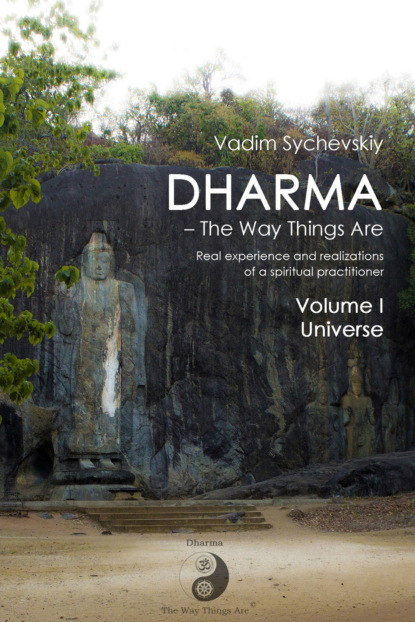
Полная версия:
Dharma – The Way Things Are. The real experience and realizations of a spiritual practitioner. Volume I. The Universe
I have been engaged in spiritual practice based on the teachings of Buddhism, Yoga, and Taoism for thirty years[5]. Having gained extensive meditative experience, fully in accordance with the ancient sutras and texts of the past Gurus, I have a moral right to speak about these Teachings and ways of practice. Of course, I must emphasize here – as I will discuss in further narration that my experience is not perfect. However, I have no right to try to explain what I have not studied and practiced. Nevertheless, the attentive reader, if willing, will be able to see for himself the parallels between the Dharma and other teachings not presented in this book which I will also describe. This is because there are no true Teachings that contradict each other.
So, the succinct term Dharma is, in my opinion, the perfect term to express what this book is about – a universal Law, a Teaching that shows and explains to us everything visible and invisible, happening to man and the Universe, on a time segment: the beginningless past-present-future. In other words, the segment of time is equal to infinity. This is the Teaching explained by the Great Gurus from the beginningless past up to our current time. For example, what is this world in which we are born in this life? By whom or by what was it created? Is our life the only one or…? Not to mention the eternal «Who am I?». This World of People, other worlds in the Universe, the structure of consciousness, the processes of emergence, existence, and destruction of the Big and Small Universe, accompanied by the processes of the fall and rise of the soul, Enlightenment and Liberation (what is the difference between them?); energy, energy channels and centers, as well as systems of spiritual practices – from martial arts to the highest meditations leading to Samadhi – all this is True Dharma.
Practice and Empirical Cognition
It is important to note that the theory of True Dharma should not exist alone. One also needs to practice and experience it.
Imagine that there is a wonderful teaching or doctrine that logically explains certain things or aspects of our lives. However, such a doctrine cannot be called complete unless it is supported by a corresponding system of practice. The relationship between a doctrine and a system of practice can be compared to a map showing a detailed route and a vehicle that can be used to reach its destination.
Now, let us imagine that we have both a doctrine (the detailed map) and a system of practice (the vehicle). However, if those who study these teachings and practice using this system do not experience any spiritual experience, this raises questions. In other words, what is described in the teachings must also be experienced by those who practice the teachings. Thus, it does not matter how many meditations you have been initiated into, nor does it matter how effective they appear to be in purifying the soul – if they do not produce the actual results described in the teachings, then the purpose of the teachings and practice has not been achieved. Conversely, if you have experienced what the teachings say through meditation, you are on the right path. It can be said that you have done an important work: you have proved through your experience that the teachings are correct and that the system of spiritual practice is effective.
So, what I have experienced, however little, while studying the Dharma and spiritual practice has been the driving motivation for me to write this book. In other words, based on my own realization of the Teachings and spiritual experience gained over several decades, I want to try to talk about the spiritual world in modern Russian, to adapt ancient knowledge for rational perception and, most importantly, for practical application in our days.
This was also preceded by a series of events that happened to me during my work and practice in Sri Lanka. The story of those events will help the reader to better understand why I decided to write this book and what exactly I want to convey to the reader in its pages.
The Place of Power, Providing a High Experience
I would like to convey that places (environments) of power contribute to high experiences. This happened to me in the following story; – This way, said my Lankan friend who had accompanied me on the trip, pointing to a path leading somewhere in the forest. In the middle of the path were strangely arranged groups of steps leading upward and forward. The place beckoned… «Maybe I can find something here?» – flashed through my thoughts. The short trip was already ending, and my work on the «Guide to the Sacred Sites of Sri Lanka» had hardly moved.
– It is all very ancient, – meanwhile, my companion said meaningfully, either trying to stir up my interest or just talking…
– Have you been here before? – I asked.
– Never.
I did not know what I would see and feel next, but as I walked down the bizarre stone «very ancient» steps, I rejoiced in the only fact so far – the absence of people. It meant that if the place were really serious, there would be an opportunity to look around, feel, maybe meditate, or be there without being startled by the shouts of tourists, like: «Let us take a picture here!»
As I went deeper into the forest with each step, I began to feel that deep down, some object radiated a strong upward energy. It was like walking through the cold in winter and approaching a source of warmth, feeling it brighter and brighter with each passing moment.
The path, taking us to a large dirt area, ended. The trees that had «accompanied» us on this short journey «parted» and… A huge Buddha carved into a rock looked at me. To his right and left, there were three more figures on each side. The surrounding space changed completely: it seemed filled with vibrations emanating from the images.
How can I describe this feeling, this state? «Rest», «stopping», «cessation», and at the same time: «warm», «sincere», even some kind of «kinship», «something very sublime, majestic, completely transcending this world».
I drew closer to the Buddha. At the same time, I noticed that the figures on the right and left were Bodhisattvas. I immediately recognized the image of Maitreya, the coming Buddha, Avalokiteshvara, the Bodhisattva of Great Compassion, and Tara, the female Bodhisattva who leads people to Enlightenment. «Stop! We are in the land of Original (Southern) Buddhism, Theravada, not the Land of Snows, Tibet, where these images are everywhere». My mind raced with surprise that one could see such images characteristic of Buddhism of the Northern tradition in Sri Lanka.
My energy began to rise, responding to the vibrations of the Buddha and Bodhisattvas. I have always experienced such a rise during technical practices such as Taoist Qigong or yogic pranayama and mudras. It takes effort and time to raise energy, but here – just a few minutes of being near these mysterious bas-reliefs… And this energetic rise was strong, but at the same time, it was natural and soft.
I handed my camera to my already bored escort and decided to meditate – while no people were around.
The meditation experience was the starting point: it was the first time I seriously considered collecting my knowledge and meditative experience and trying to show the big picture of True Dharma by writing a book.
Kensho
Many years ago, I experienced Kensho[6] for the first time in this life. I will not undertake a logical explanation of the essence of this experience: logical or philosophical tricks and Kensho are opposites. It is impossible to describe this primordial state of consciousness. In such cases, Masters of the past used to say, «It is as if a deaf mute were to see a dream». In other words, one must have a personal experience of this state. «Personal experience», in this case, means direct contact with the fact, without any intermediary.
At that moment, back in the distant year of 1996, I was doing a walking practice not far from my house, then suddenly…
I did not immediately realize what had happened, but I felt as if I had been waiting for this very dear experience all my life or longer. Where did this lightness in my body and mind come from? Whence did this unconditioned happiness and calm joy rise?
The external sensations and the internal flow of thoughts stopped, so it began to seem as if the body and consciousness had disappeared. The face itself blurred into a natural, barely perceptible smile. External and internal objects remained, but the consciousness did not cling to them, so they ceased to have any influence. The chaotic stream of thoughts no longer pressed on the mind as both thoughts and mind dissolved into a majestic state of Calm. All the darkness of things and their interactions with each other could have fit on the tip of a fingernail – why do people look for value and meaning in this illusory jumble of cause and effect?! In this primordial state of consciousness, the division of the world into two poles completely disappears – dual thinking stops. If thoughts arise, they are seen as something external, crude, and utterly meaningless.
«„Kensho” means „realization of one's own nature”. This might suggest that there is what is known as „nature” or „substance” that constitutes being and that this „nature” is apprehended by someone outside of it. In other words, it implies the existence of one who apprehends and that which is apprehended: subject and object, host and guest. This is the view most of us usually take, for our world is a rational reconstruction that always contrasts one thing with another, and through this contrast, we think. Our thinking is projected into every area of our experience; hence, this world of reality is endlessly multiplying.
On the contrary, Kensho means to go against this way of thinking and end all forms of dualism» (D.T.Suzuki)[7].
Enlightenment is generally considered the absolute state that Prince Siddhartha Gautama realized in 589 BC when he became the Buddha (i.e., «Awakened» or «Enlightened»). However, the Buddha state is the final stage of spiritual practice, the Final Enlightenment and Liberation. This path begins with the first Enlightenment or Kensho – the cessation of the workings of the superficial consciousness we use in our daily lives, which we consider ourselves to be, above all else.
In Early Buddhism (Theravada Buddhism) texts, the first Enlightenment corresponds to the first stage a practitioner realizes – the stage of the One who has entered the true stream. The sutras say that such a person receives a fleeting vision of the goal – Nirvana.
The process of the first Enlightenment is described in the most detail in the texts of Zen Buddhism. It is in Zen that the first Enlightenment is called «seeing (realizing) one's true nature» – «Kensho». Zen Masters also emphasize that Kensho is the first real step towards Buddhahood:
«Anyone who calls himself a member of the Zen family must first attain Kensho, which is the realization of the Buddha's Way. It is a cruel fraud for anyone who calls himself a follower of Zen but has not attained Kensho.
Wherever the Zen school has spread, a „home forsaker” is anyone who has attained Kensho and left the home of birth and death, not one who has abandoned his home only to shave his head» (Hakuin Ekaku[8], «Wild Ivy»).
In the following chapters and volumes of this book, I will give the reader a more detailed account of the feeling left by this experience, but now I will limit myself to the above description.
Subsequently, I realized that only after the Kensho experience does one begin real spiritual practice because Kensho gives one an intuitive and very clear understanding of everything one encounters. Since one no longer looks for oneself in objects and phenomena, one can see them for what they are rather than the chaotic dual workings of one's consciousness. He who has seen (even if only in glimpses) reality can devote himself fully to the practice. Such a person is unlikely to fail because there is nothing but spiritual practice for him. Hence, he is indeed capable of eventually attaining Liberation. The difference between Enlightenment and Liberation I will discuss in detail in Volume Two. However, it should be noted that Liberation is the fixation of the state of Enlightenment.
If I were asked, «What was the most important, most memorable thing in your life?» I would talk about my experience of Kensho. When asked what the purpose of life is, I would answer that, at the very least, it would be reliving that experience.
I will never forget the words spoken to me by a Zen Master to whom I described my experience:
– Your experience is true; I affirm it. Congratulations – you have glimpsed the Buddha! What are you going to do next?
– Continue, I replied.
– Continue what? – The experienced Master did not let me off.
– I want to continue my practice because spiritual experience should be «made one's own»! – I said to myself.
– Well, – he smiled at last – the experience should be broadened. How long can you stay in this state of stopping the flow of the mind?
– In this state, it is impossible to time it because it also stops with the consciousness, but maybe 10–15 minutes…
– When you can stay in this state indefinitely, then it will be the final Enlightenment, – summarized the teacher.
«To expand my experience» – that's what I have been trying to do ever since… «But you always have to be away on business – rushing to help, going to war», Vladimir Vysotskiy sang on another occasion. Paradoxically, the only unconditioned state requires appropriate conditions.
These «appropriate conditions» were given to me by Buddha and six Great Bodhisattvas carved into a huge rock by an unknown master. Here again, I had the experience of Kensho.
«Look, look – a white man is meditating!» – Suddenly came from outside. My mediocre level of Sinhalese at the time still allowed me to recognize this simple phrase. I opened my eyes to see a group of Lankan pilgrims dressed in white robes approaching the rock, as is customary on such occasions. We exchanged greetings. The journey into the world of absolute reality was over for me. I wanted to get out of the Lotus, but I could not: my body, especially my legs, were numb – I wondered how long I had been sitting there.
While I was getting my legs back in order, I remembered a passage from Master Hakuin's text. It said that the Buddhas and other Gurus of the past and present have given you a great treasure, the Dharma, through the practice of which you gain experience beyond this world. Further, «…to repay your unpaid debt to the Buddhas and patriarchs». A few words on the Dharma can mean much more and be a greater Merit than your whole life…
Visiting a «Real» Buddhist Temple
Before, we were in a non-working temple, where only statues were carved into rock. But this time we are going to a real working temple with monks. «It is evening, the Piriths[9] are coming, we need time to buy flowers and lamps» – my friend ranted as we raced on his «tuk-tuk» through the evening city to the «famous and revered by the people», as he put it, Buddhist temple.
The temple was typically classical: first, we went to the Bodhi tree, then to the stupa to make offerings of fire (oil lamps), incense, and flowers. Other lay believers made offerings of water and food. Sitting on the ground near the Bodhi tree, people at the stupa read passages from the sutras in Pali, occasionally peeking at the text in their little books.
Everything felt very sincere and even «homely». Then a monk appeared, and together with him, we began to read the texts in chorus. «Refuge in the Three Jewels» and «Acceptance of the Five Precepts»… Thankfully, shortly before visiting the temple, I had learned at least some of these texts in Pali.
I thought: «But this is the way to the World of Heaven for lay believers, as taught by the Buddha». Offerings, observing the precepts, studying the Dharma (then a monk gave a sermon), and the simplest meditations (in this case, reading sutras and meditating on Love for all sentient beings). Through the offerings, merit is accumulated, and worldly desires are weakened because making offerings is the opposite of satisfying desires. The precepts make it possible not to accumulate the karmas of the three evil worlds – the World of Hell, the World of Animals, and the World of Hungry Spirits[10] – and not to squander merit. The study of the teachings and meditation is accumulating information from the higher worlds, in this case, the World of Heaven.
It is interesting to note that even in all this seemingly unpretentious practice, I could recognize elements of esoteric Buddhism. For example, according to esoteric Buddhism, all kinds of offerings cleansed the three lower chakras (energy centers). If a chakra is not cleansed, energy will not flow through it, thus cutting off the connection with one world or another. In the case of three lower chakras, these are, respectively, the three lower worlds mentioned above: Hell – Muladhara chakra, World of Animals – Svadhisthana chakra and World of Hungry Spirits – Manipura chakra. The offering of odor, i.e., incense, purifies the Muladhara chakra, water – Svadhisthana, flowers, food, and fire – Manipura. The purification of chakras is the subject of another chapter in which the energetic process of attaining Liberation will be explained. But for now, I want to explain something else to you…
Everything is learned by comparison or by contrast. Unfortunately, this is how it was in my case. I had a different feeling and consciousness two days ago, meditating near an ancient rock in the jungle! Yes, I felt kindness and humility, but all this was within the framework of this gross material world, and it did not take my consciousness beyond it. The vibrations were also from the World of People – kind and pure – but no vibrations from the higher worlds.
I felt confusion and some annoyance. It was as if everyone but me was completely satisfied with this Human World. «Oh yes – we do not want to fall into Hell, but in the World of People, we are perfectly fine…»
But did not Sakyamuni Buddha say that this world is also a world of suffering (the First Noble Truth)? Did not Sakyamuni Buddha say that all the worlds created by the work of our consciousness are nothing more than an illusion? So whichever of these worlds, including the worlds of the gods, we are not born in – none of them will completely make us happy! This means only the original state of consciousness – the Great Tranquility (Nirvana), in which the actions of all past accumulated experience are stopped – is the only value not only in this world but also in the whole universe. Then – is it possible to realize Nirvana by simply following rituals and ceremonies…?
«Calm down! I must leave smiling…» – I thought to myself. I left, making a threefold bow to the altar with the Buddha statue.
It was late evening, and it started to rain heavily, and it was getting cold. I had not realized it could be cold in Sri Lanka, on the ocean coast (not in the mountains). My buddy's old «tuk-tuk» rumbled unhappily, bouncing on the bumps. I do not know what inspired Vysotskiy to create this song, but its lyrics reflected my condition perfectly at that time:
The weather has not been sunny for six months,And the souls are frozen under a crust of ice,And I am waiting in vain for the ice drift,And memory cannot keep me warm in the cold.…The orchestra is playing tiredly, faltering,The circle is closing, and I cannot break the rings…Calm down! I must leave smiling.And yet, I will finish the song!I was finally home. I stayed in a small local village hotel with one-room cottages on that trip to Sri Lanka. The whole village was located right next to the jungle. The owner of the hotel where I stayed had specially equipped one hut with air conditioning – an unnecessary luxury for the locals and an escape from the tropical heat for me – and that's where I stayed. I found no electricity when I arrived due to the rain and thunderstorms. So ironically, I was in a «tropical paradise»: a dark, damp, cold place, while just before, I was trying not to fall into bad worlds by holding ceremonies in temples…
However, be that as it may, the spiritual practitioner carries on, overcoming, and ultimately realizes the perfect stopping of consciousness by stopping the influence of external adverse circumstances and his thoughts. Therefore, despite not having the best external conditions and state of consciousness, I started my evening practice, pranayama, to raise energy and meditation.
Remembering My Past Life and Further Reflections
In the case of past lives, as one progresses in spiritual practice, one begins to remember one's past lives. This usually happens in meditation. If the practitioner enters Samadhi (the highest state of meditation), he or she can see countless past lives in different worlds. If the ability to remember past lives is at the beginning level, the person starts remembering his previous lives in dreams. Let us now stipulate the difference between ordinary dreams and dreams in which mystical experiences (such as past lives) happen. The second kind of dream is a very clear, tangible, and vivid experience. Unlike a normal dream, this type of dream is not forgotten upon awakening. To the average person, this description may seem, at the very least, strange or even frightening. However, for the spiritual practitioner, it is a natural phenomenon described in Buddhist and yogic texts that occurs naturally as the mind becomes clearer through meditation. When past lives are remembered, there is always some sort of explanation of what one sees, a kind of «voice-over narration» that seems to «light up» in the mind.
That night, I saw a temple similar to the one near my hotel. I have visited this temple many times, and it has always made a strong impression on me. The «voice-over» explained that I was seeing an event that happened five hundred years ago. The grounds looked different, although there were similarities to our present time. Many people, including me, sat in the cobblestone square before the main temple building. I noticed that people were sitting in the proper sitting posture (Lotus or Semi-Lotus with their backs straightened), unlike in our present time. A friend from back then was sitting next to me, and I realized it was my current Lankan buddy who was accompanying me on this trip. All the people were gathered in the square, waiting for a certain enlightened teacher. The teacher finally appeared. He walked from person to person, giving them advice or answering questions. I noticed his gait – how he moved very lightly as if barely touching the ground.
The teacher stopped in front of me and looked at me intently. His gaze was very calm, as if he were looking through me (perhaps he was), but there was no coldness in it – it was a gaze full of love and compassion, the gaze of a man in a state of Nirvana.
– When are you going to stop your silly mind from working? – He asked me. – That's why you are in trouble.
I woke up quite late by Lankan standards, at seven in the morning. The electricity was on (how did we live without it five hundred years ago?), I made tea and sat on the small veranda, where I thought things over. It seemed, five hundred years ago, that I had been a spiritual practitioner in Sri Lanka, probably living in the same village where I was staying now. I had an enlightened mentor pointing out the need to attain personal Enlightenment. There were too many things that fit together for it to be untrue.
As I finished my tea, I suddenly remembered that I had never finished the guidebook to the sacred places in Sri Lanka that I had been asked for.
Besides this, some of my Dharma friends and I were going to translate into Russian and publish a collection of lectures and texts by Venerable Ananda Maitreya. Guru Ananda Maitreya is truly an example for a thousand generations to come! The man lived for 102 years! At 15, he became a Buddhist monk (in 1911), and for the next 87 years he engaged in severe spiritual practice. Then, when he became an Achiever, he began to teach others. He was active in this world until he passed away in 1998. His close disciples have told me in personal conversations about his supernatural powers, which they witnessed. His supreme level and vast spiritual experience, combined with his profound knowledge of the Dharma, illuminated everything around him with the light of Truth.