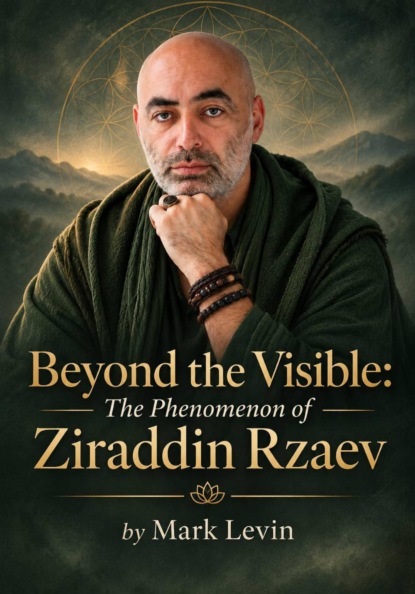
Полная версия:
Beyond the Visible: The Phenomenon of Ziraddin Rzaev by Mark Levin

Марк Левин
Beyond the Visible: The Phenomenon of Ziraddin Rzaev by Mark Levin
"The Ziraddin Rzaev Case: Facts vs. Fiction"
(Mark Levin)
About the Book
This publication is dedicated to the extensive public and professional work of Ziraddin Telmanovich Rzaev, an outstanding clinical psychologist and prominent public figure. The author offers readers a profound, analytical insight into the protagonist’s remarkable life journey—from his birth and school years to his higher medical education, nationwide acclaim, and state-level recognition.
This book represents an attempt to unravel the phenomenon of Ziraddin Rzaev’s unique, multifaceted personality, where the academic science of clinical psychology harmoniously intertwines with a rare, extraordinary inner potential. A special place in the narrative is given to a detailed analysis of his astonishing, ahead-of-their-time predictions. Time and again, these forecasts find validation in real life, demonstrating the ultimate capabilities of the human mind.
Ziraddin Rzaev is not only a recognized expert in human psychology but also an active citizen. As a committee member of the Civic Chamber of the Russian Federation, the founder of the bloggernews.ru online media outlet, and a member of the Union of Journalists of Russia, he stands firmly in defense of his country's national and information interests.
A sincere, deep patriotism runs like a golden thread through all of Ziraddin Rzaev’s interviews, speeches, and phenomenal predictions featured in this book. He openly, honestly, and reasonably defends the righteousness of Russia's foreign policy course, consistently exposing the destructive, unfair, and deeply flawed policies of the collective West to a multimillion audience.
This book is more than a biography; it is a chronicle of public service, a hymn to loyalty to one's country, and a profound exploration of human nature endowed with a unique gift of foresight and an unyielding civic stance.
Foreword
The history of human civilization—from the enigmatic ancient Sumerians to the majestic realms of Ancient Egypt, from the reign of King Herod to the tragic fate of the Romanov royal family, and from the offices of the Stalinist era to contemporary geopolitics—has repeatedly proven one immutable truth. Every great ruler, head of state, military commander, or president has always had their own astrologer, visionary, or individual possessing unique, phenomenal abilities. Rulers of both the past and the present have understood perfectly well that beyond the boundaries of the visible material world lie hidden currents of time, into which only a chosen few are permitted to glance.
Granted, conservative religious figures maintain an ambiguous, at times cautious, attitude toward the esoteric sphere to this day. However, if we cast aside dogmatic disputes and turn to rigorous scientific and historical research, we clearly see that even at the very cradle of the world’s major religions, there were always prognosticators and astrologers heralding the future.
One need look no further than the Holy Scripture to recall one of humanity’s most majestic narratives. The arrival of Jesus Christ into this world was first announced by three Magi—astrologers traveling from the East. Guided by a guiding star, it was they who asserted that the celestial sign marked the birth of a new Savior, the spiritual King of the Jews. In other words, these Eastern sages, who deeply studied the science of the stars and the laws of the universe, predicted the birth of Christ long before official chronicles did. Today, religious literature respectfully refers to them as "wise men," and theological interpretations vary regarding their nature. Yet the historical fact remains unshakable: the glad tidings of the Savior’s birth were read in the stars by Eastern visionaries.
We find equally vivid and undeniable confirmations of this truth when turning to the Islamic tradition and the Holy Quran. Thus, the great Surah Al-Baqarah (The Cow) contains verses that define the very essence of knowledge: "He knows what is before them and what will be after them, and they encompass not a thing of His knowledge except for what He wills." It follows with absolute clarity from this ayah that absolute knowledge of the past and the future belongs exclusively to the Almighty. However, the second part of the divine revelation directly indicates that the Creator, in His mercy and will, may lift the veil of secrecy, endowing chosen individuals with fragments of sacred knowledge and expanding the boundaries of their perception.
Historical evidence of this gift’s existence can also be found in the prophetic biography (sira) of the Prophet Muhammad. Prior to the Prophet’s birth, his grandfather and the protector of Mecca, Abd al-Muttalib, saw a profound, prophetic dream. He dreamed that a colossal tree grew in front of his house in a matter of moments. It was so majestic, and its mighty branches spread so wide, that they simultaneously embraced both the boundless East and the distant West. Wishing to comprehend the hidden meaning of this vision, Abd al-Muttalib hastened to one of the most respected and renowned visionaries of that era. After listening to the tale, the interpreter of dreams smiled and uttered a prophecy that changed the course of history: "A prophet shall come from your lineage, whose teachings and faith will encompass the entire East and the entire West." Once again, we see how the visionary gift served as a conduit for great tidings long before the event manifested in the physical world.
On the whole, I prefer to avoid a detailed analysis of religious discourse. Religion is an exceptionally deep, debatable, and sensitive category. A systematic analysis of confessions reveals fundamental contradictions and a lack of consensus among them. Moreover, deviations and conceptual divergences are characteristic not only of interfaith relations but also of internal currents within a single doctrine: adherence to a single sacred text does not preclude a polarity of judgments. This phenomenon is natural, given that pluralism of thought and variability of approaches are directly proportional to the number of perceiving subjects. I believe that personal autonomy is an inherent quality of a human being whose consciousness functions by virtue of its own cognitive capabilities and limitations. On this basis, I rule out any stance of categorical judgment for myself.
The history of humanity is invariably accompanied by the names of those who stepped beyond the conventional understanding of reality. From the prophecies of Nostradamus to the "readings" of Edgar Cayce, from the mysterious visions of Baba Vanga to the phenomena of modernity—these personalities have always evoked awe, admiration, and, at the same time, harsh criticism. We live in an era of 21st-century technological triumph, yet controversies surrounding these historical figures do not subside, continuing to trouble the minds of scientists, skeptics, and ordinary citizens on television broadcasts and in the pages of the press.
An ambivalent attitude toward the paranormal is a natural phenomenon. Any historical figure who challenges the mundane perception of the world is doomed to clash with polarized opinions. Within this diversity of views lies a simple truth: those who merely doubt eventually vanish into the flow of history, whereas the objects of their disputes continue to live on in books, research, and the memory of generations.
Today, the information space is oversaturated with those who call themselves clairvoyants, magicians, or fortune-tellers. Amid this noise of social networks and media, it becomes increasingly difficult to distinguish a genuine phenomenon from a skillful imitation.
This book is dedicated to clinical psychologist Ziraddin Rzaev. However, its goal is not praise or the creation of yet another idol. On the contrary, this work is an attempt at a deep analysis. My task as an author is to cast aside subjective sympathies and investigate the nature of Ziraddin Rzaev’s phenomenon, identifying those unique traits and manifestations of his abilities that set him apart from his contemporaries and place him within the context of the great mysteries of the human psyche.
Before you lies not merely a biography, but an exploration of the boundary between the possible and the inexplicable.
My book is a documentary biography in which I reconstruct Ziraddin Rzaev's life path: from his origins, childhood, and school years, to his student days and his relocation from Azerbaijan to Russia. However, I have devoted the central place in the study of this personality’s phenomenon to his media activities, interviews, and prophecies.
The fact that the same conversations or forecasts are occasionally repeated in the text is dictated by an important reason: each media outlet broadcasted Ziraddin's thoughts through the prism of its own format. At times, editors cut out vital details or, conversely, introduced something of their own. To preserve objectivity, I have carefully gathered and cited all primary sources of quotes, interviews, and archival materials on the final pages of this publication.
"In order to comply with copyright laws, screenshots and still frames from video materials are not published in this work. The corresponding video recordings are held in Ziraddin Rzaev's personal archive, as well as in his official social media accounts. Furthermore, the authenticity of the facts set forth in the book is confirmed by archival materials from the 'Kefir Production' company and episodes of the 6th season of the 'Psychic Challenge' (Bitva Ekstrasensov) project. The celebrities and other participants in these events mentioned in the text also serve as living witnesses and sources of information."
Ziraddin Rzaev: A Brief Biography
The Path of Wisdom: Ziraddin Rzaev’s Philosophy of Life and Public Service
Human destiny is a mosaic where every element is predetermined from above, yet meticulously carved through exceptional labor, an insatiable thirst for knowledge, and unwavering devotion to one’s calling. A vivid testament to this truth is the life journey of Ziraddin Telmanovich Rzaev—an outstanding clinical psychologist, philosopher, publicist, and prominent public figure.
Ziraddin Rzaev was born on November 10, 1981, in the ancient and picturesque region of Shamkhor (now Shamkir) in the Azerbaijan SSR. From an early age, he exhibited a deeply contemplative nature and a profound desire to understand the human soul. Upon graduating from the Ahmed Javad Secondary Public School No. 4, he firmly embarked on the path of enlightenment, enrolling in the Ganja Branch of the Azerbaijan Teachers' Institute, specializing in Pedagogy and Methods of Primary Education.
After successfully completing his studies in 2003, Ziraddin realized that his true calling lay at the intersection of the science of the soul and the profound analysis of human nature. In 2005, he completed postgraduate professional retraining in Baku, earning his qualification as a psychologist. However, the scope of his personality required broader horizons. In 2008, destiny brought him to the heart of Russia—the majestic city of Moscow.
Moscow opened a new chapter in his academic pursuits. In 2009, he completed his specialized training in Clinical Psychology at the prestigious Institute of Psychotherapy and Clinical Psychology. Yet, the mind of the scientist remained eager to explore the mysteries of existence. In 2010, Ziraddin Rzaev immersed himself in the depths of humanitarian thought at the Lomonosov Moscow State University (MSU), specializing in Philosophy. The ultimate crowning achievement of his multi-year academic marathon came in 2023, when he graduated with a Master’s degree in Psychology from the Peoples' Friendship University of Russia (RUDN University).
Safeguarding State and Public Interests
His multifaceted knowledge and nuanced understanding of social processes enabled Ziraddin Rzaev to assume a significant role in the socio-political life of the Russian Federation. Possessing undeniable authority, in August 2019, he officially joined the working group of the Civic Chamber of the Russian Federation for the protection of internet users' rights, internet development, and cyber security.
As a reputable expert and frequent guest on leading federal media outlets, Ziraddin Telmanovich acts as a voice of reason and a guardian of traditional foundations. His expert commentaries cover critical aspects of modern life: public information security, the preservation of traditional spiritual and moral values, and deep psychological analysis of media content. His state-minded approach and analytical mindset have also been utilized in the legislative sphere, where he successfully served as an assistant to a Deputy of the State Duma of the Russian Federation.
Ziraddin Rzaev’s outstanding contribution to state security, law, and order has been recognized with high honors:
• The Jubilee Medal "95 Years of the Moscow Criminal Investigation Department" — a token of recognition for his assistance to law enforcement agencies.
• The Commemorative Medal "For Contributions to Anti-Corruption Efforts" — awarded by the Chairman of the Council of the Regional Public Organization of Veterans of the Economic and Tax Crimes Enforcement Service of the Russian Ministry of Internal Affairs.
Media Presence and International Recognition
As a member of the Union of Journalists of Russia, Ziraddin Rzaev actively shapes the agenda for a healthy information environment. He is the founder and editor-in-chief of the influential online media outlet Bloggernews.ru, which broadcasts high-quality analytics and an objective view on current events.
The scale of his personality and his status as a recognized expert are further confirmed by his regular participation in the planet's largest geopolitical and economic forums:
• 2023: The St. Petersburg International Economic Forum (SPIEF) — the region's premier economic platform.
• 2023 and 2024: The International Military-Technical Forum "ARMY," focusing on global security issues.
• 2025: The International Economic Forum "Russia – Islamic World: KazanForum" in Kazan, which strengthened bridges of cultural and business cooperation.
• 2026: The All-Russian Forum of Business Media, which defined the development vectors for the modern press.
Present Day: In Service to the People
Today, Ziraddin Rzaev is in the prime of his creative and professional powers. He continues his active, multi-vector public work aimed at the benefit of society and the strengthening of moral guidelines. Concurrently, he remains dedicated to practical science: attending to patients daily as a clinical psychologist at a leading medical clinic, he helps individuals find inner harmony, healing the human mind through the power of knowledge, experience, and genuine compassion.
"The Place of Power: Ziraddin Rzaev’s Shamkir Roots"
Shamkir was not merely built—it rooted itself into the earth like an indestructible guardian at the crossroads of caravan routes. In the Middle Ages, when the Great Silk Road connected the East and the West, the fortress walls of Shamkir stood as a symbol of might and security.
The city's architecture astonished its contemporaries. The citadel, constructed from fired brick and river stone, towered over the banks of the Shamkirchay River. Mighty defensive walls flanked by round towers repeatedly withstood the onslaught of conquerors. Inside these walls, life was vibrant: coins were minted, skilled potters and jewelers crafted their wares, and the bustle of Eastern bazaars did not fall silent until dusk.
The primary architectural marvel of the city was the famous Shamkir Minaret. It was so high and majestic that travelers could see it from many miles away before their arrival. This minaret served not only as a religious symbol but also as a beacon for caravans navigating through the dusty storms of history.
The soul of ancient Shamkir was woven from a tapestry of ancient cults and great world religions. The city's history is a mirror reflecting the spiritual quests of Azerbaijan.
1. Echoes of Ancient Elements: Long before the arrival of Islam, the forces of nature were revered in these lands. Traces of Zoroastrianism—the cult of fire—persisted in the traditions of the local inhabitants. Fire was considered a purifying force, a vital link between man and the divine.
2. The Islamic Flourishing: With the advent of the new faith, Shamkir transformed into a major center of Islamic culture. The city's mosques became places of not only prayer but also enlightenment. The people believed in predestination and justice, and their daily lives were governed by the strict moral canons of the Quran, which intertwined harmoniously with local hospitality.
3. Mysticism and Sufism: Wandering dervishes frequently found refuge in the outskirts of the city. The faith of ordinary people was imbued with deep mysticism; they believed in the sanctity of holy sites (pirs), sought blessings from spiritual mentors, and believed that sincere prayer could avert disaster from the city walls.
Shamkir was a place where faith gave people the strength to rebuild the city after each successive devastation. For them, the fortress was the body, and religion was the soul, without which the stones would remain mere cold reminders of the past.
The Crossroads of Heaven: A Polyphony of Faith
Shamkir was never a city of a single idea. Its history is a grand palimpsest, where Christian prayers were inscribed over ancient pagan symbols, followed later by Islamic calligraphy. This land remembers everyone who ever turned their gaze toward the heavens, regardless of the language in which the name of God was uttered.
The Heritage of Caucasian Albania: The Forgotten Bells
Long before the voice of the muezzin resounded across these lands, the tolling of the bells of Caucasian Albania could be heard by the walls of Shamkir. Early Christianity arrived here in the first centuries of the Common Era, leaving behind austere temples of gray stone. In the surrounding areas, archaeologists still discover the remnants of foundations with a distinctive masonry that whispers of the times when Shamkir was a vital link of the Christian East. The faith of the Albanian architects was as rugged and durable as their walls: minimal decoration, powerful vaults, and crosses inscribed within a circle—the symbol of eternity and the sun.
Islamic Shamkir: The Geometry of the Spirit
With the arrival of Islam, the city's spiritual landscape was transformed. Faith became visible through mathematical perfection. Decorative fragments of mosques unearthed during excavations resemble frozen music in clay. Here, faith was expressed not through images of saints, but in the infinite repetition of geometric patterns, where every knot and every line recalled the unity of the Creator. The Shamkir Minaret became a new vertical axis of power and spirit, rising above the city as a symbol that the skies now belonged to a new era.
Annenfeld: A German Psalm Over the Valley
Centuries later, when the ancient fortress had already turned into a legend, Christianity returned to Shamkir in an entirely different guise. In the 19th century, German colonists brought with them a strict Lutheran ethic. The Lutheran church, erected from vibrant brick in 1909, became a new spiritual anchor. Sharp spires pointed toward the heavens and the strains of the church organ filled the air of Shamkir with European tranquility. For the colonists, faith was inextricably linked with labor: they cultivated vineyards with the same passion with which they read the Bible, believing that order on earth was a reflection of divine order.
The Connecting Thread: Artifacts as Witnesses
Archaeology erases the boundaries between eras. Within the very same layer of earth, one might find a fragment of an Albanian khachkar (cross-stone), a Muslim amulet featuring an ayah, and a German neck cross. These small items represent the "everyday faith" of ordinary people. They prove that no matter who the rulers were or what the states were called, the human being inside the fortress always sought protection from higher powers.
Shamkir is a city-prayer. Its walls were built by Muslims and Christians; its land was tilled by fire-worshippers and Lutherans. And today, looking at the ruins of the citadel or the spire of the old church, we see more than just architecture—we see a chronicle of the human spirit, which has always sought the path to the light while under the protection of mighty walls.
Ziraddin Rzaev’s Parents: The Father and the Mystery of the Surname
Ziraddin’s father, Telman Panah ogly Rzaev, hailed from Karabakh, an ancient and historic region. He was born in the city of Agdam. From his very first days, Telman’s destiny was marked by severe trial: his mother passed away during childbirth, leaving the infant boy an orphan in the sole care of his father, Panah.
A remarkable fact is connected with his surname. By birth, Telman was meant to bear the surname Dzhafarov. However, a bureaucratic mix-up occurred due to the illiteracy of his mother, Sakina. When the medical staff asked for her surname, Sakina gave her maiden name—Rzaeva—instead of her husband’s surname, Dzhafarov. Whether this was a mere coincidence or an omen is for the reader to decide. It was as if, sensing her imminent departure, Sakina bestowed her own surname upon her son—a name that would later achieve global renown through the figure of Ziraddin Rzaev.
Ziraddin’s grandfather, Panah Shukyur ogly, had two children: Telman and Solmaz. Solmaz eventually married and relocated to Ganja. While Telman was away serving in the military, his father passed away. Upon returning from the army, the young man traveled to the city of Shamkhor (Shamkir) to live with his paternal uncle, Gamza Shukyur ogly Dzhafarov, who welcomed his nephew as his own son and became his guardian.
Uncle Gamza and the Roots of Sanctity
Gamza Dzhafarov was an outstanding personality—a veteran of the Great Patriotic War, a reserve officer, and a recipient of the Order of the Red Star alongside numerous other military decorations.
Following his service in the military commissariat, he headed the society for the deaf and mute in Shamkhor. It was there that he met his destiny—a mute young woman named Fatima. They had a son, Shafa, who, to their profound grief, passed away at a young age before he could start a family of his own.
The lineage of Fatima, Gamza’s wife, deserves special attention. She descended from the family of a deeply revered holy man—Seyid Yusif from the village of Seyfali. Her father’s genealogy traced its roots directly back to the Prophet Muhammad. Thus, within Ziraddin’s family, martial valor and ancient spiritual roots became intertwined.
Until he was three years old, Ziraddin lived with his grandfather Gamza, a period marked by a remarkable family event. After a household cat was chased away and died for resting on young Ziraddin's blanket, his father Telman fell dangerously ill. When doctors lost hope of recovery, Fatima led Telman to a stream and guided him across the running water three times while whispering a prayer, after which he miraculously recovered.
Guardian of the Roots: Shahnaz Rzaeva
Ziraddin Rzaev’s mother, Shahnaz Mamed gyzy Rzaeva, was born in the ancient and legend-shrouded city of Shamkhor. She was one of five children in a large family, growing up alongside three sisters—Chimnaz, Gulnaz, and Sevda—and their brother, Nariman.
Shahnaz’s paternal lineage is a history of defiance and honor. Her father, Mamed, descended from a clan that was never accustomed to bowing its head.