Полная версия:
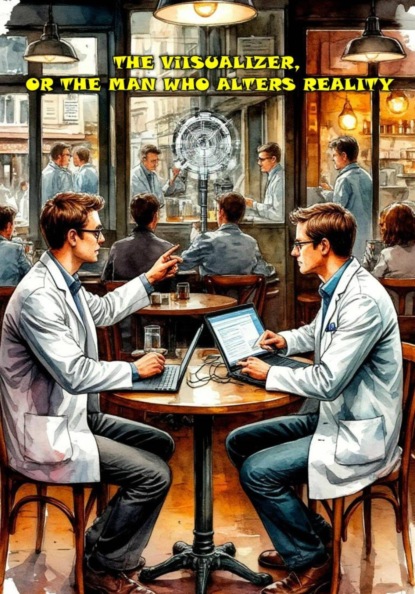
The visualizer, or the man who alters reality
At last Winston finished calibrating the program and reported that he was ready to begin. He switched the generator on and it emitted a low hum, confirming that the device was running. John noticed that the device had begun producing ozone, and that the quality of the air in the room had subtly shifted. Several minutes passed and nothing happened. John had already stopped worrying about the young couple who were having such a pleasant conversation at the neighbouring table. Apparently nothing threatened them.
Then, without warning, the man sitting just a few tables away from them rose to his feet and, as calmly as if it were the most natural thing in the world, tipped a full pint of beer over his companion. She froze for an instant from sheer shock, then stood up, slapped him across the face, and bolted out of the café. Through the window came the sounds of the offended and humiliated woman arguing with her companion, unable to understand what had possessed him to do such a thing. The man tried to defend himself, but his explanations were not accepted, and the quarrel went on just outside the window.
The waitstaff exchanged glances. They had never seen anything like it. The man appeared to have lost his mind. A cleaner appeared from somewhere, swiftly mopping up the spilled drink with a long-handled mop.
"Enough," said John, who had sobered up in an instant and now understood that everything Winston had told him was true.
Chapter 7
Do no evil — it will come
back like a boomerang,
Don't foul the well from
which you'll drink one day.
Don't scorn the man who
stands below your rung —
You may have need of him,
come what may.
Omar KhayyamKirill noticed the new chief medical officer the moment she arrived. He had never gotten along with her predecessor, who had done everything in his power to have Kirill transferred from the open inpatient ward to the closed one. Kirill never understood exactly why. Perhaps it was because certain people are simply not susceptible to hypnosis or neurolinguistic programming.
The man Vera Ivanovna had replaced disliked the fact that Kirill could make other people do things against their will. More than that, he had shared his suspicions with the clinic's director, Isaac Moiseevich Rabinovich, and the patient had been moved, over his own strong objections, to the closed inpatient ward — a section guarded far more strictly than anywhere he had been held before.
His chances of escaping from the psych ward had evaporated, and that made Kirill furious. He was determined to get out at any cost, regardless of the formidable security system installed throughout the building.
In due course he found a way to settle the score with his enemy. Using his hidden abilities, Kirill managed to turn the most seriously ill patients against the chief medical officer. Each of those patients began looking for ways to do the man harm, though before Kirill's intervention no such impulses had ever occurred to them.
Eventually one of the most severely ill patients — a woman suffering from acute schizophrenia — crept up behind him and seized him by the throat, trying to strangle him with her strong, unyielding hands. The woman possessed remarkable physical strength, having worked on the railways in her earlier life. Pulling her off took considerable effort, and the doctor spent several minutes lying on the floor, struggling to recover. The incident left him in no doubt that the next attempt would be fatal.
Had the woman not been dragged away from the terrified chief medical officer, he would in all likelihood have died of asphyxiation. It was this that compelled his predecessor to hand in his resignation, leaving Isaac Moiseevich to search for a new chief medical officer of sufficient clinical standing.
Kirill had got what he wanted. Yet his situation had not improved in any fundamental way. He was still confined to the closed inpatient ward, from which escape was virtually impossible. The staff continued to dose him with serious medications, and the young man's condition was deteriorating day by day.
Vera Ivanovna's approach to Kirill was quite different from his predecessor's — although she did not transfer him back to the open ward. Every evening the young woman sat with him and talked, trying to understand his inner world and gently reshape his behaviour. And that work produced results: his condition began to improve. She convinced him that his situation was not as bleak and hopeless as it had seemed at first. And it was true — after their conversations, Kirill would find himself looking at his circumstances in a new light. Beyond that, he began to see the other patients around him differently — the ones who shared the closed ward with him and were now a constant presence in his daily life. Friendships began to form, though Kirill had never had a single friend before. The director took note of the changes and updated the patients' files accordingly.
Shared hardship and a shared way of life drew Kirill closer to those among the patients who caught his interest. In time a loose group took shape around him, and they began spending their free hours together. This brightened Kirill's days considerably, making them far less grey and cheerless than they had been before Vera Ivanovna's arrival. He was grateful to her for it and never tired of saying so. The pleasant young woman also stirred something warmer in him, and he tried to do small things to please her whenever he could.
The group that formed around Kirill was a motley one, its members strikingly different from one another. Kirill was the spark — the unifying force that had drawn these severely ill patients to him, after which they began talking not only to him but to each other. That, too, was good for their mental state, and the chief medical officer raised no objection to the friendship, finding it genuinely beneficial for their health.
The group included the following patients:
Sanyok — Alexander Anatolyevich Fursov, who believed himself to be a genderless being;
Arthur — the "human crab," who had lost his mind over environmental protection and green energy;
Faya, a young woman who had once attempted suicide after immersing herself in novels about vampires, ghouls, and dark worlds;
And Mr. Ziberman, who spent his days trying to coax a mobile phone out of the orderlies so he could retrieve his lost identity from somewhere deep inside the computer network where it had gone missing long ago.
Something in each of these people had caught Kirill's attention. That was why he had drawn them into his small circle, with whom he now spent every hour the clinic's treatment schedule left free. In time Kirill became a kind of fixed point for these people — because he alone was capable of meaningfully changing their lives.
Chapter 8
Betray no friends — you'll
never find their like,
Don't lose your love — she
will not come back twice.
Don't lie to yourself —
time will prove the truth:
That very lie will be your
own undoing in the end.
Omar KhayyamJohn was staggered. The experiment Winston had just demonstrated had made an overwhelming impression on him.
"And how far have you actually got?" he asked his companion. "Have you managed to find a visualizer — the one who is supposed to represent the next rung on the ladder of human evolution?"
"Unfortunately, people with truly powerful energy fields are far fewer than we initially assumed. Besides, the prototype was only finished recently, and so experiments of that kind have not yet been conducted," Winston replied. He was relieved that his old friend had shared with him this portion of the classified information that had been tormenting him for the past two years.
At last he had been able to unburden himself — to tell someone the secret material that had turned into his own personal nightmare and haunted him day and night. This meeting gave him the chance to speak freely and shed the nervous tension that had been building inside him for years.
"And aren't you afraid of conducting forbidden experiments on people?" John asked — the very question that had, not long ago, driven him to leave the Tavistock Institute of Human Relations.
"Experiments like these are being conducted all over the world, and whoever achieves practical results first will gain a decisive global advantage over every other state. In essence, this is the PSY weapon we have been working toward for so many years," Winston replied.
"If you build a large installation capable of generating spin impulses at a specific frequency, you will be able to irradiate enormous territories — for instance, the territory of a potential adversary — from aircraft flying overhead, influencing the psychological state of its population.
"In essence, a war could be won without firing a single shot, in a very short space of time, while leaving the material results of the population's productive activity entirely untouched. This is precisely the kind of weapon Hitler once dreamed of when he was planning his surprise attack on the USSR. Now our own leadership has begun thinking along the same lines.
"And it seems to me that hatred toward other peoples lies at the root of it. That is probably why this non-lethal weapon receives such close attention from our Government — which, like that dictator, is not exactly known for its restraint. And of course they want us to lead the field, pulling ahead of our potential adversaries and nearest competitors — the Americans included — by many, many years."
"I even have the feeling that my staff are being watched. There are a great many people who would like to get their hands on this device. And that could mean the Chinese, the Russians, or representatives of the major information-analytical conglomerates that talk about a world government and are reaching for global dominance.
"Generals want to win wars sitting at their office desks, and they are not the least bit troubled by the fact that some portion of the population of our shared little planet will suffer. They have no regard for human life. That is precisely why they keep raising the question of overpopulation — a question that, in reality, has no genuine foundation whatsoever.
"Unfortunately, classified information about the fact that we are conducting these complex neuropsychological experiments has made its way into the press, and that has drawn entirely unnecessary attention to our work. Now I fear for my life," Winston said, and glanced around the room.
He looked frightened, and his psychological state spoke of a serious nervous strain that could easily land his friend in a psychiatric hospital. He was not far from a breakdown, and so John did his best to give him the space to keep talking.
The café had an intimate feel to it. The lamps fixed along the edges of the room were dimmed low, barely illuminating the wide hall where the two men now sat. Outside, evening had fully fallen, and the interior was correspondingly dark. All of it created a particular atmosphere that produced very different impressions on different people.
It unsettled Winston, but John rather liked it. This kind of atmosphere was made for people in love, or for close friends who wanted to unburden themselves or talk quietly from the heart.
"By the way, this is one of the reasons I wanted to meet you," Winston continued. He was about to share something else with his old friend but did not know quite where to begin.
"And how can I help you?" John asked.
He had no particular desire to be drawn into someone else's problems, but the conversation had caught his interest. The professional dimension was certainly engaging — yet the information he had received could prove extremely dangerous. He was well aware that carriers of classified information could be eliminated by their own intelligence services just as readily as by agents of an adversary.
"The thing is," Winston said, "in order for the generator to function correctly, certain initial data need to be entered into the program. This data can only be obtained through experimentation, at the cost of a great deal of time and resources.
"Beyond that, a number of countries have enacted legislative bans on conducting experiments of this kind on human beings, and that complicates the intelligence services' work enormously. Russia, for instance, has such a prohibition in place at present. Although I personally believe that work of this nature is being carried out there as well. They are not so very different from you and me."
At that, Winston spread his hands, as if to say that all the world's intelligence services operate by the same methods — and that the work he was engaged in was simply necessary for maintaining the state's defence capacity.
"The hardware alone could turn out to be useless if it falls into non-professional hands. In essence this is a software-hardware complex, and the experimental data entered into the program are no less important than the full inventory of electronics that make up this advanced generator," he said, and fell silent.
After they had finished the fragrant sausages that had been brought alongside the beer, Winston continued his substantive account.
"In fact, this data exists inside my head," and Winston tapped himself on his large bald head, which occupied a considerable expanse of his skull. "But as a precaution I have also written the data onto a flash drive. And naturally I would like to ask you to keep that flash drive at your home.
"Nobody knows that we meet, so you will remain above suspicion," he said. "I don't want it to fall into the hands of people who have no moral principles whatsoever," Winston went on, looking his companion in the eye. At that moment he resembled a stray dog from whom someone had snatched a piece of sausage.
"That includes the leadership of the Tavistock Institute of Human Relations, which has no appreciation of the full danger of our research. But you understand that perfectly well yourself."
With that he slipped the flash drive containing the classified data into his friend's breast pocket.
"Please — keep this information hidden from everyone, somewhere well out of sight," Winston asked. "I have a bad feeling about things, and as you know, my feelings have never led me astray. Anything could happen to me. I think about that constantly while I'm at work, and I'm becoming terribly suspicious and absentminded."
The two friends then said their goodbyes. It was time to head home. Winston packed the hardware back into his briefcase and walked toward the exit. John decided to stay on at the café a little longer — to finish his beer and turn over his friend's words in his mind.
The experiment had exceeded all his expectations and made such a powerful impression on him that it was visible to the naked eye. He sat thinking about the capabilities of the device his companion had just demonstrated here in this bar. It was dangerous — it could reach into people's minds, into their thoughts and their actions.
John said goodbye to Winston and sank into reflection. The world they all lived in was an extraordinarily fragile place, and all it would take was the appearance of some powerful trigger for humanity to slide back into savagery.
That was probably why, several years ago, he had declined the rather lucrative offer that the leadership of the Tavistock Institute of Human Relations and a number of Her Majesty's secret agents had pressed upon him. He had written his resignation letter then. He did not regret it now. He had done the right thing.
Without warning, loud shouting erupted outside, followed by the sound of a vehicle striking something solid. The noise pulled John out of his grim reflections, and he decided to step outside for some fresh air and to see what had happened. He beckoned to a waitress, settled the bill for himself and for his friend who had left a few minutes earlier, and then looked out through the window. Directly in front of the café entrance a sizeable crowd had gathered around a car, and around a man who had been caught up in an accident.
John went out onto the street and saw a girl crouching over a man who had been struck by the passing vehicle just minutes before. The girl kneeling beside the figure on the pavement was frantically trying to call an ambulance. John was a doctor, and so he stepped forward to help. He bent down to check the man's pulse and confirm that he was still alive.
The man lay face down, pressed against the asphalt, making it impossible to get a clear look at him. Evening was coming on, which made identification harder still. Yet there was something remarkably familiar about him — he had the same enormous bald patch as John's friend. John turned the man onto his back. And froze.
He had not been mistaken. Lying on the asphalt was Winston, from whom he had parted just minutes before. The pulse was weak, but John managed to bring Winston around. His eyes opened and he murmured: "John — is that you? Where is my briefcase?"
"Don't worry," John said. He was far more frightened for his old friend's life than for the fate of some piece of hardware.
"I'll get it for you right now," he said, and turned to look for the thing Winston had asked him to find.
But the brown briefcase was nowhere to be seen. Someone among the bystanders who had reached the scene of the accident before him had apparently taken the opportunity of the commotion to make off with someone else's property — without the faintest idea what was inside it, or what danger it posed to the world.
Chapter 9
A plucked flower must be
given away,
A poem begun must be seen
to its end,
Конец ознакомительного фрагмента.
Текст предоставлен ООО «Литрес».
Прочитайте эту книгу целиком, купив полную легальную версию на Литрес.
Безопасно оплатить книгу можно банковской картой Visa, MasterCard, Maestro, со счета мобильного телефона, с платежного терминала, в салоне МТС или Связной, через PayPal, WebMoney, Яндекс.Деньги, QIWI Кошелек, бонусными картами или другим удобным Вам способом.
Вы ознакомились с фрагментом книги.
Для бесплатного чтения открыта только часть текста.
Приобретайте полный текст книги у нашего партнера:
Полная версия книги
Всего 10 форматов