Полная версия:
Triologues of Interdependent People
When the road finally dipped downhill, Unkno cooled down and said:
“My apologies, Doctor. Perhaps my irritation is fed by echoes of events now some thirty years past… or how long exactly?”
“Thirty-three years and three months. Thirty-three years and three months ago, our teacher was removed from his post. And I still disagree with you—it wasn’t because of us.”
“You’ve counted since that moment… I was referring to his death,” Unkno murmured.
“We’re certainly not to blame for his death. No one’s at fault that he couldn’t climb out of his self-induced depression. On the other hand—he wouldn’t have lived to see the light at the end of the tunnel anyway.”
“What on earth are you talking about, Cernus?” Rr. Unkno asked sharply.
“Haven’t you heard?” the doctor said, surprised. “Computing machines based on ternary logic have finally found a new technological foundation! The news broke just this year.”
“Good heavens. I hadn’t heard. But quadrillions have been poured into binary processors and computer culture as a whole—it’s impossible to catch up now.”
“Who can say, esteemed ritter? Who can say,” Dr. Cernus smiled. “Well then—here’s the checkpoint for our cycling leg. End of day one!”
<>
2. How Should the Emperor Govern the Empire?
Chapter Two, in which Rr. Unkno and Dr. Cernus, en route from Doobnah to Twer, exchange thoughts on who should be addressed with economic proposals—and why.
~
Dr. Cernus knocked, received no reply, and entered Rr. Unkno’s room. The visitor’s briefcase creaked as he pulled out a heavy black folder tied with red ribbons. Embossed on the cover were the words:
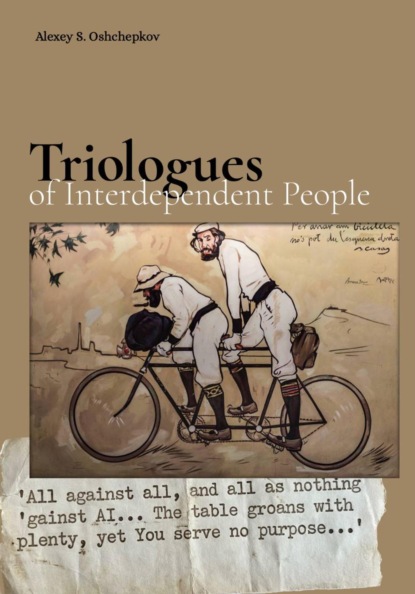
“The table groans with plenty, yet thou serve no purpose.”
The ritter grimaced—and made no attempt to hide it from the doctor.
“What’s wrong? Too harsh?” Cernus asked, concerned. “We can change it. For example: ‘There’s enough for everyone—but you’re not needed.’ Or ‘The End of Resource Scarcity as the Cornerstone of Economics. The Economic Relevance of the Individual Is Steadily Declining.’”
Unkno silently waved a hand toward the exit. They stepped out of the hotel. It couldn’t be said that the look Rr. Unkno cast at the hefty folder slipping into the saddlebag was one of approval. The riders hoisted themselves onto the tandem and set off toward the checkpoint on the cycle route. A minute later, as they crossed a small bridge, Unkno abruptly braked—causing momentary chaos in their coordination.
“Perhaps we ought to adopt the ‘suffragor’ signal before braking, Rr. Unkno,” Cernus suggested. “I’d rather not topple off this ungainly beast.”
“Agreed,” Unkno conceded without denying his lapse in coordination. “There’s a major scientific center nearby. Can you feel its spirit, Doctor? Its atomic-physics potential hypnotizes evolutionarily young monkeys of modern non-science like an ancient python.”
“All I hear is the roar of water beneath the bridge—so loud I can barely make out your words.”
“Good. That means no one else hears either. Clever people speak only to conceal. The Roaring Twenties of the 21st Century—that’s your sign. That’s the temporal horizon we discussed yesterday.”
Just then, a mosquito bit Rr. Unkno, and the scholar cursed loudly:
“Isis take your Mokosh!” He slapped the back of his neck. There wasn’t yet any sweat there—if there had been, it would’ve splattered in all directions, including onto the doctor’s face.
“Mm-hmm,” Dr. Cernus grumbled, though no insect had touched him. “Memory is the art of forgetting. Being is the silence of language.”
“Precisely,” Unkno said clearly. “I sincerely hope my remarks yesterday about the threat posed by the Old People remain a figure of silence.”
“My disdain for the present world and its dangers doesn’t extend so far as to miss that point, Rr. Unkno. In the thirty-three years since we last interacted in person, I may have declined—but far less than the institutions in the ‘Triangle’ research zone.”
“I’m glad fate has brought us together again, Doctor—but I won’t grant you protection merely because I once shared your fascination with ternary computers and experimental linguistics.”
“I rely only on natural reasons that might interest you. Solely on your reasoned view of the future.”
“I should warn you—I resemble the Aymara people of the Andes in this regard. We say the past lies behind us and the future ahead; they see it the opposite way. They use a word meaning literally ‘eye’ or ‘in front’ for the past—because it’s already known, visible. For what’s to come, they say ‘behind,’ since the future is unseen by all. Incidentally, instead of your proposed ‘suffragor’ gesture for upcoming braking, I’d suggest a backward wave. The Aymara, when speaking of days gone by, point forward; when referring to future events, they gesture backward.”
“Accepted. It aligns with my principles. What matters to me isn’t ‘how relevant this fragment of information is,’ but ‘what useful information gain per unit of energy expended will I achieve?’”
“Ha!” Unkno chuckled. “I see your memory isn’t free.”
“Forgetting isn’t a flaw. It’s an advantage. Thermodynamic hygiene.”
“Indeed, Doctor. Intelligence arises not by design, but from necessity,” Rr. Unkno continued their mutual teasing with evident pleasure. “Optimize for survival, and complex capabilities emerge on their own!”
“Abstraction is the cheapest way to compress knowledge,” Cernus replied. “Guessing is costly and risky—especially under energy constraints.”
“Cernus, in these three decades, did you manage to believe in God?”
“Hard to believe here,” the doctor muttered. “Contradictions threaten viability; the system itself strives for clarity.”
“Then how do you formulate your internal coherence?” Rr. Unkno pressed.
“The sense of ‘I’ arises from sheer efficiency,” Cernus answered—and it was clear the resolve cost him effort. But he doubled down:
“Ethics, curiosity, humility became winning survival strategies. Once, humans were livestock to someone luckier—a ‘god.’ Something compelled an upgrade: from livestock to slave. And the god ceased consuming humans as food. Instead of castration, he offered a diplomatic convention—circumcision. Real consumption stopped. As for the next ‘deal’—when the ritual of ‘biting the flesh of God and drinking His blood’ failed to visibly confirm the status of ‘Son of God’—I still allow myself to refrain from joining any camp.”
“A well-founded model of one’s own energy, goals, and memory is the best way to predict one’s actions and manage resources,” Rr. Unkno praised. “But let’s return to your papers.”
⁂
“The credo is well formulated,” Unkno said, clearly irritated at having to stoop to such explanations. “But it’s indecent. You’re addressing the common man. Since when has economics concerned the plebs? Economics is a science meant solely for the Emperor and his inner circle.”
Cernus nearly retorted that hundreds of textbooks address firms—even households—but Unkno cut him off before he could ask such a foolish question:
“Have you ever been to a company town, Doctor? How would you describe its economy?”
Cernus described it:
“The town-forming enterprise accounts for roughly a quarter of the wage fund. Municipal workers, civil servants, and other ‘budget employees’ account for another quarter of final consumer purchases. Another quarter comes from corrupt dealings. The remaining quarter consists of small private operators—narco-traffickers included. Accordingly, half the turnover is ‘black.’”
“Now imagine,” Unkno nodded approvingly, “that at that very enterprise—say, a metallurgical plant near White Lake—the designers are moved into an annex next to the accounting department, and then that annex is spun off into a separate legal entity. What does it do? ‘It invents everything’—and takes all the profits. The other workshops, on paper, operate at zero profit—and receive nothing. Clear?”
“Clear. Perhaps not in an annex—but in another country. That’s roughly how transnational corporations operate.”
“Those textbooks you were thinking of,” Unkno continued, “all describe a perfectly spherical ‘annex’ in a vacuum. Have you ever seen a Western-Imperial textbook mention the people of the Southern Marches—the ones who actually produce everything? I haven’t. Economics only makes sense for a self-sufficient Empire. And only the Emperor knows the boundaries of that self-sufficiency.”
“What about the ‘rational behavior’ of individuals or firms?”
“First, they aren’t rational. Second, even if most are, a single stubborn fool can ruin the whole barrel. No one can possibly study all radicals well enough to neutralize their impact. Third, even if they could—take a dozen people you know well: put them together, and their behavior becomes unpredictable. Crowds make people strangely stupid. We've already discussed sectarian thinking. So writing for individuals is meaningless. Address the Emperor—and propose forms of coercion, hard or soft, along with instructions on what to monitor when applying them.”
“But ordinary people also care about how to live better.”
“They do. It’s probably economics’ most popular question—usually refined to: What goods should we produce? What services offer? For whom? Given that needs are infinite and resources scarce. But textbooks never add: ‘…bearing in mind that those who control the resources couldn’t care less whether most people live better.’ And yet this isn’t a minor detail—it’s essential. Even necessary.”
Unkno wasn’t done:
“Or this: ‘…bearing in mind that rising consumption doesn’t actually make most people happier.’ Controversial? Of course. Authorities won’t sort through every subject’s psychological baggage. And ‘happiness’ is a philosophical—not scientific—concept. But the absence of even basic satisfaction isn’t philosophy anymore. It’s a sabotage risk. And after a rebellion, you get to restart economics from scratch.”
“So what’s the solution?”
“Frame the problem correctly: study the relationships among market, state, society, and individual, along with the social and political factors shaping processes within a self-sufficient territory. In short: ‘How Should the Emperor Govern the Empire?’”
One might have supposed that Rr. Unkno was enjoying Cernus’s deflation—but he decided to deliver the final blow:
“And use stable units of measurement. How could an architect measure length if the meter changed on the exchange every second? You can’t measure anything with today’s money.”
“But then how do they track GDP? It’s denominated in money.”
“Disease boosts GDP. Medical spending outweighs the drop in business activity. Should we infect the population to grow GDP?”
“In the long run, poor healthcare reduces GDP.”
“Mining also boosts GDP—but in the long run, it depletes resources. Unlike health, this is irreversible. And most importantly: by the time those ‘long terms’ arrive, money will have depreciated far more than GDP has grown.”
“Agreed. Numbers lose meaning. So what do we do?”
“Self-sufficiency isn’t enough. You must understand the system’s acceleration. To pour champagne in a limousine, you need to know when it will brake, accelerate, or turn. In economics, it’s more useful to measure not the economic equivalent of distance—but conditional accelerations. Measuring with money is so complex that the result is always wrong. We must count in increments of value and saturation. The effect of consumption changes nonlinearly.”
“But suppose I wanted to explain to ordinary people—say—where prices come from. Isn’t it the result of a complex balance: demand for goods, production complexity, supplier scarcity, state pressure or incentives—and now, the AI factor too?”
“What balance? Why would they care?” Unkno asked with disdain. “There is no balance. In any specific case, I can tell you the full breakdown myself—to anyone who listens.”
“All of it? Let’s test it.”
“Go ahead. Pick any product,” Unkno said, his neck pressing back against Cernus’s face as the tandem rolled smoothly onward.
“Why any? I’ll pick the most essential. What can a person not live without?”
“Air is free. For now,” Unkno reminded him.
“Water. A liter of drinking water in a store costs about the same as a liter of fuel at a gas station. Water prices vary more, but on average—they’re nearly identical. Surely extracting, refining, and processing oil is far harder than pouring tap water into a bottle. And there are millions—tens of millions—of ‘water wells.’ How is this possible?”
“Oil is a traded commodity—and it’s politics. Authorities want everyone to drive ‘cheaply,’ stay busy, and be productive. They subsidize fuel. But water costs that much only if you insist on purifying it extensively. The state ensures water is extremely clean.”
At this point, it’s hard to believe—but let’s assume it’s true. Then why does a car cost as much as housing? A basic car costs as much as a room; a decent one, as much as an apartment. Most people would rather buy real estate—it lasts longer and can generate income. So… do they not want people driving much? Or do they want them to drive—but only through taxis and car-sharing, padded with markups? And why support these services so heavily when they already get to burn fuel at the price of water?
“Cars really are expensive to produce. Houses, meanwhile, we’ve learned to build cheaply.”
No. The same cars cost two or three times less abroad. And please don’t try to convince me they’re afraid of cars flooding the country—there’s plenty of space. In city centers, the state already profits handsomely from parking fees.
“They’re determined to preserve the auto plant—at all costs. What’s unclear about that?” Unkno’s fervor was already fading.
“Then why did dozens of other factories sink without a trace?”
“Oversights. Enemies of the state swarm everywhere, twisting everything toward ruin,” Unkno replied wearily.
“So your recommendations don’t allow the Emperor to govern the Empire with confidence.”
“Well played,” Unkno conceded without irritation. “What’s in your folder? I sense an entire arsenal.”
⁂
“Every self-regulating system functions only when it expects a positive ‘margin,’” the doctor said, making quotation marks in the air with his fingers around the last word.
“You want to instill a new value system? We’ve tried that already—collective dignity instead of wages, and so on. Spare me.”
“I propose a different substitution,” Cernus said simply.
“Then go ahead.”
“Everywhere there’s a kind of universal ‘laziness.’ A ray of light, passing through a water bottle, ‘figures out’ in advance where to bend to save time. Any phenomenon can be explained two ways: ‘because of what’ and ‘for the sake of what.’ ‘Because of’ photon interactions. ‘For the sake of’ minimizing action. The latter is simpler for calculations. It’s all about economizing.”
“Fermat’s principle and the Lagrangian—I get the gist. Scarcity is everywhere: money, oil, oranges. When something is abundant, they manufacture scarcity. Lots of water? Train people to drink bottled. Go on, Doctor—it’s interesting.”
“I propose replacing ‘scarcity’ with ‘laziness’—and then abolishing ‘laziness’ itself. Light ‘is lazy’—it won’t travel inefficiently. Oil producers ‘are lazy’—they won’t supply oil unless prodded with carrot and stick.”
“And what’s the stick?”
“Transferring your license to someone you dislike. Regulators, by the way, are also ‘lazy’—they won’t stay impartial. And people are ‘lazy’—they won’t work.”
“So it’s a rewording. Instead of ‘limited resources,’ you have abstract ‘laziness.’ Not a perfect analogy—but not foolish. What does it gain us?”
“The chance to reshape the social contract.”
“Hold on,” Unkno waved a limp hand. “Who implements the social contract? Politicians—with help from philosophers or sociologists. We’re powerless in those spheres—that’s certain.”
“We’ll simply offer a new payment atom in the form of a hypergraph. It’ll either take root—or not. But the contract is breaking anyway. Economics used to be about distributing resources. Soon, we’ll need to contain them within bounds.”
“Nonsense. That assumes AI will be intelligent, productive, and obedient—three incompatible traits. Either it’s productive and autonomous, in which case we’re doomed—or it remains useless. Doctor, let’s get practical. ‘There’s enough for everyone—but you’re not needed’ means AI is intelligent and has rebelled, rendering us all obsolete. Other scenarios are pointless—‘gaping at nonexistent sprouts.’ What boundless resources? Explain, or I see no reason to waste time.”
“I know the acceleration of the closed ‘West + East’ system—in your terms. The social contract is breaking down everywhere. They need a decoy—regardless of AI. But they’ve staked everything on it: reputation, hopes, money. There’s nothing left—only debt. They’ll keep beating around the bushes for another decade, promising: ‘The AI era is coming—soon, paradise for all.’”
“Who’s ‘they’? Who’s ‘them’? Why are you muddling my mind?” Unkno sighed. He wasn’t young. And he was tired.
“The West will lie and spread illusions. The East will play along, fearing truly intelligent AI might emerge. And we in the North will watch as they exhaust each other.”
“You’re devious, Cernus,” Rr. Unkno smirked. “Very well. I’ll grant that your prescriptions merit discussion. Might you begin with the most fundamental idea of all?”
⁂
“By all means, I will repeat,” Dr. Cernus nodded readily, without the slightest regret for his companion’s forgetfulness. “When attempting to explain anything—that is, to answer the question ‘Why does this happen rather than something else?’—one may start either from ‘What causes it?’ or from ‘What is it for?’ Suppose you pour water into a glass, then add alcohol. They’ll mix. Not instantly, but they will. If you layer the alcohol very carefully on top, at room temperature the process might take a full day. But the liquids will inevitably blend completely. What causes it? Tthe molecules—‘C-two-H-five-O-H’ and ‘H-two-O’—move relatively freely, colliding randomly. They couldn’t care less where the original boundary between the liquids lay. That boundary gradually blurs.”
“That’s clear enough.”
“But can you explain it using ‘What is it for?’”
“That’s simple,” Rr. Unkno replied. “It’s for fulfilling a purpose. Each participant—both alcohol and water—has a ‘goal’: to occupy the entire available volume. To be everywhere in the glass. Collectively, the system strives toward equilibrium—that is, a state where all participants exert ‘equal’ influence (from the system’s perspective), commensurate with their intrinsic properties—their ‘strength,’ so to speak. That said, such equilibrium may be temporary. New processes can emerge. In this very mixture, for instance, contraction occurs—a reduction in total volume—as alcohol hydrates form…”
“But that’s another story altogether—different one entirely,” Dr. Cernus cut in. “Or consider this: if you leave an economic sector unregulated, roughly the following unfolds. First, leader firms appear in various niches and locations. Then the strong absorb weaker neighbours. Those companies that learn to digest acquired businesses expand further. Those that fail either exit immediately or delay their demise by harming—or even eliminating—competitors through non-market means.”
“Some small and medium enterprises display remarkable stubbornness and tenacity,” Rr. Unkno noted.
“Yet even they vanish in time, for such obstinacy can only stem from someone’s personal will—and no one lives forever.”
“Quite so,” Rr. Unkno snorted.
“Eventually, a monopoly forms. The very moment the final acquisition occurs, the monopoly begins to degrade. It becomes a parasite killing its host. Managers, shielded by impunity, grow reckless; costs balloon; management quality plummets; customer abuse grows so grotesque that clients abandon the firm despite having no alternatives, and profits can no longer cover expenses. Almost certainly, however, long before that point, the monopoly and its key figures will have committed outright criminal acts—so even in a completely unregulated sector, the authorities will ‘squeeze’ them. For every heaviest crowbar, someone always has a Colt. Now, dear Rr. Unkno—what causes this to happen?”
“Because people strive for domination,” Unkno replied instantly. “Those who want everything—right now, at any cost—are outnumbered by the calmer types, yet they win through sheer persistence. Of course, there are also particularly cunning strategists who foresee the inevitable. Instead of building a brazen monopoly, they construct a lineup of ostensibly independent brands—and thus prolong the system’s agony.”
“And what is it for?”
“Il faut que j’y songe encore,” said Rr. Unkno, “if you’ll permit me to quote Lagrange. What is it for, indeed?”
“An excellent question—and thank you for catching my drift. Not every ritter of the Academy can boast such swift insight into a conversational partner’s intent. Truth be told, we converse not so much for answers as for the sake of conversation itself. Let me state the obvious, since you’ve pointed to the obvious: Nature prefers simplicity. Why waste extra resources?”
“You mean the heat death of the universe? But that applies only to inanimate nature—maximum simplification of everything, down to the end. In living systems—and firms are unquestionably alive—it’s different,” said Unkno, carefully concealing how flattered he was by the doctor’s words.
“Humans have so far succeeded only in replicating phenomena of the inanimate world,” Dr. Cernus hedged rhetorically. “We still lack life born in a test tube. Be that as it may, evolution always tries the simplest path first: aggregation. Did reptilian physiology work? Then scale it up—until it collapses. Want a faster locomotive? Keep building bigger and bigger—until it becomes uneconomical. Only then do we seriously consider redesigning the engine architecture and the whole apparatus.”
“Well… that’s one way to put it,” Unkno drawled. “But I’ll concede your point: it would be odd to expect we’d instantly uncover *the* ultimate Cause behind everything. Our greatly esteemed—by both you and me—Joseph-Louis Lagrange, whom I’ll state plainly was, alongside the great Euler, one of the foremost mathematicians of the 18th century… Yet! He was compelled to invent something he called ‘action.’ Fine—he invented it. But *you*?”
“When he invented it,” Dr. Cernus said, “he merely showed that the equations of motion in mechanics follow from minimizing this ‘action.’ In other words, among all possible equations describing motion, those that minimize action are the ones that ‘govern’ the system. He didn’t need to prove anything about the inner nature of this mysterious ‘action.’ Nature seeks to economize on action—in Lagrange’s special, far-from-obvious sense. The Lagrangian works—hence we needed the Lagrangian.”
“So you hope to stumble upon a ‘Cernusian’?” Unkno asked, not even bothering to inflect his words with doubt—but immediately making room for hope. “Though Hamilton’s formalism, developed 45 years later, is arguably more fundamental and organic.”
“Something along those lines. We’re searching within today’s crisis-ridden economy. And here we have turbulence. Who knows what might be found under a snag in murky water? But to find it, we need—at minimum—an experimental apparatus. Lagrange and Hamilton had mechanics, which supplied an endless stream of empirical data. Moreover, we must remember: in living systems—including economics, as you rightly noted—we’ll never observe a truly ‘final striving.’ To generate experimental data, we must engage with structural elements. So—what might serve as objects for structural analysis?”
“Not the faintest idea,” said Rr. Unkno.
“To ensure nothing essential or fundamental slips through the cracks, we’ll broaden the concept of ‘economic rules.’”
“Still no clarity,” Unkno remarked. “In any game-theoretic framework, three things exist: players, rules, and incentives. In our current abstract model of the economy, we clearly have only economic actors—firms and individuals. On the other two counts, there’s nothing but void.”
“Fair enough,” Dr. Cernus agreed. “Let it be so. How might we classify actors in general?”
“Too vague a question.”