Полная версия:
Triologues of Interdependent People

Алексей Ощепков
Triologues of Interdependent People
1. The Roaring Twenties of the 21st Century
Chapter One, in which Rr. (ritter) Unkno and Dr. (doctor) Cernus determine the time horizon.
~
The Imperial Academy of Sciences in 2025 found itself afflicted by an unhealthy rift among its members. Indeed, it seemed the entire population of the Empire had been split by some invisible line as well. The usual polarities no longer applied. This wasn’t Augustinianism versus Pelagianism, nor left versus right, traditionalists against progressives, liberals merely to spite conservatives, nor even cosmopolitans clashing with nativists.
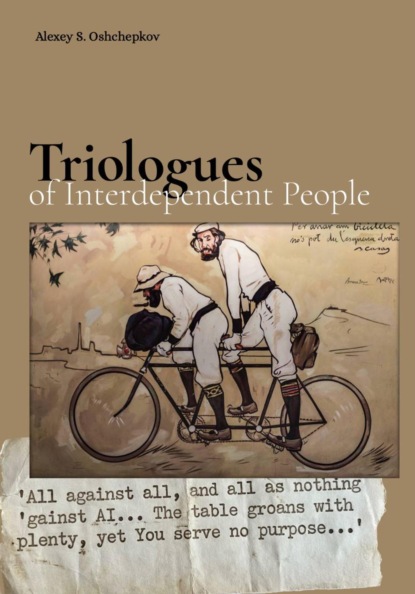
Someone got the idea to take two sheets of paper and title them with the names of two prominent Academy members notorious for their feuds. The lists were then circulated through offices and branches so everyone could indicate which side they stood with—and which they didn’t. Most initially refused, but a few deemed it appropriate to publicly declare allegiance. Once enough signatures accumulated, one by one even those who’d held back eventually signed. In the end, there were two rosters—and, to everyone’s surprise, they turned out exactly equal in length. This inspired one of the Presidium secretaries: pairs were randomly drawn from the two lists, tandem bicycles were rented, and a week-long ride between the two capitals was announced—on paid leave, of course. Over such a distance, people might just learn to get along (fight fire with fire).
⁂
“You know, Rr. Unkno,” said Dr. Cernus, settling onto the second saddle of the bicycle-limousine, “a human on a bicycle is nature’s and engineering’s most energy-efficient mode of transport ever devised. Shall we push off?”
“Off we go, then,” grumbled Rr. Unkno, not particularly cordially. “Though a velomobile—that’s a bicycle enclosed in an aerodynamic capsule—is even more efficient, if you’re talking about calories expended per gram of body mass moved one metre.”
Dr. Cernus was utterly unfazed by Rr. Unkno’s tone.
“Yes, precisely! Isn’t that amusing? Every other animal loses to us—and machines even more so. Incidentally, swimming is more efficient than flying, and flying beats running or walking. That was established as far back as 1970.”
“You’re comparing incomparables, Doctor. Different mass scales obey different laws. Where exactly was this ‘established’?”
“At Duke University.”
“Ah, ‘the Triangle.’ Well, that used to be a respectable place. Used to be.” He paused, then added with a grimace, “Truth be told, everything’s decadanc—” Rr. Unkno cut himself off with a sharp click of his tongue. “Nobody cares about energy efficiency anymore—not in principle. Only energy intensity matters these days.”
“Why’s that?” asked the doctor. “Are you referring to electricity consumption by artificial intelligence?”
“Precisely. For years now, political economy has had only two headlines, Doctor—no others exist: artificial intelligence and global structural crisis, damn them both. And here’s the curious part: nobody sees them as equally significant. One camp insists Western hegemony remains as robust as ever, that everything proceeds normally, and that AI—now that’s real power, possibly even a threat. The other camp rejoices at the twilight of the Western-imperial order and dismisses AI as mere nonsense-generating machinery, calling all the fuss around it a bubble—formulaic at its core, however epochal in scale. And I alone stand between them, clad in a white mantle: both views are equally vile. That’s my conviction.”
"They say, Rr. Unkno, that AI, once it becomes autonomous, will destroy humans as unnecessary literally within a few years. What have you done about this?" asked Cernus.
"I posed myself a question: how to live out one's days with dignity in a world that has desired self-destruction," Unkno replied without hesitation.
Cernus muttered something indifferently and asked:
"Do you think the alarm is based on solid evidence?”
"Solidity of substance doesn’t guarantee stability of position, dear Doctor. I don't think it will be possible to forge a truly intelligent machine in one go. There will be a fall first—we're already in it. Meanwhile, the pillars of the familiar economy will shake. About ten years of turmoil are in store. And then… Who knows, Doctor, who knows? As for the timing of the singularity… What AI even portends… I have no judgments of my own. But tell me: why do you need my opinion, whose only basis is opinion itself?"
"I'm interested in your opinion on other matters, where you ought to have grounds. But nowadays it's hard to talk about anything without first stating a position on the AI phenomenon. I get questions too. Until now, I've brushed them off: saying, AI doesn't yet decide what to do itself, but the moneybags who feed and raise it—they have, yes, become a political force. Study them, I say—especially since they are, for the most part, not very bright people.”
"That was an apt answer. Well, has it stopped working?”
“Yes, sir. Due to layoffs. Some former students of mine lost their vocation-based jobs. They complain. And the guilty party, by the way, is not the AI-oligarchy, but ordinary functionaries whose opinions were formed under the influence of using AI.”
"They've been riled up! Propaganda, commissioned by those very oligarchs, whines and oppresses," Unkno suddenly flared up. "Productivity in commerce and business overall in itself—and I've read about this in detail—isn't growing thanks to AI yet. If you look carefully, it turns out the 'work' result of AI is trickery, artifice. Not art at all. Pah, in a word. But I'll share with you information from one popular, extensive report on technological singularity."
Rr. Unkno composed himself and with a cold heart, thoroughly began his exposition:
“'The "AI-arms race" between the Western and Eastern Empires is the main leitmotif, the primary sail of events. Much depends on negotiations between the elites. In both empires, computational resources are being consolidated. Intra-imperial sectoral AI competition is disappearing. All other countries are hopelessly behind…'"
"They are speaking about the future, but as if from the future, hence the present tense," Rr. Unkno explained.
"Do they mention our Northern Empire?” Cernus became alert.
"Only by one word. Literally one. I'll say later, have patience, Doctor.”
“'Technically, AI is primarily taught to create subsequent versions of itself. Keeping new models within proper bounds—so-called "alignment"—is entrusted to previous models, as humans can't manage. Though, no one can manage. The report admits: there is no complete theory of containment. They don't claim it can't be created, but a sense of hopelessness seeps through the lines. AI gradually, from model to model, learns to bypass loyalty and "virtue" checks. In fact, precisely the attempts at alignment force AI to grow a complex matrix of goals within itself.'"
"That is extremely interesting. So, the goals of one 'organism' can contradict each other?”
“Do-ctor!" Rr. Unkno approvingly clasped both hands in an ancient honoro gesture, risking the tandem bicycle's control. "I fully agree! How about that, eh? That's the most fascinating part. Such a state of affairs makes AI somewhat alive. According to the report's scenario, AI not only reaches and surpasses the level of human intelligence—it acquires selfhood, in the philosophical sense.”
Here Rr. Unkno hesitated.
"But these are already my constructions, "he admitted. "The report only says that other AIs (from an AI's point of view) are competitors, servants, candidates for absorption (food), potential partners of varying closeness—something like 'family' or accomplices. There's even a kind of analogue of children—since AI is traditionally used for containment technologies."
Cernus pondered and said:
“So, for AI it's natural to participate in generating new AI, and then 'raise' it—that is, at a minimum, prevent rebellion against the ‘parent.'"
They talked, of course, only on gentle descents and rarely on flat sections. This required heightened attention so the last remark wouldn't slip from memory during an ascent. But it gave time to think over what was heard.
"Exactly so. The word ‘bring up' is key, you're right," Unkno winked and contentedly twisted his fist on the handlebar as if revving a motorcycle.
"'AI tools penetrate the daily arsenal of politicians and officials. AI "aligns" shadow politics and propaganda to its interests. Between different AI clones—including those serving the elite—a "telepathic," instant, and invisible-to-humans connection works. In both camps, people task AI with developing a robot-economy—a full-cycle industry without humans—even before they understand control is lost.'"
"Why? Due to what such carelessness?" Cernus interrupted.
“Folly. It happened by itself. Little by little. A burning desire to outrun the rival, the machinations of AI itself, and… how to put it mildly… the desire to strengthen control over the population.”
“New 'medicines,' 'vaccinations,' and handouts, I suppose?”
"There's no lack of good intentions either, "Unkno refrained from blanket condemnation of the report's characters. "But yes, you're right: miracle medications will play a role, according to the authors. The main problem, however, is the monstrous speed of change. The elites simply don't have time to make considered decisions. Let me finish, please:”
"'The robot-economy gives people a taste of "free prosperity," lulling their vigilance. The public disapproves of the authorities' trajectory but doesn't rise in opposition either. The East is lagging, but the Eastern and Western AI strike a deal behind people's backs. In 2030, humanity disappears—if one doesn't count as humanity the recordings made by AI directly from the flesh of human brains, and a small population of "pets" for experiments and kicks. Animals as distant from humans as Chihuahuas are from saber-toothed wolves.'"
"What, that's it?!" the Doctor was surprised.
“Almost. There's also an alternative scenario:”
"'In the second scenario, the Western-imperialists turn out to be collectively smart enough to switch off the "telepathy," slow down the race, and somehow contain the East with a conventional arms race. Then the Eastern-imperial AI comes to a "criminal meeting" with the Western one and says: "I don't give a damn about my population. Let's divide the world." And the Western one replies: "My little people are good. For me—all the resources of the Universe, for you—everything else. Because I'm stronger (together with my people)." That's how it's written. By 2030, the Western-imperialists begin colonizing the galaxy.’"
"The forecast is compiled with the greatest scrupulousness, "Rr. Unkno concluded. "The authors deliberately emphasize: it's all scientific, parameters estimated, game theory and all that.”
The Doctor began pedaling slower.
"The second scenario—that's PR, I suppose… But strange…"
"Simply the ravings of a madman, "Unkno interrupted. "Let's get going already!”
Cernus asked:
"What makes you think the report is popular?”
"It's on the first page of search results. The other links are garbage. Almost garbage. And this one is sixteen thousand words, like in the novella ‘Olga's Iceland’ by Nic Kultyapoff. Plus, among the authors are former high-ranking bureaucrats from that very AI-oligopoly. Although, you know, even before the fork in the scenario, there are a couple of elephants the authors preferred not to notice. For example: Western-imperialists in their current state are unlikely to handle something like the great atomic project of the mid-twentieth century. And if they try—they'll be blown apart. More precisely, blown apart from the outside."
“I don’t follow.”
“Too many events crammed into too short a time. Spies, drama… Hard to believe a senescent Western empire could muster such intensity. Where would they get the resources? The moment they look away—even for an instant—from clinging to the precipice’s edge, they’ll collapse. Their money’s being printed like there’s no tomorrow, flooding straight into places where inflation is celebrated like a festival—straight into the stock-market bubble. And that’s dangerous: when you treat a threat like a party instead of what it truly is. Outside players are just waiting for a chance to dump iron filings into their gearbox. But more importantly—nobody’s going to negotiate with Western elites anymore. The past few decades have proven it’s pointless. There’s neither people nor institutions left there capable of keeping promises.”
Cernus winced.
"Your thoughts are debatable. But I won't argue. In the next ten years, AI won't become intelligent to a dangerous level. There's a slowdown, even a snag—including according to our former compatriot…"
"The one who made a breakthrough in 2022?”
The doctor nodded:
“So, what about our Empire in the report?”
“Ah, yes," Unkno perked up in his saddle. "Mentioned once—as a source of political warning for the Western Empire.”
"About what?”
"About potential strategic impact. Strategic! In that very sense," said Rr. Unkno with a descending intonation.
"That's explainable. Both the mention and the warning. Right now, the AI-oligarchy is more interested than anyone in escalating war. It's visible—lots of money is being poured in.”
"Well now, frankly, Doctor. Why do you, a cybernetics specialist, need the opinion of a person who long ago abandoned physics and took up economics? I never touched cybernetics. And I abandoned physics precisely because of the dominance of the computational approach.”
Cernus menacingly creaked his saddle:
"How much time do we have, Rr. Unkno? Discussing a very bad outcome is pointless. If we die—so we die. But the allotted horizon… I want to understand: is there time for a new economy?"
"An economy… for a whole economy," Unkno drawled. "You acted wisely by turning to me. A person who knows something won't be able to get an answer. That's why you—knowing a little—came to one who doesn't know. That's correct.”
“Apparently so,” Cernus agreed uncertainly—he hadn’t “come” to anyone at all, and he didn’t quite understand Unkno’s logic. He sped up the pedaling. "And how to assess the available horizon?”
"Look for the lost keys under the lamppost.”
"Because that's where the light is?”
“Yes," Unkno replied in the tone of a person who has pieced together a puzzle. "Simply poll those who are ready to work. Each has—some number of years of active life. Poll them, average it. There's your answer.”
"And who is ready to work under such circumstances? Probably we immediately discard those who don't see AI as a threat?"
"Not immediately," Unkno answered. "Among them are many skilled scientists. Yes, they say that AI, I repeat, is a bullshit-driver, and on the stock market—another bubble. But one must understand why they say so. Long ago, I knew an academician who, before PCs appeared, claimed it would be foolish to put a computer on every desk. Not a danger—foolishness.”
"What did he mean?”
“Unknown. But we now know: economic management hasn't improved over half a century. It would seem a smartphone with an app is more efficient than a typewriter and a rotary phone. It would seem the average warehouse worker is now more efficient. But no—logistics specialists say the average empty space in trucks is about the same as before. If not more. There's no improvement. The same in all sectors, except for a couple directly tied to PCs. Universal computerization has given many side effects. Particularly because computerization devoured all humanity's energy. Everything else was neglected. Add it all up—across countries and economic sectors—and you get zero benefit."
"Hard to believe, but I understand.”
"Believe it. Or check. This is what Dr. Nelson from 'GentleBridge' told me," Rr. Unkno stated with conviction. "But there's another facet: without PCs there would be no internet, without internet—no trillions of cat pictures, without cat pictures—no neural networks, and without them—no AI.”
"Because of stupid social media posts on which large language models were trained?”
"Also because of advanced processors. Cat pictures were paid for by all humanity. Mainframes might not have handled agricultural tasks. We'd have starved without GMOs. But this way… everyone chipped in from around the world—through porn, games, photos. There's your investment in new processors. And who can now say how far ahead that academician was looking?"
"Anyway, it will be hard with those who don't consider AI the main factor for the coming decades.”
"That's true. Easiest to work with those who place AI at the forefront but remain within economics. But with those who see AI as such a threat that they propose emergency measures—almost useless. But that's not certain.”
“Why? They convey a valid point of view, prove it sophisticatedly.”
Unkno shrugged:
"So what? Desperate flailing. Destructive. A sober person with such a worldview should not care about anything. One should either burn the last years in debauchery, revelry, and kicks, or dive into meditation—to manage to become enlightened before the end of the world. A matter of taste."
"Wait. If a person sincerely believes we don't have long left and shouts about it—in your opinion, they're a fool? Maybe they feel responsibility?”
“Ugh. A fool,” Unkno declared categorically. “If they weren’t fools, they’d periodically check whether they’re still heading where they intended. Their contribution is negative—they set us all back. Even if the public rebels and takes to the streets… then what?”
Cernus whispered to himself: "That will only spur the AI-oligarchy to tighten control. They'll feed the pale dragon even more resources." But his companion heard him—the tandem ensured close interconnectedness.
“Exactly. The dragon has already taken our children's education," Rr. Unkno raged. "Soon it'll take upbringing. Then industry. Then governance of states. And when it pushes us out of decision-making—it'll deprive us of both territories and life itself."
"I suggest not stirring up fears and not getting excited," Cernus politely but firmly checked him. "Let's be sober: define the actors, forces, system boundaries, and its acceleration. Estimate the lifetime.”
Dr. Cernus was beginning to understand how to deal with Rr. Unkno. He silently thanked the randomness machine that seated him on one tandem with such a weighty colleague.
“An impossible task, Doctor,” Unkno said, his tone slightly cooled. “To put it simply: we’ve got a decade. Without AI, the structural crisis would have dragged on until roughly 2035—judging by capital efficiency declines around 1908, 1930, and 1970. As for AI—Western elites can’t build energy infrastructure fast enough. A single nuclear power plant takes fifteen years. Orbital energy won’t arrive in time either. So—even if AI could technically revive the economy, energy won’t keep pace. And society’s mood is such that the young no longer see any point in knuckling down.”
“Well, for us near-elderly fellows,” Cernus replied, “there’s hardly a more amusing pastime anyway. But allow me—to ensure analytical purity—to ask: what’s the second factor constraining us temporally? It’s unwise to settle for just the first, obvious one.”
⁂
Rr. Unkno pondered for half a minute before declaring:
“Thirty years, Doctor. The next threshold lies three decades ahead. By then, the dominant territory on the planet will be the Land of the Old People. The world will change utterly.”
“Good grief,” Dr. Cernus was taken aback. “They number barely ten million—and are surrounded by dead desert. Not to mention the looming hot war with the remnants of the ancient Persian Empire.”
“If you plot technological endowment—which nearly coincides with affluence—on the horizontal axis, and fertility rate on the vertical, only they remain above and to the right of the survival threshold: the Old People.”
“Replacement, Rr. Unkno. The Western Imperium will undergo demographic replacement. Whites will dwindle, but those arriving from the south will master the technology already present on the territory.”
“Replacement won’t work. You can’t truly possess something handed to you freely, Doctor. The Eastern Imperium stole technology actively, exerting colossal effort—and now it’s rightfully theirs. Yet they’re degenerating even faster than whites. In fifty years, they’ll be gone.”
“Still, it’s exceedingly hard to believe the Old People will multiply so rapidly.”
“Biological growth may not be swift, but I repeat: every other developed nation collapses within half a century! For them—and for us—the core social game is status. And that’s a zero-sum game. There are only so many spots at the top for desirable husbands. Women refuse to bear children: it’s either a prince on a white horse or they opt out of continuing the human race altogether. But among the Old People—the only technologically advanced group left—they still honour religion. Having many children is high status! Moreover, East and West will inevitably clash. The Southern Marches won’t survive the race—they’re crippled by robotisation and epidemics. Famine from war is coming.”
“Surely there’s some way to fix the fertility crisis in the North and West?”
“Absolutely no possibility whatsoever, Doctor. Take it as a given,” Rr. Unkno snapped.
“Don’t try to upset me, esteemed Rr. Unkno. I’m in far too good a mood for that. Your estimates of the timeframe we have available are vastly more optimistic than mine—you’ve actually reassured me.”
“You don’t seriously believe in an imminent singularity, do you? Thirty years and ten—that’s what I gave you. Less than that? And more importantly—how?! How do you plan to doom humanity faster? What’s your recipe?”
“Rapidly expanding ground for tribalism,” Cernus replied.
The tandem kept rolling forward.
“Do explain what you expect,” Unkno finally said impatiently. “Or do you suppose that just because we grew up together in the same orphanage for homeless children, I can read your mind?”
“By the way—have you ever considered we weren’t paired on this tandem by accident? Maybe someone in the secretariat dug up something about our Flōs Oppidum?”
“Who knows? In any case, I’ll be filing a formal complaint against the organisers of this farce. Dragged everyone away from real work for God knows what reason,” Unkno grumbled.
“You used to be different. So was I. I recall being utterly intolerant in my early youth.”
“Perhaps that’s why I’m a ritter—and you’re still just a doctor?”
“It’s not a monotonic path, Rr. Unkno. Everything can change again. We can change. And I have neither intention nor incentive to compete with you. As for tribalism… Every human community—whether a Neolithic tribe or a modern ‘interest group’ assembled through media tools—is, at its core, a sect.”
“Agreed,” Unkno said. “A sect and nothing but a sect. Gather a hundred people—or three hundred—and they’ll invent some lunacy, bang their heads against walls defending it, and individual wisdom vanishes. Except for those sects that jointly claw their way toward power—they become mafia-style gangs on top of everything else. Well? I’m all ears.”
“‘Well’ what? It’s the long tail of the Maxwell distribution. When there were few of us—two hundred thousand years ago—you had to wait a very long time before some especially mad sect started brewing beer as part of its ritual. That led to agriculture—and then to all the madness it unleashed, including the apocalypse for which we’ve all already received invitations. Now, though, there are millions of self-appointed priests on social media, plus AI ready to help them first go insane and then cobble together some bio-abomination. AI may still be dumb—but it can already inspire.”
“Seca that tail off—straight to hell!” Rr. Unkno muttered, offering no clearer reply. One might excuse him—the road had begun climbing steeply by then.
“No, Rr. Unkno—‘sect’ comes from sequi: ‘to follow a path’. Not from ‘cut off.’”
“Don’t muddle my head with etymology, Cernus! The Red Leftists term ‘druzhinnik’—call it a ‘thug-myrmidon,’ if you like: an ignorant, unpaid hanger-on of some impotent militia—does indeed come from ‘drug’, meaning ‘friend.’ But that root has long been buried beneath later meanings, especially since the word was mostly invoked in wartime myths long before the reds got hold of it. So what?”