Полная версия:
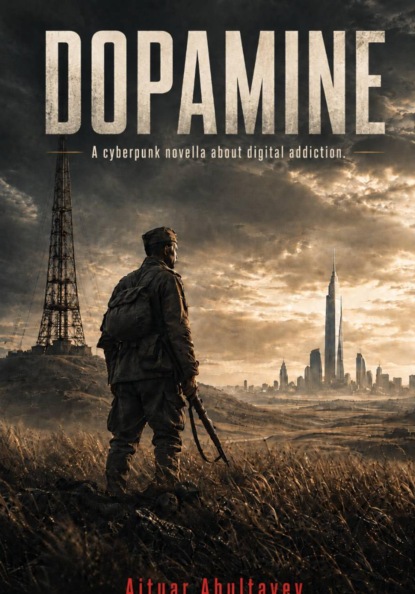
DOPAMINE
WELCOME, ERNAR SAPAROV.
CLEARANCE LEVEL 7.
“Cute,” Malika said. “Get a shot of me with it in the background.”
“Get outside the fence.”
“People have a right to know what’s happening.”
“The people are standing right behind me.”
She rolled her eyes, but stepped back.
Ernar went in alone. Dry grass crackled under his shoes. The closer he got to the base, the more the implant behind his ear itched. The system kept trying to connect to a network that did not exist.
There were no signs of tampering on the equipment cabinet. Power was on. Batteries were charged. The fiber line to the node was intact. By every technical measure, the station should have been providing service for tens of kilometers.
Ernar opened the update history. The last change matched the start of the outages to the minute: three nights earlier, the station had automatically received the ZHYLTYR package as part of the pilot group. The signature was corporate, but for some reason the delivery path ended neither in the cloud nor at the modern base station. It terminated at an unknown local node beneath it.
And yet there was no signal.
Ernar plugged in a cable directly.
The terminal woke up.
Diagnostics raced across the black screen. Most lines were routine—until an unnamed folder appeared. Creation date: October 17, 1942.
Impossible.
He opened it.
Inside was a single audio file: komanda.wav
“Find something?” Daniyar called from beyond the fence.
Ernar put on isolated headphones and played the file.
Static. Wind. The lieutenant’s voice:
“Squad, ready!”
Rifle bolts snapping.
“Aim!”
Then the high-pitched tone.
Ernar tried to pull off the headphones, but his muscles would not obey. The note opened inside his head and fractured into thousands of notification sounds. Every one promised something important: news, love, rescue, an explanation from his father. He knew that if he listened to the end, he would get an answer.
Just one answer.
A video feed appeared on the screen.
The steppe in black and white. A man with his hands tied stood with his back to the soldiers. Slowly, the condemned man turned and looked straight at Ernar.
The face was unfamiliar, but the line of the eyebrows, the shape of the nose, even the habit of biting the inside of his cheek all felt strangely familiar.
“You came too late,” the man said.
“Who are you?”
“The one they never shot.”
“Where’s my father?”
The man nodded toward something above and behind the camera.
Ernar looked up.
A man stood on a crossbeam twenty meters above the ground. No safety line. Wearing an old jacket Ernar remembered from childhood.
“Dad?” he breathed.
The man stepped off the beam.
Chapter 6. Granny
Ernar lunged forward and threw up his arms as if he could catch a falling body.
No one fell.
Rust flakes drifted down from above. A blade of sunlight cut across his eyes. The beam was empty.
“What did you see?” Malika had already pushed her camera between the fence bars.
Ernar tore off the headphones. The world tilted. People stood on the other side of the fence, but for several seconds their faces looked like flat icons: anxiety, interest, mockery. The emotion-recognition system in his lens was labeling everyone even though he had switched it off on the road.
MALIKA — ENGAGEMENT 91%.
DANIYAR — AGGRESSION 63%.
MURAT — FEAR 78%.
The label above a teenager in a red cap flickered:
USER NOT FOUND.
Ernar blinked, and it all disappeared.
“Nothing,” he said. “Visual-channel error.”
“You called somebody Dad,” Daniyar said.
“Error.”
“Handy word.”
Ernar disconnected the terminal from the station. The folder dated 1942 was gone. The audio file was not even in the cache. But the unknown frequency kept knocking through the diagnostics: three pulses, pause, three.
He stepped back outside the fence.
“The tower is technically fine. The hardware isn’t the problem.”
“Then what is?” Murat the teacher asked.
“I don’t know yet.”
“How long is the fix?” someone shouted.
“An hour? A day?”
“Are our food deliveries coming?”
“My kid’s being treated remotely!”
Malika turned the camera toward herself.
“We are standing at the epicenter of a total digital collapse,” she said in her polished presenter voice.
“A Nomad-Link expert refuses to give an estimated restoration time...”
“Stay with me. This is only the beginning—the best is yet to come. Your Malika is right here...”
Ernar covered the lens with his palm.
“Don’t stir up a panic.”
“The panic is already here. I’m making content.”
“Nobody can see it without a network.”
Malika smiled.
“We’ll see.”
On the way back, Daniyar caught up with Ernar.
“You’ve got signal, don’t you?”
“No.”
“Company channel.”
“No.”
“Then why did you get a notification?”
Ernar stopped.
“You were looking at my phone?”
“Everybody saw it.”
“You’re hiding something and you’re scared we’ll find out the truth?”
“I’m scared you’ll see something that isn’t there.”
Daniyar smirked, but his eyes stayed cold.
Back in the yard, his grandmother was crouched beside a garden bed pulling up dry stalks, as though there were no tower, no voice of his father, no crowd at all.
“Aje, come inside,” Ernar said.
“Wash your hands first.”
“Aje, I saw Dad.”
Her fingers froze in the soil.
“Where?”
“On the tower.”
Kulzhan-apa slowly straightened. There was no surprise on her face. Only the exhaustion of someone who had spent too many years waiting for an unavoidable question.
“He ran into something strange there too,” she said.
“When?”
“The night he disappeared.”
“You knew.”
“I knew only that he’d gone back there again.”
“And you told me he abandoned us.”
“I told you he left.”
“You let me hate him for twenty-eight years.”
“Hate kept you away from the tower.”
“You can’t cheat fate, Aje.”
His grandmother looked out the window toward the tower in the distance.
“Then this time it called louder.”
Ernar was silent for a moment.
“What’s wrong with this place?”
Kulzhan-apa wiped her hands on her apron.
“I don’t know. People just spent too long waiting for things there.”
“That’s not an answer.”
“It’s the only one I have.”
She went inside and returned with a tin box. Inside lay an old audio cassette, a faded photograph, and a folded sheet of paper. In the photo, a young Kulzhan-apa held baby Serik in her arms. Beside her stood the condemned man from the recording, only much older.
On the back, in his grandmother’s handwriting: “Tulegen-ata, my grandfather. 1978. Do not listen to the recording after sunset.”
“That’s your grandfather?”
“My grandfather. Your great-great-grandfather.”
“I kept quiet back then because that tower called to our family harder than it called to anyone else. Tulegen-ata used to say that if a person waits near that place for too long, one day the signal starts passing through them. And our family has been waiting here for generations.”
Ernar wanted to ask why their family, but his grandmother continued:
“After what happened during the war, he lived almost forty more years,” Kulzhan-apa said.
“But every evening he heard the command that was never given.”
The radio crackled again.
Through the static came Serik’s voice:
“Mom, open the door this time.”
Chapter 7. Three Bars
Kulzhan-apa went pale, but she did not move toward the door.
The radio sat on the table. Its tuning scale glowed a faint green even though the batteries had leaked dry years ago. Serik’s voice came through the static again:
“Mom... I’m cold.”
Ernar stepped toward the radio.
His grandmother slapped his hand away so quickly he recoiled.
“Don’t answer.”
“It’s a recording.”
“A recording doesn’t know I’m in the house.”
“We can trace the source.”
“Your father wanted to trace it too.”
The voice seemed closer now.
“Ernar, balam. Is that you? Look how grown you are.”
Ernar’s breath caught. The last time he had heard his father’s voice, he was seven—not the voice itself, really, but a memory of it, long since worn away and replaced by family videos. Yet now every inflection was real: the soft roll of the r, the quick breath before a question.
“Turn it off,” his grandmother whispered.
Ernar covered the radio with a metal pot. The static did not stop. He wrapped the set in a blanket, carried it outside, and put it in the old stove. Only then did the voice cut out.
Back in the kitchen, Kulzhan-apa poured tea. Her hands were shaking, and the spoon kept chiming against the glass.
“Tell me everything, Aje,” Ernar said.
“Not everything can be put into words.”
“Start with Dad.”
She watched the steam rise from her cup for a long time.
Serik had worked as a technician at the tower. In the late 2000s, the equipment was being replaced and the first digital line was laid. He found an old cable running down into the earth beneath the concrete base. It appeared on no schematic. When they cut it, the entire village lost power for several minutes—and phones began ringing at the same time in dozens of houses, phones no one could find.
After that, Serik started seeing things. Different people appeared to him near the tower, including a man in military uniform.
“The lieutenant?” Ernar asked.
“Sometimes the lieutenant. Sometimes his father. Sometimes you. Grown up.”
“Me?”
“He said you were calling to him from the future.”
A group of children walked past the window, phones held out in front of them.
At one point they all turned their heads toward Aje’s window at exactly the same time, then kept walking without slowing down.
“The night Serik disappeared, he came home and said he’d found a way to shut the signal down,” his grandmother continued. “He wanted to reach the soldiers in 1942 and convince them not to give the command. He recorded everything he knew on a cassette, left it with me, and went to the tower. Nobody saw him again.”
“Why didn’t the police—”
“They searched for Serik. But they barely looked at the tower. Nobody had any reason to connect his disappearance to that place. And who would’ve believed me?”
Ernar rubbed his temples.
“Aje, this sounds like superstition.”
“Call it superstition if you want. I’ve seen what it does to people.”
The phone in his pocket gave a short vibration.
He took it out. The signal indicator showed three bars.
Not one. Not a weak emergency channel. Full signal.
“You have internet,” his grandmother said.
“I shouldn’t.”
Ernar switched to secure mode. Data packets moved with no delay. There was no satellite lock; the device believed it was connected to a base station called KARASU-0—the one with the all-zero ID.
A message from Aigerim appeared:
Are you okay? I’m angry. But answer me.
He typed: Yes. Network unstable. Don’t come.
The message went through.
Kulzhan-apa watched him without blinking.
“Don’t show anyone.”
“Why?”
“Because a starving man asks for a piece of bread first. Then he asks why you have the whole loaf.”
Footsteps sounded in the yard. Someone pounded on the gate.
“Ernar!” Malika shouted. “Open up! I just got a notification saying you’re back online.”
Ernar froze.
“What notification? There’s no internet.”
He looked at his phone. For one second, a single bar glowed beside the network icon.
Then it vanished.
People were already gathering outside the gate.
Chapter 8. A Voice in the Static
Ernar went into the yard without his phone. He had left it in the bedroom, wrapped in shielding fabric from his work kit.
Malika, Daniyar, and about twenty others stood outside the gate. Some held their devices out in front of them like compasses.
“What do you want?” Ernar asked.
“Internet,” several voices answered at once.
Malika showed him her screen. A system notification was displayed there:
USER ERNAR_S IS BACK ONLINE.
“I’m not registered under that name.”
“Everybody got it,” Daniyar said.
People nodded. The same line glowed on all their screens.
“It’s a local broadcast. Fake notifications.”
“But you sent a message,” Malika said.
“To who?”
“Doesn’t matter. We saw the outgoing packet.”
Ernar caught the word packet. Malika knew next to nothing about networks. Either someone had fed her the term—or her device was showing her more than it should.
“My work module sometimes catches a backup channel,” he lied. “It’s closed and diagnostic-only.”
Malika gave him an irritated look.
“Then hotspot it. Why are notifications coming through if the internet doesn’t work? This is getting insulting.”
“I can’t.”
“Why do you get it and we don’t?”
“Because I’m using it to try to restore service for everybody.”
“Convenient,” Daniyar mocked. “We’re losing our minds out here while you’re texting your girlfriend.”
Ernar understood. They knew who the message had gone to.
“Where did you get that?”
Daniyar held up his phone. White letters glowed on the black screen:
HE TOLD HER NOT TO COME.
The crowd stirred.
“Who’s ‘her’?”
“So there is a connection!”
“Make him call the doctors!”
“My mother’s running out of insulin!”
“I need to confirm a loan!”
“My kid can’t log in to his school profile!”
The demands piled on top of one another until they became one many-voiced roar. Insulin. Loan. School profile. A call to family. Ernar raised a hand, but nobody quieted down.
“Give me until morning,” he said.
“Why morning?” someone asked.
“Because nobody goes out there at night.”
He had not meant to say that. The words slipped out on their own.
For one second, the yard went silent.
Malika narrowed her eyes.
“What happens at night? Does the signal come back?!”
Kulzhan-apa came out of the house and stopped by the gate.
“It’s best not to go near the tower after sunset,” she said.
A few people snickered.
“Apa, we’re not kids.”
“Kids at least know when it’s time to be afraid.”
Daniyar looked toward the tower.
Even from here, they could see two teenagers already climbing the steel frame.
“So what happens after sunset?”
Kulzhan-apa said nothing.
Then Daniyar’s phone came alive.
At almost the same moment, several dim lights blinked on at the tower. One by one, status indicators lit across the equipment.
Ernar looked up.
The tower seemed to wake.
Daniyar’s screen flooded with light and game music burst from the speaker. A holographic team emblem appeared above the device. Daniyar shouted with joy.
“Yes! Internet’s back!”
Everyone rushed toward him.
Ernar grabbed the guy by the shoulder.
“Turn it off.”
“Get off me!”
A match was playing on the screen. Daniyar’s teammates yelled through the voice channel, calling him by his handle. He laughed and cried at the same time, frantically hammering the virtual controls.
“That isn’t the network,” Ernar said. “This game’s servers were shut down five years ago.”
Daniyar was no longer listening.
One phone after another lit up. People received messages, calls, transfers, likes. Dozens of faces glowed from below in screen light. Almost blissful smiles spread across them.
Malika went live.
“We’re back online,” she whispered. “I knew you were waiting for me.”
Конец ознакомительного фрагмента.
Текст предоставлен ООО «Литрес».
Прочитайте эту книгу целиком, купив полную легальную версию на Литрес.
Безопасно оплатить книгу можно банковской картой Visa, MasterCard, Maestro, со счета мобильного телефона, с платежного терминала, в салоне МТС или Связной, через PayPal, WebMoney, Яндекс.Деньги, QIWI Кошелек, бонусными картами или другим удобным Вам способом.
Вы ознакомились с фрагментом книги.
Для бесплатного чтения открыта только часть текста.
Приобретайте полный текст книги у нашего партнера:
Полная версия книги
Всего 10 форматов