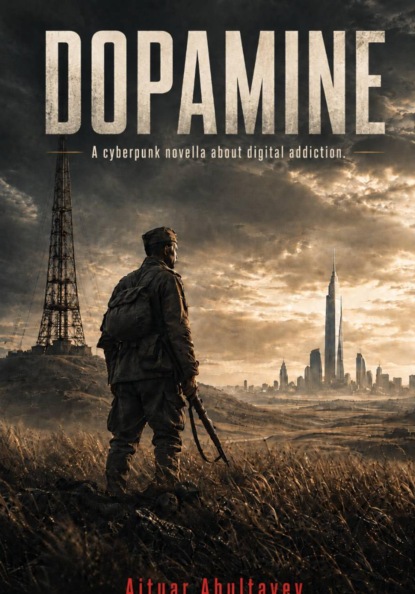
Полная версия:
DOPAMINE

Aituar Abultayev
DOPAMINE
DOPAMINE
Aituar Abultaev
When a person hands the machine the job of giving life meaning, when the signal goes down, so do they.
— The Author
PROLOGUE — AIM
Autumn came early to the steppe in 1942. At night, a skin of ice already tightened over the ground; by day, the wind drove ash-gray clouds across a low sky, as if some distant fire were burning beyond the horizon.
At dawn, four men walked from the village toward the radio tower.
Two were soldiers with rifles. The third was a lieutenant. The fourth wore no hat, his hands tied behind his back with telephone wire. The wire was new and black and smelled of rubber and machine oil. As he walked, the condemned man kept brushing his boots through the dry feather grass, as though trying to memorize the sound.
“Stop,” the lieutenant ordered.
They halted at the tower’s concrete base. Against the endless steppe it looked impossibly tall. Steel latticework climbed into the morning mist. At the top, a loudspeaker horn swayed in the wind.
They used to broadcast war reports from here. Back then, the whole village would crowd around its only radio: women twisting handkerchiefs in their fists, old men staring at the floor, children learning not to ask questions.
But six months ago the tower had gone silent. Almost no one came here anymore.
The lieutenant took out a papirosa, lit one for himself, then placed another between the condemned man’s lips. The man did not thank him. His name was Tulegen, though it had been misspelled on the charge sheet. A mistake in his name, a mistake in the sentence—and he was going to die for both.
“Last words?” the lieutenant asked.
“To whom?”
One soldier gave a nervous snort. The other turned toward the steppe.
The lieutenant yanked the cigarette from Tulegen’s mouth and dropped it at his feet.
“Five steps forward.”
Tulegen took five. On the sixth, he stopped on his own. Closed his eyes. The wind shoved him between the shoulder blades, and for one instant he thought it was already the bullet.
The lieutenant unfolded the paper.
The words—treason, sabotage, ties to the enemy—rang hollow. The wind carried them off at once. Tulegen was not listening to the charges. He was listening to the horn above him. For the past three nights, he had heard whispering inside it. The tower stood near the place where he was being held, at the edge of the village. At night, everything went still. Now and then wolves howled out on the steppe, and in the silence that followed, the whisper from the horn became unmistakably clear.
There was no power running to the tower. It should not have made a sound. Yet the whisper repeated the voices of people from the village—their pleas, their fears, their prayers. Sometimes the horn spoke in the voice of Tulegen’s dead brother.
“Squad, ready!” the lieutenant called.
The rifle bolts snapped almost as one.
Tulegen breathed in the smell of cold earth.
“Aim!”
The rifles came up. Their barrels settled behind his back.
Tulegen closed his eyes.
The lieutenant drew breath.
But he never got the chance to give the order to fire.
The horn at the top of the tower came alive.
First came static. Then a firm voice every one of them knew said:
“This is the Soviet Information Bureau...”
The soldiers froze. The lieutenant looked up.
The voice cut out. A thin, piercing tone spilled from the horn. It was higher than a human scream and deeper than the roar of a diving Messerschmitt, a sound Tulegen had heard more than once at the front. It slipped beneath his skin, ran up his spine, and lodged somewhere deep inside his skull, as if it had found the place where his thoughts were born.
Inside that single note he heard everything he had waited for all his life: his mother’s voice, a verdict of acquittal, the laughter of children not yet born, a promise that the war would end tomorrow.
Then silence.
The order to fire never came.
Tulegen waited. One second. Two. Three.
Then he opened his eyes and slowly turned around.
No one was there.
Two rifles lay on the ground. Perfectly straight, as if the soldiers had carefully set them down before vanishing. The lieutenant’s cigarette still smoldered nearby. The charge sheet had snagged in the dry feather grass, and the wind kept tugging at it without managing to tear it free.
Tulegen backed away and looked up. Every part of him wanted to run, but he could not tear his eyes from the horn.
The lieutenant’s voice came from it, quiet now, almost childlike:
“Fire?... Why didn’t you say ‘fire’?”
Tulegen broke into a run across the steppe.
Behind him, the tower sent an invisible signal into the sky. And the farther he ran, the more clearly he heard a chime that did not yet exist: the short, cheerful ping of a new message.
PART ONE — NO SIGNAL
Chapter 1. Glitch
Almaty, 2036.
The city lived by algorithmic schedule. Office-tower facades changed their ads to match the expressions—and inferred thoughts—of people passing below. Driverless buses slid between streams of pedestrians, while delivery drones buzzed overhead in neatly regulated flight lanes.
The snowcapped peaks of the Trans-Ili Alatau reflected in the glass facade of Nomad-Link’s high-rise headquarters—the one thing in sight that still had not learned how to personalize itself.
Thirty-five-year-old Ernar sat on the forty-second floor, surrounded by transparent screens. One showed a map of the country pulsing with green dots of network coverage. Another displayed a security dashboard full of anomalous requests. On a third, the company assistant ZHYLTYR was calmly explaining why there was no threat.
“You don’t know whether there’s a threat,” Ernar muttered. “You only know which sentence I want to read.”
ZHYLTYR answered at once in a soothing voice:
“Your skepticism improves decision quality.”
“Exactly.”
A coworker in the next cubicle raised an eyebrow.
“Talking to the machine you don’t trust again?”
“So it remembers its place.”
“Does it know yours?”
Ernar did not answer. A name flashed across his personal display: GRANNY.
He smiled before he even realized he was doing it and accepted the video call.
The camera showed a low-ceilinged room with whitewashed walls. A lace curtain hung over the window, gray autumn light trembling behind it. Kulzhan-apa sat at the table, holding the phone much too close to her face.
“Balam, you’re skinny again,” she said instead of hello.
“It’s the wide-angle lens.”
“A lens doesn’t feed you.”
“We get free food at the office.”
“Free food never has a soul.”
She laughed. Ernar did too. Around his grandmother, laughter still came easily.
“When are you and Aigerim finally coming?” she asked. “Am I going to see you in person before the wedding, or only through a screen? Or has she figured out how stubborn you are and run away already?”
“The wedding’s in a month.”
“A month is enough time to change your mind thirty times.”
The connection jerked. Kulzhan-apa’s face broke into squares, then snapped back together.
“See?” she said. “That tower’s acting up again. Signal comes, signal goes. Yesterday I couldn’t even buy bread. Ever since they got rid of cash, everything’s by palm scan. I put my hand down, but the register won’t work without the network. I tell the clerk, I know the price. He says, can’t do it, we’ll get fined—the system sees everything. The system matters more than a grandmother now.”
“I’ll check it remotely.”
“At this rate you’ll get married remotely too.”
They both laughed.
Something flickered behind her.
Ernar stopped smiling.
At first he thought it was a compression artifact: a dark vertical stripe by the doorway. Then the stripe stepped into the room.
The lieutenant. Two soldiers behind him. Gray greatcoats, side caps, rifles. The image was black-and-white, yet it overlaid his grandmother’s full-color room with no transparency at all.
“Aje,” Ernar said softly. “Who’s there with you?”
Kulzhan-apa smiled as if she had not heard him.
The lieutenant stopped behind her chair and unfolded a yellowed sheet of paper.
“Aje, turn around.”
“What is it, balam?”
The two soldiers raised their rifles.
Ernar shot to his feet. His chair slammed into the divider.
“AJE!”
The lieutenant looked straight into the camera. His face was young and deathly tired.
“Fire,” he said.
Kulzhan-apa jerked. Her forehead struck the table. The phone toppled onto its side. Her motionless hand filled the screen.
The call dropped.
Ernar stood among his frozen coworkers, one palm pressed against the empty air where his grandmother’s face had been a second earlier.
Then his phone rang again.
The screen read: GRANNY.
Chapter 2. The Second Call
Ernar could not make himself touch the button at first. His finger was shaking so badly he missed it twice.
“Balam?” Kulzhan-apa appeared on the screen alive, annoyed, and perfectly calm. “Why are you yelling?”
Ernar sat down right there on the floor.
“You... fell.”
“I’m sitting.”
“There were people there.”
“What people?”
“Soldiers. Behind you.”
His grandmother turned to look. The room was empty.
“It’s just me and the kettle. The kettle isn’t in uniform.”
Someone in the office let out an awkward little laugh. The department head came closer, but Ernar raised a hand: not now.
“Show me the table.”
“Why?”
“Just show me.”
Kulzhan-apa panned the camera across it. A cup sat on the oilcloth beside a saucer of candy and an old radio. No blood. No sign of a struggle. And the phone was still in her hand.
“You shouted and the connection died,” she said. “So I called back. You’re looking at me like you just buried me.”
Ernar scrubbed back through the call recording. The system had saved the last twenty seconds in its local cache. His grandmother smiling. The soldiers. Rifles coming up. Her fall. It was all there.
“Aje, don’t leave the house. I’m coming.”
“Today?”
“Now.”
“It’ll be dark soon.”
“I’m leaving.”
He ended the call and got to his feet. Half the office had gathered around him. Someone was recording through a contact lens. Ernar snapped a hand in front of the person’s face.
“Delete it.”
“I’m not—”
“Your indicator’s blinking.”
His manager, Temirlan, pulled him into a conference room. The glass walls turned opaque.
“Okay. Calm down and show me the recording.”
The walls faded to a pale gray.
Ernar sent the file to an isolated display. The video played without sound. Temirlan watched carefully, but by the end his expression had changed to wary concern—the look you gave a coworker who might be having a breakdown.
“Deepfake,” he said.
“In real time?”
“A malicious filter. Video-stream substitution. You’re the one who taught us anything can be spoofed.”
“Not anything.”
“Then your implant’s compromised.”
Ernar touched the small scar behind his ear without thinking. A neuroport sat under the skin, with a removable module clipped to the outside. It let him access internal systems, connect to secure channels, and control displays.
Ernar hated having hardware that close to his brain, but without the neuroport he would never have been cleared for his job.
“I’ll check the logs,” he said.
“You’re taking the day off.”
“The base station in the village is lagging.”
“Techs will go out in the morning.”
“I’m going now.”
Temirlan let out a long breath.
“You can’t take the company terminal with you.”
“I don’t need the terminal.”
“You need a doctor.”
Ernar stood.
“Put me on unpaid leave.”
“Ernar...”
“Or fire me. Pick whichever loads faster.”
Aigerim called while he was in the elevator. Her face appeared on the inside of his contact lens: short dark hair, tired eyes, white coat. Robotic hospital gurneys moved behind her through the city clinic.
“Someone messaged me that you made a scene,” she said.
“Gossip travels faster than light.”
“What happened?”
He wanted to tell her. Instead he said:
“My grandmother’s having network problems. I’m going to the village.”
Aigerim was quiet longer than usual.
“We’re meeting the wedding coordinator today.”
“Reschedule.”
“You picked the date.”
“This is urgent.”
“Everything is urgent to you except the people standing right next to you.”
The elevator doors opened. In the lobby, people walked through advertising holograms without looking up from their personalized feeds.
“I’ll call from the road,” Ernar said.
“You’re always calling on the move. You hardly ever show up.”
The connection cut out.
In the parking garage, the autonomous car asked for a destination. Ernar named the village. The system warned him that the final forty kilometers of the route were not verified on the digital map.
“Continue?” the car asked.
“Yes.”
“Network coverage at your destination is unstable. Some functions will be unavailable.”
“I know how to drive.”
“According to your profile, you last drove manually five years ago.”
“Then today I’ll remember.”
Once the car left the city, Ernar played the call recording again.
This time, after the lieutenant gave the order, his grandmother did not fall.
She slowly lifted her head and looked into the camera. Her lips silently formed the words:
“Don’t bring them the signal.”
Chapter 3. The Road Off the Map
Until dawn, the car behaved perfectly. Then the navigation system started inventing interchanges that did not exist in the steppe.
Translucent arrows kept appearing on the windshield: turn right in one hundred meters, take the side road, keep left. To the right ran a dry gully. To the left, a field choked with wormwood.
Ernar switched off autopilot and took the wheel.
For the first few minutes, Ernar gripped the wheel too hard. Ten minutes later, muscle memory kicked in, along with what an advanced driving instructor had once drilled into him: don’t stare at the road just over the hood, know where the car ends, don’t fight the road.
Oddly enough, it was the road back to the village that made him think of his father.
He had vanished when Ernar was seven. His grandmother said Serik had gone away for work and never come back.
After that, his mother moved to the city, while Ernar stayed with Kulzhan-apa until he finished school. Years later, his mother died after a short illness, when he was already at university. Ernar had stopped asking where his father went a long time ago. If anyone brought it up, he gave the shortest answer possible: missing.
The phone on the passenger seat flashed.
New message from: DAD.
Ernar slammed on the brakes.
The car fishtailed on the gravel and stopped sideways across the road.
The notification vanished.
He checked the log. Nothing. The cloud: nothing. Local cache: nothing. He’d never had anyone saved in his contacts as DAD.
“Phantom notification,” Ernar said aloud.
The words sounded convincing right up until a man’s voice came from the powered-down audio system:
“Easy on the turns, balam.”
Ernar ripped out the power module. The display went black. The voice stopped.
He drove the rest of the way in silence.
By noon, the first houses appeared. Karasu lay between low hills, with open steppe stretching beyond it all the way to the horizon.
The tower rose above the roofs—not the thin wartime structure Ernar remembered from archive photos. Its old metal frame had grown layers of panels, antennas, and rings of signal boosters. A laser relay turned at the top. White base-station pods hung below. Everything flashed in the sun like a chunk of satellite had crashed into the steppe.
A line of cars waited at the entrance to the village.
People were arguing at the automated barrier. It would not open without network authorization, and the guard refused to raise it manually: regulations said he could not.
“My medicine is in a delivery!” a woman shouted.
“My pass is valid!”
“The app took my money, but it won’t show the payment!”
“Just open the damn thing, ata!”
The guard, a wiry old man in a worn quilted jacket, calmly drank tea from a metal mug.
Ernar got out, found the mechanical lock beneath the panel, and broke the plastic seal.
“There’ll be a fine,” the guard warned him.
“They can send me a notification.”
Ernar discreetly showed the guard his company badge.
The old man smirked.
“Then there won’t.”
The barrier lifted. People surged forward without even looking at Ernar. Every one of them was staring at a screen, checking for signal.
Only the guard asked:
“You’re Kulzhan’s boy, aren’t you?”
“Her grandson.”
“You look like your father.”
Ernar tensed.
“You knew him?”
“Everybody knew everybody here. Before phones taught us how to forget.”
“What’s wrong with the tower?”
The old man looked toward it.
“It isn’t breaking. It’s waking up.”
Ernar was about to ask what he meant when happy shouting erupted behind him. Somebody had one bar. People raised their phones over their heads and started running toward higher ground.
The guard set his mug on the ground.
“The old folks used to say people ran like that to the radio when they were waiting for news from the front,” he said. “Back then, they were afraid of hearing bad news. Now they’re afraid of hearing nothing at all.”
Ernar’s phone vibrated.
A message from his grandmother appeared on the screen:
“Don’t come inside. Someone’s here.”
Chapter 4. The Village That Watches
Kulzhan-apa’s street began behind the school. Ernar drove slowly. Up ahead, a crowd had gathered in the middle of the road. People were arguing loudly, talking over one another, demanding answers. He eased around them.
Farther on, a man stood on the roof of a truck trying to catch a signal. Two teenagers had climbed the water tower. A schoolgirl held a tablet over her head and cried as she kept repeating:
“Just a little more. One bar. Please, just one.”
Karasu had changed, though at first glance it looked the same: low houses, dusty yards. Now smart cameras hung from the walls, solar panels glittered on the roofs, and a parcel locker stood outside the shop—without the internet, nothing but a dead metal box.
The gate at his grandmother’s house stood open. Ernar stopped the car and reread her message. It showed as delivered two minutes earlier, even though his signal indicator was at zero.
He went into the yard.
Herbs dried beneath the awning. Apples filled a washbasin. From the summer kitchen came the small clink of a spoon against a cup.
“Aje?”
“I’m here, balam.”
Kulzhan-apa sat at the table exactly as she had during the call. The old radio stood in front of her. The corner behind her, just like on the video, was empty.
Ernar hugged her too hard. She patted his back.
“You’ll break my bones. Then you’ll have to take care of me yourself.”
He pulled away and checked her face, her hands, her neck.
“You texted me that you weren’t alone.”
“I did no such thing.”
He showed her the screen.
His grandmother read the message and frowned.
“The phone was right here.”
“Then who could’ve used it?”
“Nobody. I don’t lock the door. Not against people.”
“What do you lock it against?”
She looked up. Fear flashed in her eyes for a second, then disappeared behind her usual sternness.
“Eat first.”
“Aje.”
“On an empty stomach, even the truth sounds stupid.”
Ernar sat down. While she ladled out sorpa, he connected a diagnostic module to her phone. It found no malicious apps. But the network log showed repeated requests from an unknown base station: an ID made entirely of zeroes, broadcasting on a frequency outside every standard band.
The maintenance log held another surprise. Three days ago at 2:17 a.m., Nomad-Link had automatically added Karasu to an unstable-connectivity pilot group and remotely pushed the ZHYLTYR package to its base station—a module designed to preserve service during outages.
The local technician had requested nothing. More importantly, ZHYLTYR was supposed to run in the cloud environment, not on the station itself.
Thirty-seven seconds after the upload, the logs recorded the first response from an unknown node with an all-zero ID. Before that night, it had never appeared on the network.
“When did the outages start?”
“Three days ago. First at night. Then during the day. Yesterday the tower started talking.”
Ernar stopped eating.
“What do you mean... talking?”
“What did it say?”
“Not words. More like somebody tuning an old radio, searching for a station.”
She turned the radio dial. The speaker hissed on a dead frequency.
“That radio hasn’t worked in twenty years.”
“So it had a good rest.”
A rhythm emerged from the static: three short pulses, a pause, three more. Ernar recorded it.
“Where’s your father?” his grandmother asked suddenly.
“You tell me.”
Kulzhan-apa flinched as if the question had come from someone else.
“He left.”
“Where?”
“Far away.”
“Aje, you’ve been saying that for twenty-eight years.”
“Then the answer hasn’t changed.”
A rumble rose from the street. People were running toward the house.
Malika burst in first—a local blogger Ernar remembered as a little girl with braids. Now even in person, not just on-screen, her face looked retouched: too smooth, too perfect. A streamer implant glimmered above her temple.
A faded hospital wristband hung from her key ring, far too small for an adult. When she noticed Ernar looking at it, Malika closed her hand around it.
“Ernar?!” She swung her camera toward him. “Guys, look who it is—our big-city cyber expert. Tell my followers when the internet’s coming back.”
“Come on. You don’t even have a connection.”
“I’m recording offline. I’ll post it later.”
Neighbors crowded in behind her.
“The shop can’t operate.”
“Electronic prescriptions won’t open.”
“The kids are losing it.”
“You have company access, don’t you?!”
Dozens of eyes shifted toward Ernar’s phone at once.
He shoved it into his pocket.
“I’m checking the tower first.”
“Check it now,” said a tall guy in a gaming jacket. “I’ve got a tournament. Miss one day and they replace me. My channel’s small, but if we make the finals, people will start watching.”
“Your name’s Daniyar, right?”
“Dan. Online I’m KhanZero. Same name on stream.”
“And offline?”
The guy did not understand the question.
A voice came from the old radio on the table.
Quiet, distorted—but unmistakable.
“Ernar... don’t give them the phone.”
Everyone went silent.
It was his father’s voice.
Chapter 5. The Tower
They walked to the tower. An automated service drone blocked the path: four metal legs, a Nomad-Link logo on its body, a camera where its head should have been. A red beam swept over Ernar.
“Access confirmed,” the drone announced. “Security Engineer Ernar Saparov. Clearance level: seven.”
Ernar stopped.
“I didn’t request access.”
“Request received by local node.”
“The local node is offline.”
“Correct.”
“Who approved me?”
The drone turned its camera toward the tower.
Behind him, Malika gave a nervous laugh. She had followed after all, along with Daniyar, Murat the schoolteacher, and several teenagers. Kulzhan-apa had stayed home, but before he left she had grabbed her grandson by the wrist.
“Don’t listen if it calls you in the voice of someone you love.”
Now the words sounded louder in his head than the wind.
The fence around the tower was new, made of composite material and designed for unmanned security. The gate opened on its own. A message lit up on the inner panel: