Полная версия:
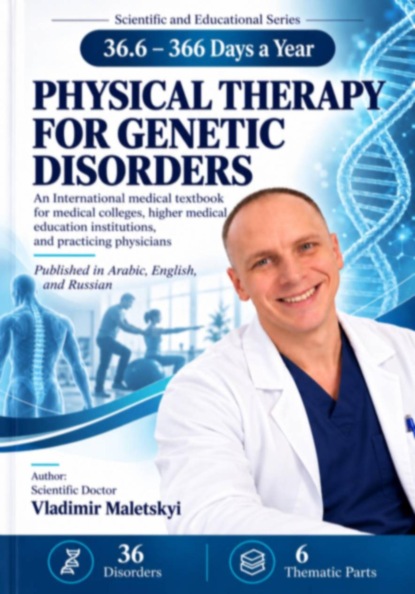
Physical Therapy for Genetic Disorders

Владимир Малецкий
Physical Therapy for Genetic Disorders
Copyright
Physical Therapy for Genetic Disorders 36.6 — 366 Days a Year, Book 1
Copyright 2026 Vladimir Maletskyi. All rights reserved.
First edition. English language edition. Published in Arabic, English, and Russian.
Published by Vladimir Maletskyi Press.
No part of this publication may be reproduced, distributed, or transmitted in any form or by any means without the prior written permission of the author, except as permitted by applicable copyright law.
Medical Disclaimer
This textbook is intended for medical education, scientific reference, and professional development.
The information presented is not a substitute for individualized clinical assessment, professional medical judgment, or applicable clinical guidelines.
Physical therapy and rehabilitation interventions must be selected according to the patient's diagnosis, clinical condition, functional status, contraindications, and individual needs.
Medical knowledge and clinical recommendations evolve over time. Readers should consult current scientific evidence, relevant clinical guidelines, and applicable professional standards before implementing any diagnostic or therapeutic approach.
The author and publisher do not guarantee specific clinical outcomes from the application of the methods discussed in this publication. Clinical decisions and patient care remain the responsibility of appropriately qualified healthcare professionals.
Publication Information
Series: 36.6 — 366 Days a Year Book 1: Physical Therapy for Genetic Disorders Language: English Publication Year: 2026
Abstract
Physical Therapy for Genetic Disorders is a specialized medical textbook by scientific doctor Vladimir Maletskyi, devoted to contemporary approaches to physical therapy, medical rehabilitation, and functional support for patients with hereditary disorders.
The publication is part of the authors scientific and educational series 36.6 — 366 Days a Year, united by the idea of continuous care for human health, the advancement of medical knowledge, and the improvement of clinical practice.
The textbook is based on a systematic study of 36 hereditary and genetically determined disorders grouped into six thematic parts.
Each of the 36 chapters addresses an individual disorder or a group of related genetic disorders and follows a uniform ten-section framework, progressing from an understanding of genetic mechanisms and clinical manifestations to the development of an individualized physical therapy program, prevention of complications, and recommendations for the patient.
The textbooks principal distinguishing feature is its combination of fundamental medical knowledge with practical principles of rehabilitation.
Disorders are considered not only as genetic diagnoses but also in terms of their effects on movement, muscle strength, coordination, independence, learning ability, social adaptation, and quality of life.
Structure of the TextbookPart I. Hereditary Muscle Diseases
The first part is devoted to disorders involving primary damage to muscle tissue, progressive muscle weakness, contractures, and impaired motor function.
It covers Duchenne and Becker muscular dystrophies, limb-girdle muscular dystrophies (Erb–Roth), facioscapulohumeral muscular dystrophy (Landouzy–Dejerine), myotonic dystrophy (Steinert), and Emery–Dreifuss muscular dystrophy.
Particular attention is paid to maintaining motor activity, appropriate exercise dosing, prevention of contractures, orthopedic support, and monitoring of cardiac and respiratory complications.
Part II. Hereditary Disorders of the Nervous System
The second part examines hereditary neurological disorders involving motor neurons, peripheral nerves, neural pathways, and structures of the central nervous system.
It includes spinal muscular atrophy, Charcot–Marie–Tooth disease, hereditary spastic paraplegia, Friedreich ataxia, ataxia-telangiectasia (Louis–Bar syndrome), and Huntington disease.
The main areas of physical therapy include maintaining functional mobility and independence, correcting gait and balance impairments, reducing the functional consequences of spasticity and ataxia, preventing falls, and helping patients adapt to progressive neurological limitations.
Part III. Genetic Syndromes
The third part addresses genetic syndromes in which motor development disorders may coexist with cognitive, behavioral, sensory, and systemic manifestations.
It examines Down, Joubert, Rett, Angelman, and Prader–Willi syndromes, as well as fragile X syndrome.
Special importance is given to early intervention, development of motor skills, support for communication, promotion of independence, creation of a safe environment, and interdisciplinary care for patients of different ages.
Part IV. Hereditary Skeletal Disorders
The fourth part is devoted to disorders associated with congenital abnormalities in bone and cartilage formation, skeletal deformities, joint instability, and orthopedic complications.
It includes achondroplasia, osteogenesis imperfecta, diastrophic dysplasia, campomelic dysplasia, Larsen syndrome, and congenital spondyloepiphyseal dysplasia.
Topics include safe physical activity, prevention of fractures and secondary deformities, orthotic management, functional adaptation, and specific considerations for rehabilitation in patients with increased bone fragility or spinal instability.
Part V. Hereditary Connective Tissue Disorders and Multisystem Syndromes
The fifth part brings together disorders in which abnormalities of connective tissue, the musculoskeletal system, and internal organs require special consideration when prescribing physical exercise.
It examines Marfan syndrome, Ehlers–Danlos syndromes, Bethlem myopathy, tuberous sclerosis, neurofibromatosis type 1, and Wilson disease.
The emphasis is on assessing individual risks, preventing injuries to joints and soft tissues, addressing cardiac and neurological complications, and combining motor rehabilitation with specialized medical follow-up.
Part VI. Hereditary Metabolic Disorders and Lysosomal Storage Diseases
The final part addresses hereditary metabolic and lysosomal disorders that can cause progressive involvement of muscles, the nervous system, the skeleton, and internal organs.
It examines Pompe disease, Hurler syndrome, Hunter syndrome, Gaucher disease, metachromatic leukodystrophy, and Niemann–Pick disease type C.
Particular attention is paid to combining modern disease-specific treatments with medical rehabilitation, preserving functional independence, preventing respiratory and orthopedic complications, and maintaining quality of life in progressive disease.
Uniform Framework for Each ChapterEach chapter of the textbook is organized into ten consecutive sections:
1. General characteristics of the disorder — genetic causes, inheritance pattern, pathogenesis, prevalence, and principal features of the disorder.
2. Clinical presentation — characteristic symptoms, age of onset, functional impairments, and potential complications.
3. Goals of medical rehabilitation — identification of individual objectives, functional priorities, and expected outcomes.
4. Therapeutic exercise — principles of designing an exercise program, dosing of physical loads, and development and preservation of motor skills.
5. Massage and device-based physiotherapy — potential symptomatic methods, their limitations, safety considerations, and assessment of clinical appropriateness.
6. Orthopedic and functional rehabilitation — prevention of deformities and contractures, use of orthoses and assistive devices, and adaptation of everyday activities.
7. Rehabilitation for systemic and coexisting disorders — specific considerations for patients with involvement of the heart, respiratory system, nervous system, and other organ systems.
8. Contraindications and limitations — conditions and clinical risks requiring modification or temporary suspension of rehabilitation interventions.
9. Recommendations for patients and relatives — organization of home-based assistance, prevention of complications, support for independence, and training in safe caregiving.
10. Conclusion — key clinical and practical findings that determine the rehabilitation strategy for the specific disorder.
This structure enables a consistent progression from theoretical understanding of a disorder to practical decisions needed in the day-to-day work of medical professionals.
International Educational FormatThe textbook is intended to be available in three language versions: Arabic, English, and Russian.
The Arabic, English, and Russian editions are designed to broaden access to professional knowledge and to apply a common educational concept across different countries.
Intended ReadershipThe publication is recommended as educational and reference literature for students at medical schools and colleges, students at higher medical education institutions, and specialists in physical therapy and medical rehabilitation.
The textbook is also of practical interest to rehabilitation physicians, neurologists, orthopedists, pediatricians, medical geneticists, physiotherapists, and other professionals involved in the comprehensive care of patients with hereditary disorders.
The material can be used for independent professional study, preparation of thematic classes, discussion of clinical cases, and planning of individualized rehabilitation programs.
Concept of the Publication36.6 is more than the title of a medical series. It symbolizes the continuity of medical knowledge and care for human health throughout all 366 days of the year. The series 36.6 — 366 Days a Year embodies a clinical credo: the symbol of normal body temperature and the number of days in a year, brought together in a single title, remind us that caring for health is an everyday commitment rather than a one-time course of treatment.
The patient is at the center of this textbook: not only the diagnosis, but also the persons ability to move, communicate, learn, work, and retain the greatest possible degree of independence.
A genetic diagnosis identifies the cause of a disorder. Medical rehabilitation helps identify a persons capabilities.
This is the principle to which scientific doctor Vladimir Maletskyis book Physical Therapy for Genetic Disorders is dedicated.
Why This Book Is a Significant ContributionFirst. This is a textbook in which genetics and physical therapy are treated not as parallel disciplines but as a unified clinical approach. Genetic disorders cease to be viewed as a sentence and instead become conditions to which rehabilitation technologies can be applied.
Second. The book was written by a scientific doctor with substantial international experience working with patients with genetic disorders. Behind every chapter are clinical experience, knowledge of the evidence base, and an understanding of what actually works in clinical practice and what remains theoretical.
Third. The series 36.6 — 366 Days a Year is a philosophy that places the patient, rather than the diagnosis, at its center. Thirty-six disease entities, 366 days a year, and normal body temperature are three meanings that remind us that rehabilitation accompanies a person throughout the year, not only during treatment. The book teaches systematic thinking, patience, and respect for movement.
Fourth. The trilingual publication serves as a bridge between medical schools. Arabic, English, and Russian span regions with different healthcare systems but a shared challenge: hereditary disorders require rehabilitation, while professionals trained to provide it remain in short supply.
Vladimir Maletskyi | 36.6 — 366 Days a Year | Physical Therapy for Genetic Disorders
Chapter 1. Duchenne Muscular Dystrophy
Part I. Hereditary Muscle Diseases
Duchenne Muscular Dystrophy (DMD)
1. General Characteristics of the DiseaseDuchenne muscular dystrophy is a severe inherited neuromuscular disease characterized by progressive weakness and degeneration of skeletal muscles, as well as involvement of the cardiac and respiratory muscles.
The disease is caused by pathogenic variants in the DMD gene, located on the X chromosome. This gene is responsible for the production of dystrophin, a protein that maintains the stability of muscle cell membranes. In its absence or in cases of severe deficiency, muscle fibers are damaged during contractions and are gradually replaced by adipose and connective tissue.
The disease occurs predominantly in boys, with an incidence of approximately 1 case per 3,500–5,000 live-born boys (on average, approximately 1 in 5,000). In rare cases, girls who carry a DMD gene variant may also experience muscle weakness and signs of cardiac involvement.
The first signs usually appear between 2 and 5 years of age. Despite the progressive nature of the condition, timely treatment and comprehensive rehabilitation can help patients retain functional abilities for longer.
2. Clinical PresentationEarly manifestations include delayed motor development and difficulty running, jumping, and climbing stairs. The child falls frequently and has difficulty rising from the floor. Gowers sign is characteristic: the patient rises by successively using the hands to push against the legs.
Pseudohypertrophy of the calf muscles, pelvic girdle weakness, and a characteristic waddling gait are observed.
As the disease progresses, joint contractures, postural abnormalities, scoliosis, and loss of independent ambulation develop. Later, the risk of respiratory failure and dilated cardiomyopathy increases.
The diagnosis is confirmed by molecular genetic testing. Blood creatine kinase activity is usually markedly elevated.
3. Goals of Medical RehabilitationThe primary goal of rehabilitation is to preserve existing functional abilities for as long as possible without causing additional muscle damage.
Key priorities include preventing contractures, maintaining range of motion, supporting independence, preventing orthopedic complications, and helping the patient adapt to everyday life.
The program must take into account the patients age, disease stage, motor activity, and cardiovascular and respiratory status.
4. Therapeutic ExerciseTherapeutic exercise is the principal method of motor rehabilitation in Duchenne muscular dystrophy.
Three stages are conventionally distinguished: early ambulatory (independent walking and preserved upper-limb function), late ambulatory (assisted or limited walking and increasing contractures), and nonambulatory (wheelchair mobility). The goals and intensity of therapeutic exercise differ at each stage.
In the early stages, moderate aerobic exercise and gentle active and active-assisted movements are recommended. Aquatic exercises may be beneficial provided the patients condition is stable.
Particular attention is given to maintaining mobility of the ankle, knee, and hip joints.
Shortened muscles should be stretched slowly, without pain or excessive force. Session duration and intensity are determined individually.
Training to the point of muscular failure is strongly discouraged. High-intensity resistance exercise, jumping, exercises with a substantial eccentric component, and excessive resistance should be avoided.
Pain, prolonged fatigue, or deterioration in motor abilities after exercise requires a reduction in the workload and reassessment of the patients condition.
5. Massage and Device-Based Physical TherapyMassage may be used as an adjunctive procedure to improve patient comfort, reduce the subjective sensation of muscle tension, and facilitate care.
Gentle, superficial techniques are preferable. Deep kneading, intense vibration, and painful manipulation of weakened muscles are undesirable.
It is important to understand that massage does not restore dystrophin or prevent the destruction of muscle fibers.
Electrical stimulation (TENS and NMES), therapeutic ultrasound, infrared therapy, and magnetic therapy lack convincing evidence that they slow the progression of Duchenne muscular dystrophy. TENS may be considered for selected pain-management purposes, but not as a treatment for the dystrophy itself. Routine use of NMES to strengthen affected muscles is not recommended without specialist assessment.
Rehabilitation should be based primarily on therapeutic movement, prevention of contractures, orthopedic support, and respiratory care.
6. Orthopedic RehabilitationAs the disease progresses, muscle imbalances and restrictions in joint mobility develop.
Ankle-foot orthoses, including those intended for nighttime use, may be prescribed according to individual indications. Appropriate limb positioning and regular assessment of the spine are important.
After the loss of independent walking, the patient should be provided with a suitable wheelchair, trunk support, and equipment for safe transfers.
Particular attention should be paid to preventing falls and fractures. Patients receiving long-term glucocorticosteroid therapy are at increased risk of reduced bone mineral density.
7. Respiratory RehabilitationAs respiratory muscles weaken, cough effectiveness and the ability to maintain adequate lung ventilation decrease.
Retention of bronchial secretions, nocturnal hypoventilation, and recurrent respiratory infections may occur.
Patients require regular assessment of respiratory function. Assisted coughing techniques and noninvasive ventilation are used when indicated.
Respiratory rehabilitation is conducted in collaboration with a pulmonologist and specialists in neuromuscular diseases.
8. Contraindications and LimitationsWhen planning procedures, progressive muscle weakness, cardiomyopathy, reduced bone strength, and possible respiratory impairment must be considered. Patients with low bone mineral density and respiratory muscle weakness require particular attention, since even relatively minor trauma may cause a fracture, while excessive physical exertion may increase respiratory fatigue.
The following should be avoided:
Intensive strength training and exercise to exhaustion.
Aggressive stretching of muscles and joints.
High-impact exercises associated with an increased risk of falling.
Deep, painful massage of weakened muscles.
Physical exertion during acute infection, fever, or unstable cardiopulmonary status.
Routine use of device-based procedures without justified indications.
If severe shortness of breath, chest pain, dizziness, or sudden marked weakness occurs, the session must be stopped and a medical assessment performed.
9. Recommendations for Family MembersThe family plays a key role in maintaining the patients motor activity and quality of life.
Parents are taught how to perform home exercises safely, position the limbs, use orthoses, and prevent falls.
It is important not to force the child to exercise through pain or pronounced fatigue.
As the disease progresses, the living environment must be adapted to ensure access to education, communication, and everyday activities.
Psychological support for the patient and family members should accompany rehabilitation at all stages of the disease.
10. ConclusionDuchenne muscular dystrophy requires comprehensive multidisciplinary management involving a neurologist, rehabilitation physician, cardiologist, pulmonologist, orthopedist, and other specialists.
Modern treatment may include glucocorticosteroids and certain mutation-specific therapies for patients who meet the established indications.
Medical rehabilitation does not eliminate the genetic defect; however, it helps preserve motor function, prevent secondary complications, and maintain the greatest possible degree of independence.
The fundamental principle guiding rehabilitation professionals in Duchenne muscular dystrophy is to preserve movement without overloading weakened muscles.
Vladimir Maletskyi | 36.6 — 366 Days a Year | Physical Therapy for Genetic Disorders
Chapter 2. Becker Muscular Dystrophy
Part I. Hereditary Muscle Diseases
Becker Muscular Dystrophy (BMD)
1. General Characteristics of the DiseaseBecker muscular dystrophy is a hereditary neuromuscular disease characterized by progressive weakness, predominantly of the proximal skeletal muscle groups, and possible involvement of the heart muscle.
The disease is associated with pathogenic variants in the DMD gene located on the X chromosome. Unlike Duchenne muscular dystrophy (see Part I, Chapter 1), in which functional dystrophin is virtually absent, Becker muscular dystrophy usually involves the continued partial production of an altered or shortened protein. Consequently, the disease progresses more slowly in most cases. However, the severity of clinical manifestations varies considerably, ranging from moderate muscle weakness to severe motor limitations and cardiomyopathy.
The condition occurs predominantly in males. Some women who carry pathogenic variants in the DMD gene may also develop muscular and cardiac manifestations. The incidence of Becker muscular dystrophy is approximately 1 case per 18,000–19,000 live-born boys (according to different estimates, from 1:18,450 to 1:19,000). The disease is considerably less common than Duchenne muscular dystrophy.
2. Clinical PresentationThe first symptoms may appear in childhood, adolescence, or adulthood.
The most characteristic difficulties involve running, climbing stairs, and rising from a seated position. Weakness of the pelvic girdle and thigh muscles gradually develops.
Patients may exhibit calf muscle pseudohypertrophy, a waddling gait, Gowers sign, muscle pain, and increased fatigability.
Over time, joint contractures, postural abnormalities, and a reduced ability to walk independently may occur.
An important feature of Becker muscular dystrophy is the possibility of significant myocardial involvement even when muscle strength is relatively preserved. In some patients, cardiomyopathy becomes the predominant clinical manifestation.
The diagnosis is confirmed by molecular genetic testing. Creatine kinase activity is usually elevated.
3. Goals of Medical RehabilitationThe primary goal of rehabilitation is to maintain the patients functional independence while minimizing the risk of additional muscle damage.
The rehabilitation program aims to preserve joint mobility, prevent contractures, maintain achievable levels of muscle activity, improve balance, and prevent falls.
Unlike more severe forms of dystrophinopathy, many patients with Becker muscular dystrophy retain the ability to walk independently for a prolonged period.
Adapted physical activity and independence in occupational and daily activities therefore play an important role.
Cardiovascular assessment is required before prescribing exercise.