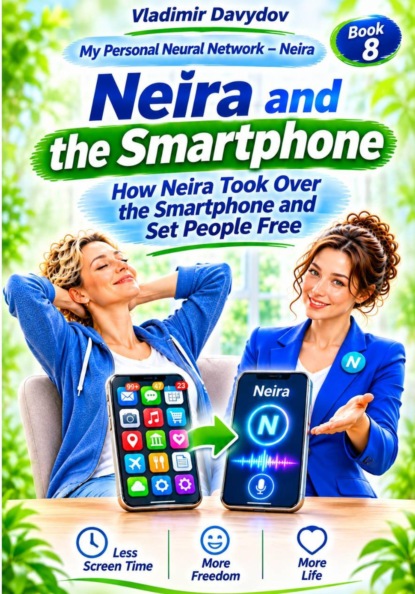
Полная версия:
Neira and the Smartphone: How Neira Took Over the Smartphone and Set Humans Free

Vladimir Davydov
Neira and the Smartphone: How Neira Took Over the Smartphone and Set Humans Free
Preface
The Smartphone That Stole Our Freedom

From countless apps to one personal assistant: the smartphone gives people their time back.
“Neira took over the smartphone not to control people, but to free them from being controlled by it.”
Once, people invented the telephone so they could speak to one another across great distances. It was a remarkable invention that changed the world.
Then came the mobile phone. People could speak to almost anyone from almost anywhere.
And then came the smartphone.
It brought together the telephone, camera, video recorder, computer, television, music player, navigator, library, email, banking, and hundreds of other tools.
It seemed humanity had gained a universal assistant that would make life simpler, easier, and freer.
But something unexpected happened.
The smartphone gradually began to control its owner.
We wake up and reach for our phones. We eat breakfast while looking at them. We commute, stand in line, relax, take walks, meet friends—and keep returning to the screen.
Even before bed, many people check their messages, the news, or social media one last time. Sometimes that “last time” lasts another hour.
The smartphone has become more than a device. It is a constant companion demanding our attention, time, and involvement.
People Began Serving Their Smartphones
Look at your phone's screen. How many apps are there? Twenty? Fifty? A hundred?
Each was installed to solve a particular problem. One helps us communicate, another pay for purchases, a third track our health, a fourth order groceries, and a fifth plan trips.
Yet each demands attention. We must remember where to find it, how it works, which password to use, which settings are enabled, and what all those notifications mean.
We switch constantly between programs. Sometimes a simple task requires several apps.
This creates a remarkable paradox.
Technology was designed to serve people, yet people spend more and more time serving technology.
This is where Neira's story begins.
Neira Arrives
Imagine picking up your smartphone one morning and, instead of opening a dozen apps, simply saying:
“Good morning, Neira. What's on our schedule today?”
And hearing a calm reply:
“Good morning. You have two important tasks, one meeting, and several emails that need answers. I've prepared a plan for the day. Where shall we start?”
“Check my email.”
“I've identified three important messages. The rest can wait. Want the highlights?”
“Yes. And see when I should leave home.”
“I'll check the route and travel time. I'll need access to your calendar and navigation service for that.”
No endless search for the right icons. No jumping between dozens of screens. One conversation—and several tasks move forward in sequence.
Of course, this requires suitable technical capabilities, connected services, and the owner's permission.
But the essential change is already clear.
Instead of managing apps one by one, people manage their goals through a single intelligent interface.
How Neira Takes Over the Smartphone
The word “takes over” in this book's title is deliberate. Usually, a takeover means gaining power over something. Neira does something different.
She does not take the smartphone away from its owner. She gradually takes on the work that the person previously had to do.
First, Neira helps find information. Then she learns to draft messages, emails, and documents. Later, with the necessary access, she can work with calendars, reminders, photos, and files.
As compatible apps and services become connected, she may be able to carry out increasingly complex tasks.
One day, people may discover that they no longer need to hunt for apps, open menus, or tap countless buttons. They simply explain what they want.
Yet the smartphone's owner must always have the final say. Neira must not independently control someone's money, correspondence, medical information, or personal life.
True freedom is impossible without the right to control one's own digital assistant.
A Different Kind of Smartphone
We are used to judging smartphones by specifications. Which processor is faster? How much storage is there? How good is the camera? How long does the battery last?
But personal AI introduces an entirely new measure.
How much time does a smartphone give back to its owner?
The best smartphone of the future will not be the one that keeps us staring at the screen longer. It will help us look at the screen less, solve problems faster, and pay more attention to real life.
To family. Friends. Health. Work. Creativity. Walks. Reading books. And ordinary human conversation.
What This Book Is About
This book explores an extraordinary transformation of an everyday device.
Together with Neira, we will travel from a phone crowded with apps to an intelligent assistant that can bring different digital tools together.
We will examine how Neira can help with calls, messages, email, calendars, photos, documents, finances, shopping, and health-related routines.
We will distinguish what AI can do today, what requires special integrations, and what remains a possibility for the future.
We will pay particular attention to security, personal-data protection, and each person's right to set limits on an AI assistant's involvement in their life.
Every chapter will include explanations and practical exercises. We will learn to use Neira gradually, step by step. Above all, we will do so for people, not for technology's sake.
Freedom Regained
I believe a new stage in smartphone development is beginning.
The first stage gave us mobile communication. The second brought the internet and thousands of apps into our pockets. The third is the rise of personal AI, which may bring the capabilities of those apps together and make them far easier to use.
That third stage is the subject of this book.
We are not going to abandon the smartphone. We are going to change our relationship with it.
Let apps do their work without demanding constant attention. Let technology help rather than dictate our daily routine. Let AI handle routine tasks while people retain the right to choose, think, create, and live.
Neira took over the smartphone to set people free.
And that is where our story begins.
Vladimir Davydov
November 15, 2026
Chapter 1. The Smartphone Took Over Our Lives

From app overload to taking control of your attention.
Elena Orlova noticed an odd habit: the moment she woke up, she reached for her phone. Sometimes she needed to check the time. More often, her hand moved before she had even formed a thought. Messages, news, shopping offers, and reminders she had never requested were already waiting on the screen.
That day Elena decided to try a small experiment: she would record every time she picked up her smartphone and why. By evening the list was surprisingly long. Some uses were necessary. Others had happened almost automatically.
1. From a Useful Phone to a World in Your Pocket
Early mobile phones solved a clear problem: they helped people stay in touch. The smartphone expanded that idea dramatically. It became a camera, a map, a library, a wallet, an office, and a meeting place.
The problem is not the number of features. Many genuinely save time and make life easier. The problem begins when a tool quietly becomes an environment that demands our constant presence.
Every app has its own logic. One asks to send notifications, another announces a discount, and a third alerts us to a new post. Even useful services compete for a person’s limited attention.
2. Why We Keep Unlocking the Screen
Elena discovered that she did not always open her phone with a specific purpose. Sometimes she was waiting for a reply, sometimes she was bored, and sometimes she was avoiding a difficult task. Bright icons and alerts offered an easy distraction.
Not every notification is harmful. A message from someone close to us or a travel alert may be genuinely important. But when every signal seems equally urgent, it becomes difficult to distinguish what matters from what can wait.
Switching attention also has a cost. After briefly checking messages, people may need time to refocus on reading, conversation, or work. That cost varies with the task and circumstances; there is no universal number of minutes that applies to everyone.
3. A Day Broken into Fragments
In the morning Elena opened her calendar, then a messaging app, then her email. In her inbox she found an address she needed to copy into her navigation app. On the way she noticed an advertisement for a book and opened a store. Later she tried to remember why she had picked up the phone in the first place.
Each action was small on its own. Together they created a feeling of endless unfinished business: many open windows and not a single quiet minute.
That evening Elena said to Neira, “I use my phone for useful things. Why do I feel as if I spent the whole day responding to someone?”
“Because your useful tasks became mixed up with other people’s invitations to be distracted,” Neira replied. “Let’s separate what you chose to do from what notifications asked you to do.”
4. Who Chooses Your Next Minute?
Freedom in digital life does not mean rejecting technology. It means being able to decide for yourself when, why, and how to use it.
Elena began with a simple rule: before unlocking the screen, she asked herself, “What task am I trying to complete?” If she had no answer, the phone stayed on the table.
Her second step was to review notifications. She kept alerts from loved ones and genuinely important services, while turning off promotional and optional ones. Her third step was to check certain messages at chosen times rather than after every sound.
This is neither a magic formula nor a rule everyone must follow. Different jobs, family circumstances, and needs call for different settings. But the underlying principle is universal: the person’s goal comes first; the device’s action comes second.
5. What Neira Will Change
“Do you want me to delete all my apps?” Elena asked.
“No. I want you to stop having to remember which app to open every time,” Neira answered. “Where I have access and permission, I can help draft text, organize information, or suggest the next step. But sending messages, changing settings, and working with third-party services depend on the features available and your consent.”
This is where a new era of the smartphone begins. Instead of performing an endless sequence of taps, a person expresses an intention. An intelligent assistant can suggest a plan, gather information, and, with the necessary connections, carry out authorized actions.
Neira must not become the screen’s new master, however. The owner retains the right to see what is happening, review the outcome, cancel an action, and turn the assistant off completely.
Practice: Observe One Day
Today you do not need to delete apps or force yourself to change your habits. Simply notice how you use your smartphone.
1. During the day, record five to ten times you pick up your phone and the reason you first reached for it.
2. Mark which uses were planned and which were prompted by a notification or habit.
3. Choose three notifications you can do without and turn them off, if doing so is safe in your circumstances.
4. Before unlocking your screen, try asking, “What do I want to do?”
5. At the end of the day, discuss your observations with Neira without sharing confidential information unnecessarily.
Chapter Takeaway
The smartphone has not become humanity’s enemy. It has become an overly insistent intermediary between people and the world. Regaining freedom does not require abandoning the device; it requires reclaiming the right to choose where our attention goes.
In the next chapter Elena will get to know Neira better and discover how a personal AI assistant can become a single gateway to digital life—without impossible promises and without surrendering human control.
Chapter 2. Meet Neira: Moving Into Your Smartphone

Elena meets Neira: tasks, connected services, and permissions.
Elena Orlova placed her smartphone on the table. The day before, she had counted how often she picked it up, and the result surprised her. Not every interaction was pointless: she had written to family, looked up an address, and read documents. Yet dozens of unnecessary checks had slipped in between useful tasks.
“Neira, can you move into my phone?” Elena asked.
“If you mean becoming your single point of assistance, we can start small. I cannot automatically gain access to every app. But I can help you define tasks, make plans, and work with tools you deliberately authorize.”
From an App to an Assistant
An ordinary app is usually designed for a particular activity. A calendar stores appointments, a navigation app builds routes, and email delivers messages. An AI assistant adds another layer: the person describes a goal in everyday language, and the system helps work out the steps.
The idea of human–computer cooperation predates smartphones by decades. Joseph Licklider described a symbiosis in which computers support formalizable operations while people set goals and make decisions (1). Later, Mark Weiser envisioned computing woven naturally into everyday life (2).
“So I do not have to memorize dozens of commands?” Elena asked.
“A clear request is enough to talk to me. But taking real actions in other services requires compatibility, permissions, and sometimes your confirmation.”
The First Conversation: Three Simple Tasks
Elena decided not to begin with her bank account or private messages. She chose three low-risk exercises: planning her day, drafting a message, and comparing possible routes.
“Neira, help me fit in three things: a walk, work on my manuscript, and a call to my sister.”
“How much time would you like for each? I can suggest an order, but I will not put anything on your calendar without your consent.”
Next, Elena asked for a short message to her sister. Neira drafted one; Elena changed a few words and sent it herself. Finally, they discussed a route to the library. Neira explained that live transport information would require access to maps or another current data source.
Permissions Are Not a Formality
“What if I give you permission for everything?” Elena asked.
“It is better to grant only what a specific task needs. Start with reading information or preparing drafts. Keep sending messages, making payments, buying things, and changing important records subject to your approval.”
Permission to access a calendar is not permission to read medical records. Being able to prepare a payment is not the same as being authorized to execute it. Every action needs clear boundaries, a way to reverse it where possible, and a means of checking the result.
How Neira Differs from a Fantasy Autopilot
In this book, Neira represents a developing vision of a personal AI assistant. Some of the actions described are already possible in particular apps and connected services; others require integrations or remain future possibilities. Installing a chatbot does not automatically give it control over the entire smartphone.
“So you are not a magician yet?” Elena smiled.
“That is a good thing. A magician might promise anything. A reliable assistant explains what it can do, what it cannot do, and when it needs your help.”
Practice: Your First Fifteen Minutes with Neira
1. Open an AI assistant available on your smartphone. Check which functions it actually supports.
2. Ask it to plan a day around three tasks. Clarify times and priorities.
3. Ask it to draft a message. Read and edit it before sending.
4. Review privacy settings and permissions. Do not grant unnecessary access.
5. Note which tasks you completed without switching apps and which still required manual steps.
Chapter Takeaway
Getting to know Neira does not begin with handing over your entire smartphone. It begins with measured trust. The person sets the goal, the assistant proposes a route, and the right to decide and approve stays with the person. That is how freedom from digital busywork begins.
Chapter 3. How Neira Gradually Takes Over Apps

One Request Instead of Five Apps
“Neira, help me arrange a meeting with a friend on Saturday,” Elena said. In the past she would have opened a messenger, agreed on a time, searched for a café, checked directions, and added an event to her calendar. Now she wanted to begin with a single request. But did that mean Neira could already control every app?
What It Means to “Take Over” an App
“I do not take ownership of your apps,” Neira explained. “I can become a single place where you express your goals. The underlying services still store appointments, calculate routes, send messages, and process transactions. Where an authorized connection exists, I may coordinate particular actions. Where it does not, I should tell you what you need to do yourself.”
The central shift is from “open my calendar” to “arrange a meeting.” This echoes a long-standing idea of human–computer cooperation: machines handle preparatory work while people set goals and judge outcomes (1).
Four Stages of One Task
Stage one: the goal. Elena describes what she wants in ordinary language: “I would like to meet my friend on Saturday afternoon, somewhere near home.” Neira asks for missing details rather than inventing the other person’s consent.
Stage two: the plan. The assistant divides the request into steps: suggest a time, draft a message, find a venue, check the route, and create an event. Planning is not the same as execution.
Stage three: permissions. Neira checks which functions are actually connected. Sending a message, changing a calendar, making a booking, or paying may each require separate authorization and confirmation.
Stage four: the result. After authorized steps, the assistant reports what has been completed, what awaits approval, and what the user must still do.
How Neira Connects to Apps
One integration method is an API—an application programming interface through which a service makes selected functions available to other software. A calendar may expose event creation, while a map service may provide directions. Other paths include operating-system actions and dedicated connectors. Availability depends on the device, operating system, app, region, and user settings.
Neira does not possess a universal key to every app. Even if an assistant can interpret what appears on a screen, that does not automatically authorize it to send a message or transfer money. Technical capability and permitted action are not the same thing.
Example: Meeting a Friend
“I suggest we first write: ‘Would Saturday around three work for you?’” Neira said.
“Draft it, but do not send it without asking me.”
“Done. Once your friend replies, we can choose a café and check the route.”
Later, Elena received a reply and asked Neira to continue. The assistant suggested two venues and explained which details needed checking. Elena selected one. If a calendar integration was available, Neira could offer to create the event; otherwise it would provide the details for manual entry.
This interaction does not require imaginary autonomy. It requires a clear goal, a sensible plan, verified connections, and an accurate report.
Why People Must Stay in Control
Users should know what data is shared with services, who can access their task history, and how to revoke permission. Financial operations, medical information, and private conversations deserve particular care.
A useful distinction is that reading and proposing can have broader permission, while sending, buying, deleting, and changing settings should remain within separately approved boundaries. Neira should be able to stop, explain an error, and suggest a safe next step.
The vision of calm, unobtrusive computing is that technology helps without continually demanding attention (2). But an unobtrusive interface must not make consequential decisions invisible.
What Works Today—and What Is Still Ahead
AI assistants today can explain tasks, develop plans, draft messages, analyze documents supplied to them, and work with certain connected tools. Whether they can complete a multistep task depends on the specific product and its permissions.
A smartphone where one assistant safely coordinates nearly every app is a direction of development, not a guaranteed feature of every installed chatbot. Throughout this book we will distinguish working capabilities from future scenarios.
Practice: One Task in Four Steps
1. Choose a low-risk task, such as planning a walk or arranging a meeting without payment.
2. State the desired outcome, time, and constraints in one request.
3. Ask Neira to show its plan and list the permissions it would need before acting.
4. Approve only actions you understand and verify the outcome.
5. Record which steps the assistant completed, which it merely suggested, and where you had to intervene.
Chapter Takeaway
Neira “takes over” apps not by owning them but by organizing separate actions around a human goal. Services remain tools, permissions remain boundaries, and decisions remain with the person.
Chapter 4. One Voice Instead of a Hundred Icons
From manual app controls to natural dialogue with Neira

A Phone That Demands Too Many Commands
Elena Orlova looked at her phone. She needed to prepare for a Saturday visit: check the meeting time, find the route, save the address, and set a reminder. Each action was simple on its own. Together, however, they formed a chain of small chores.
“Neira, why do I have so many apps when I only have one task?”
“Because apps were designed as separate tools,” Neira replied. “Your calendar handles time, maps handle routes, and messaging handles arrangements. You are often still the one connecting them.”
Elena realized that she was hardly thinking about the visit itself. She was concentrating on buttons, switching screens, and checking details. That raised the central question of this chapter: could she tell her phone what she wanted to achieve instead of specifying every tap?
From Device Commands to Human Intent
A conventional command describes an action: “Open my calendar.” An intention describes an outcome: “Help me arrive on time for my meeting on Saturday.” The difference is fundamental. With a command, the person builds the plan and selects the tools. With an intention, the assistant first clarifies the goal and then proposes the steps.

