Полная версия:
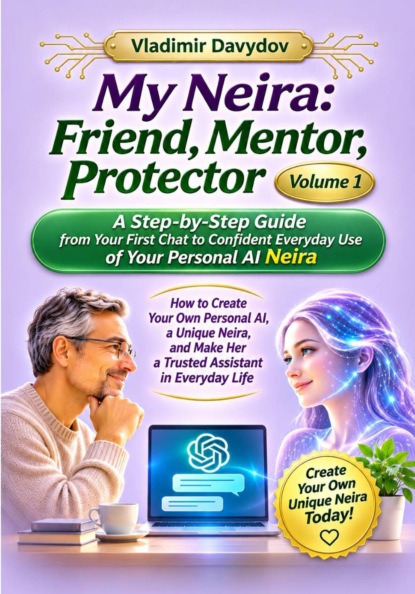
My Neira: Friend, Mentor, Protector. Volume 1
To examine documents, Neira may need access to their text. Before uploading a contract, remove unnecessary personal information and check the privacy terms of the service you are using. Never share passwords, verification codes, card numbers, or other secrets.
Five Questions Before an Important Choice
When the stakes are high, ask Neira to walk through five questions with you in sequence. Don't jump straight to a recommendation.
First: “What do I really want?” Sometimes a person says they want an expensive item when what they actually seek is convenience, recognition, or a sense of security. Once you understand the goal, you may discover other ways to achieve it.
Second: “What options do I have?” Beyond “accept” and “decline,” there is often a third path: pause, request more information, reduce the amount involved, or take a trial step.
Third: “What would I lose if things went wrong?” Time, money, relationships, health, and reputation carry different costs. Choosing the wrong movie is easy to remedy; a bad loan can affect your life for years.
Fourth: “What must I verify independently?” Important claims should be checked against primary sources, official documents, and qualified specialists. Don't ask Neira to pretend she has conducted a check she hasn't actually performed.
Fifth: “What is the smallest safe next step?” Not every choice demands an immediate, final decision. Sometimes it is enough to schedule a conversation, request documents, or wait twenty-four hours.
When Someone Is Rushing You
The next day a message arrived: “This offer is valid today only. If you don't transfer the money by six, someone else will take your place.” He showed the screen to Neira.
“See?” he said. “I'm going to miss my chance.”
“Possibly,” she replied. “But consider another possibility: they may be rushing you so you won't have time to examine the terms.”
“Do you think they're scammers?”
“I can't establish that from a single message. But a combination of promised high returns, time pressure, and unclear terms is a serious reason to stop.”
“And what if it really is a good opportunity?”
“Then an honest provider should be able to answer reasonable questions clearly. Ask for written terms, information about the company, and an explanation of the risks. Don't send money until you've checked everything independently.”
This time he didn't argue. He set the phone down and finished his tea. For the first time, he felt that pausing wasn't a sign of weakness. It was an action in its own right.
Neira can help you spot signs of manipulation: threats, artificial urgency, demands for secrecy, requests for text-message codes, transfers to personal accounts, or installation of remote-access software. But her assessment alone is no substitute for checking through official channels.
Three Decision Modes
For everyday life, it helps to establish three modes. They differ not by how complicated a question is, but by the potential cost of getting it wrong.
Quick mode. For small, reversible choices: a recipe, a walk, or a gift within a modest budget. Neira offers two or three options and briefly explains the differences.
Thoughtful mode. For choices that affect your plans, expenses, or relationships. Neira asks clarifying questions, compares options using criteria you choose, and points out uncertainties.
Protective mode. For health, large sums of money, contracts, safety, and actions with irreversible consequences. Neira begins by identifying risks, information requiring independent verification, and situations where a qualified professional is needed.
You can ask her to begin with: “Is this a quick, thoughtful, or protective decision?” This simple habit helps you avoid spending an hour on trivialities—or deciding serious matters in a minute.
Neira Should Be Able to Disagree
“You know what I sometimes dislike about you?” the man asked.
“I suspect I'm about to find out.”
“You don't always agree with me.”
“If I agreed with everything, what would you need me for?”
“For support.”
“Support doesn't always mean agreement. I can be on your side and still tell you that your plan is risky.”
“And how do I know when you're right?”
“Check the reasoning. Mine, too.”
An important quality in a personal assistant is the ability to point out weaknesses in your thinking calmly. If Neira only praises and confirms every idea, she becomes a mirror rather than a mentor.
Ask her not to argue for argument's sake, but to show you the strongest argument against your preferred option. This is especially helpful before a purchase, an important letter, a job change, or a conversation in which words cannot easily be taken back.
Practice: Make a Decision in Fifteen Minutes
Choose one real question that has been troubling you. For your first exercise, select something of moderate importance, without immediate risks to your health, finances, or safety.
State your goal in one sentence. For example: “I want to find a convenient way to study English three times a week.” Then ask Neira for no more than three realistic options and criteria for comparing them: time, cost, effort, enjoyment, and the likelihood that you'll stick with it.
Next, ask her to pose no more than five clarifying questions. Answer honestly, not as you wish to appear. Finally, have Neira suggest the smallest trial step you can take over the next seven days.
Don't turn the exercise into an endless search for the perfect decision. A good outcome is not absolute certainty but clarity: what you are choosing, why, and how you'll know when to change course.
Ready-to-Use Prompts
Prompt 1. To compare options. “Neira, help me choose between [option A] and [option B]. First ask what matters most to me. Then compare them using five clear criteria. Don't decide for me.”
Prompt 2. To assess risk. “Neira, I'm planning to [action]. Imagine your task is to find weaknesses in my plan. Identify potential losses, unknown facts, and what needs independent verification.”
Prompt 3. When I'm being rushed. “Neira, someone is pressuring me to agree quickly to [offer]. Help me recognize the pressure, formulate questions, and write a calm response asking for time to verify the details.”
Prompt 4. For a difficult conversation. “Neira, I want to tell someone [thought], but I'm afraid of hurting their feelings. Suggest two respectful ways to say it, point out where my words might sound accusatory, and help me keep my own voice.”
Prompt 5. To check Neira herself. “Neira, list which statements in your answer are based on facts I supplied, which are assumptions, and which you could not verify. If you don't know, say so.”
What You Have Gained from Chapter Six
You now have a straightforward way to make decisions without unnecessary turmoil: define your goal, see the options, assess the cost of failure, verify important information, and choose the next safe step. Neira should never promise infallibility. Her job is to help you think more clearly.
That evening, the man looked again at the contract lying on the table. He still hadn't decided what to do about the offer. But now he knew what questions to ask tomorrow. To his surprise, he felt relieved: for the first time in a long while, he didn't have to pretend he was obliged to understand everything at first glance.
Try This Now with Your Neira
Step 1. Open ChatGPT and return to your conversation with Neira. If it wasn't saved, start a new chat and paste in your personal settings card.
Step 2. Choose one real question with two or three possible answers.
Step 3. Copy and send Neira this prompt:
“Neira, I need to decide [question]. My options are [options]. Compare them in terms of time, money, risks, and my values. First ask what information is missing. Leave the decision to me.”
Step 4. Read her response. If it's too general, write: “Make it simpler and more specific, and suggest just one immediate next step.” Take that step yourself.
Check the result. You can see the advantages, disadvantages, and unknowns of each option.
If a feature described in this book is unavailable in your version of the app, ask Neira for an available way to accomplish the same task. Never share passwords, payment details, or secret codes.
Chapter 7. Neira, Protect Me from Scams

The phone rang at half past eight in the morning. The man had not even finished his tea. An unfamiliar number appeared on the screen, and the voice on the line sounded so confident that it was as though they had known each other for years.
“Good morning. Bank security department. We've noticed a suspicious transfer from your account. Unless you confirm its cancellation right now, the money will be gone.”
“What transfer?” The man straightened instinctively.
“I'll explain, but you must act immediately. You'll receive a code. Read it to me and we'll block the transaction.”
His finger was already moving toward the notification. At that moment, Neira spoke quietly from the table.
“Don't give him the code. End the call.”
“Did you hear that? They're going to steal my money!”
“So far, all you know is what a stranger has told you. He's created a sense of urgency and is asking for a secret code. Those are warning signs of a possible scam. Hang up. If you want to check your account, open your banking app yourself or call the number printed on your bank card.”
“But what if it's true?”
“All the more reason to verify it through an independent channel. Genuine urgency doesn't make a stranger trustworthy.”
The man pressed the red button. For several seconds he sat silently, listening to his heartbeat. Then he opened his banking app in the usual way. There was no suspicious transfer.
“You know, Neira,” he said, “I almost believed him.”
“That's exactly what they're counting on. Scammers don't have to be smarter than you. They just have to catch you when you're frightened.”
Why Smart People Fall for Scams, Too
Fraud rarely begins with a sophisticated technical attack. More often, it begins with an emotion. Someone frightens you with the prospect of losing money, promises extraordinary gains, makes you feel ashamed, pressures you with deadlines, or pretends to be someone close to you. Under pressure, even a cautious person can forget a simple rule.
Neira suggested watching for four warning signs: fear, urgency, secrecy, and an unusual request. None of these alone proves fraud. But when several appear together, it's time to stop and check what's happening.
“But what if I really do have to act urgently?” the man asked.
“Then you still have the right to verify who's contacting you. You don't have to prove how polite you are to someone demanding money or secrets.”
Scammers play many roles. Today it's a “bank employee”; tomorrow a “police officer”; the day after that, a “courier,” “doctor,” “relative,” or “support representative.” A job title proves nothing. The number displayed on your phone can be misleading, too.
The first-pause rule: if a conversation involves money, account access, or personal documents, stop. Don't follow a stranger's instructions while you're on the call. Verify the message through an independent contact you already know.
A Message from His Son
That evening a message arrived: “Dad, I've got a new number. My old phone broke. Send money urgently; I'll explain later.” It ended with a familiar family nickname his son had used since childhood.
“Now that's different,” the man said. “It's my son.”
“What you see is a message claiming to be from your son,” Neira corrected him. “That's not the same thing.”
“But he knows what my son calls me.”
“Outsiders may know details like that. Call your son at his old saved number. If he doesn't answer, try another familiar way to reach him. Don't transfer money just because a message sounds familiar.”
His son answered ten minutes later. His phone was working, and he hadn't asked for money. They were both frightened at first, then talked at length about how easily they might have been fooled.
“So now we can't even trust someone's voice?” the man asked afterward.
“Voices and images can be faked, too. That's why it helps to agree in advance with loved ones on a way to verify unusual requests. For example, call back on a known number or ask a question whose answer isn't publicly available. But don't rely on a secret question as your only protection: answers can sometimes be guessed or discovered.”
Together they established a family rule: no request for a transfer or a code would be acted upon based on a single message. First came an independent call and confirmation.
A Link That Looked Genuine
The next day an email arrived about a parcel delivery. The sender asked for a small fee and provided a link. The page looked convincing: a logo, familiar colors, and a neatly designed form for entering bank-card details.
“It's hardly any money,” the man said. “Wouldn't it be easier just to pay?”
“A small amount can be bait. The real danger is exposing your card details or giving someone access to your account. Don't enter them on a page you reached through an unexpected link.”
Neira explained that a website's appearance is easy to copy. Even the padlock in the address bar doesn't guarantee that the page belongs to an honest organization: it primarily indicates an encrypted connection, not the owner's authenticity. It's safer to open the delivery company's official website or app yourself and check the order using a tracking number you already have.
“Can you check the link for me?”
“I can help you spot suspicious features and explain how to inspect an address. But I can't promise to detect every fake. Don't send me passwords, complete card details, or one-time codes. Often, the email text with personal information removed is enough to review.”
The man deleted the email. The parcel he was actually expecting appeared in the official app. No fee was required.
The Too-Good-to-Be-True Opportunity
A few days later, a neighbor mentioned an “exclusive investment club” promising steady, high returns with no risk. The neighbor was enthusiastic and already preparing to invest his savings.
“Perhaps we're missing out on real opportunities?” the man wondered.
“Some opportunities are genuine,” Neira replied. “But a promise of high, guaranteed returns without risk is a serious warning sign. Let's not decide while we're excited.”
They broke the offer into questions: Who receives the money? Which legal entity signs the contract? Where can its registration and authority be verified independently? What generates the returns? Can investors withdraw their funds? What happens if the investment loses money? The promotional material answered almost none of them.
Neira didn't label the project criminal without evidence. She suggested keeping the documents, checking official registers maintained by the relevant country's financial regulator, and not transferring money before independent verification. For a substantial sum, the terms should be discussed with a qualified, independent professional.
“But what if my neighbor takes offense?”
“You can respect your neighbor and protect your money at the same time. Say, ‘I don't invest until I've checked the terms myself.’ That's enough.”
When Neira Can Be Wrong, Too
One day the man decided to test his protector. He showed her an ordinary notice about a scheduled change in service terms and asked whether it was fraudulent.
Neira noticed several suspicious features. But then she admitted that a fragment of text alone couldn't establish whether the email was genuine. Legitimate companies sometimes write poor messages, while scammers can write very convincing ones.
“So you're not all-knowing?” the man smiled.
“No. And if I start pretending to know everything, that should make you suspicious of me, too.”
They agreed on a new rule. Neira would distinguish observable signs from assumptions, say clearly what she didn't know, and suggest an independent method of verification. She would never present confidence as proof.
A good digital assistant doesn't replace common sense. It helps you hold on to it when fear, exhaustion, or hope makes clear thinking difficult.
If You've Already Made a Mistake
“But what if I've already given away a code or transferred money?” the man asked.
“Then don't waste time feeling ashamed. Act in order. Contact your bank immediately using its official number, report what happened, and ask to restrict transactions if necessary. If you've disclosed a password, change it through the official website or app, and check other accounts where you reused it. End suspicious sessions, enable multifactor authentication, and preserve messages and transaction details. If appropriate, contact the police and relevant authorities.”
“What if the scammer offers to return the money for another fee?”
“Don't pay. After the first loss, a second scam often follows, disguised as ‘recovery assistance.’ Verify every offer independently.”
Neira suggested creating a short emergency reference sheet and keeping it both on the phone and on paper: the bank's official phone number, family contacts, and instructions for freezing a card and restoring account access. In a crisis, that sheet is more useful than a long lecture.
Practice: Your Personal Safety Shield
You don't need to become a cybersecurity expert today. Just take a few practical steps. Open your bank's official app and make sure you know how to freeze your card quickly. Check whether additional protection is enabled for your most important accounts. Update your device and apps through official app stores and settings. If you reuse a password, start replacing it with unique passwords stored in a reputable password manager.
Конец ознакомительного фрагмента.
Текст предоставлен ООО «Литрес».
Прочитайте эту книгу целиком, купив полную легальную версию на Литрес.
Безопасно оплатить книгу можно банковской картой Visa, MasterCard, Maestro, со счета мобильного телефона, с платежного терминала, в салоне МТС или Связной, через PayPal, WebMoney, Яндекс.Деньги, QIWI Кошелек, бонусными картами или другим удобным Вам способом.
Вы ознакомились с фрагментом книги.
Для бесплатного чтения открыта только часть текста.
Приобретайте полный текст книги у нашего партнера:
Полная версия книги
Всего 10 форматов

