Полная версия:
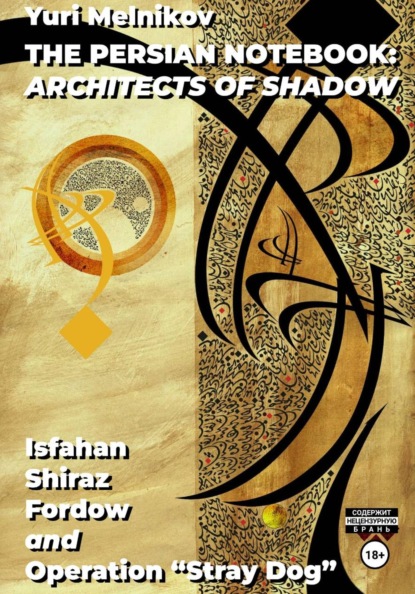
The Persian Notebook: Architects of Shadow
“And I updated my wardrobe last week,” Maryam suddenly perked up, lowering her voice. “Reza took me to a… special place.”
Fatima leaned closer. Even Zahra found herself listening.
“Can you imagine, a whole underground boutique! French lingerie, Italian dresses. All genuine, not Chinese fakes.”
“How do they get it in?” Fatima asked. “That’s contraband.”
Maryam smiled mysteriously, enjoying the attention.
“Reza says they have their own channels. Something… diplomatic. Certain people fly back and forth, carrying it in their luggage. For the wives of the big bosses. They have connections at the embassies. They bring it in diplomatic pouches, which don’t get searched.”
“And is it expensive?” Fatima inquired.
“Oh, yes! But it’s worth it. Handmade lace, silk…” Maryam rolled her eyes dreamily. “I bought a set the color of Burgundy wine. Reza was thrilled.”
And in that moment, between the words “diplomatic channels” and “Burgundy wine,” a switch seemed to flip in Zahra’s memory. The revelation didn’t come in a flash, but like a photograph slowly developing in a chemical bath.
Paris. Charles de Gaulle Airport. February 2014
She was returning from a conference, had missed her flight, and had to book the next one. Economy class was full, but she got lucky – a window seat, and next to her…
A man with an academic face, engrossed in his laptop. She caught a glimpse of the screen – tanks. He was playing World of Tanks. It was so unexpected, so… human. A respectable man in an expensive suit, enthusiastically driving pixelated tanks across virtual battlefields.
“Excuse me,” she couldn’t help herself then, “is that World of Tanks?”
He looked up, slightly embarrassed.
“You know the game?”
“I play sometimes. When I need a distraction from work. I have a T-34-85.”
His face lit up with a smile – that special smile that appears when one finds a kindred spirit in an unexpected place.
“A Jagdpanther – a ‘tank hunter’,” he replied with pride. “Just bought it. You’re a physicist, aren’t you? I saw your bag from the conference.”
Jagdpanther. The name echoed faintly in her memory, like the sound of a distant explosion. It had been her first serious vehicle in the game. She had bought it a year earlier, in 2012, in Sarov. During that internship at the Russian nuclear center, about which her official file contained only three lines. Long, lonely evenings in the closed city, snow outside the dormitory window, and virtual battles as the only escape from the oppressive silence and the constant feeling of being watched. It was there, in the heart of a foreign nuclear program, that she, an Iranian physicist, had chosen the German tank destroyer for its precision and elegant engineering.
But after returning to Iran, everything changed. That period of her life had to be sealed off, stored in the furthest compartment of her memory. She had «forgotten» the password to her first account, the way one forgets an uncomfortable dream. She created a new one and switched to the Soviet T-34-85. It seemed more… appropriate. Safer. And so, German precision was replaced by Soviet reliability. But she didn’t mention this to Mr. Fakhrabadi. She just smiled back at him, as if the name Jagdpanther was just one of many in the game’s endless catalog.
They talked for almost the entire flight. About tank battles and shell ballistics, about the physics of armor penetration and optimal angles of attack. He said he worked in a trade mission. Import-export. Textiles. He had a slight accent – not quite Iranian, as if he had lived abroad for a long time.
“The game is a perfect model,” he said somewhere over Istanbul. “Limited resources, the need for strategic thinking, understanding the enemy’s weak spots. Just like in life.”
He introduced himself. Mr. Fakhrabadi.
But that wasn’t what she remembered most. It was how he was met at the airport.
He wasn’t just met. He was met by a man holding a sign that read “Diplomatic Service.” They walked past the long line for passport control, past customs, and disappeared through the doors of the VIP lounge. No inspection. No questions.
And now, ten years later, this man with whom she had discussed virtual tank battles was standing in the rain, watching the protest dispersal. Watching her.
“Zahra-jan, you aren’t listening!” Maryam’s voice brought her back to the present. “I’m asking if you’d like to visit that shop too.”
“What? No, thank you. I have everything I need.”
But now she lacked the most important thing – an understanding of why a man who played with tanks at thirty thousand feet had been in the right place at the right time. And why he had been looking specifically at her.
A roar erupted from the living room – someone had scored a goal. The men shouted, argued. The world was divided into those who cheered and those who cursed the referee.
And Zahra sat between two worlds – between the lace of contraband lingerie and virtual tank battles – feeling invisible threads begin to tighten around her, forming a pattern she could not yet decipher.
The tea in her glass had grown cold. The cardamom had settled at the bottom, like heavy isotopes in a centrifuge.
“Limited resources, the need for strategic thinking, understanding the enemy’s weak spots,” she recalled his words. Now she understood: he hadn’t been talking about the game.
He: The Tank Hunter
6 Aban 1401 (October 28, 2022)
Friday in Iran is a pause. A day when time slows its pace, submitting to a different rhythm: not the hum of centrifuges, but the call of the muezzin from the minaret of Isfahan’s Jameh Mosque. It is a day for family, a day when the crystal lattice of society becomes, for a moment, visible and orderly.
After her morning prayers, Zahra retrieved her old laptop from the top of the wardrobe – a massive, heavy artifact from a decade past. The dust on its lid lay like volcanic ash on the ruins of Pompeii.
“Where are you off to?” Amirkhan asked, fastening his watch as he prepared for Friday prayers at the mosque.
“To Naqsh-e Jahan Park, with Zeynab. She needs some fresh air.”
“You’re taking that data mausoleum for a walk? Why?”
“I want to reread drafts of some old papers. Something for my current research. There were ideas… that I abandoned. Perhaps I shouldn’t have.”
“In the park?” His eyebrows rose with that particular blend of disbelief and condescension men reserve for a woman’s whims.
“Zeynab will play. I’ll have some time.”
Amirkhan shrugged. To him, it sounded like another of her physics abstractions, bearing no relation to the real world where one had to pay for electricity and water and ensure one’s daughters did their homework.
“As you wish. Just don’t sit with it the whole time. Zeynab wants to feed the ducks.”
On a Friday morning, the park was like a Persian carpet woven from a hundred living threads. Families spread tablecloths on the grass, children chased pigeons, and old men played backgammon in the shade of the plane trees. The air smelled of jasmine, cotton candy, and the damp earth near the fountains. Zahra chose a bench set slightly apart, by the rose bushes.
“Mama, I’m going over to the girls, see them, by the swings,” Zeynab, whose face was the embodiment of pure, undistorted geometry, pointed a finger at a group of her peers.
“Go on, my sweet. Just stay where I can see you.”
Zeynab ran off. Zahra was left alone. She was a mother watching her daughter. A perfect disguise. She opened the laptop. The old version of Windows seemed to take an eternity to load. Every turn of the cooling fan sounded deafeningly loud to her.
On the desktop, among folders with names like Plasma_Instabilities_2011 and Tokamak_Simulations, was a shortcut icon depicting a tank – World of Tanks. A portal to another world, to a simulacrum of reality where she had once found an escape.
She launched the game. The interface was as familiar as an old, forgotten formula. A field for a username and password. She entered the credentials for her old account, NeutronStar_7. The system replied: “Incorrect username or password.” She tried again. And again. The memory that held the most complex equations refused to yield this simple combination. Perhaps the account had been deleted for inactivity. Ten years was an entire epoch in the digital world.
She would have to find another way in. She clicked “Register.” She created a new identity. Zahra_K_1983. A name, an initial, a year of birth. Minimum information, maximum truth. The best lie is one that is nearly indistinguishable from the truth.
She entered the game. In the garage stood a basic, pathetic Tier I tank. It didn’t matter. She wasn’t interested in combat. She was interested in the list. The catalog of players. An endless list of names, a library of shadows.
She opened the search. What was she looking for? A ghost from a decade ago. A name similar to “Fakhrabadi.” She tried variations: Fahrabad, Fahrabadi, FahrabadyFer… Nothing. Then she remembered – Jagdpanther. He had been proud of that machine. A search by vehicle… by registration date…
She changed tactics. Instead of a name, she typed the tank’s name into the search bar. Jagdpanther. The list was enormous. Thousands of players owned this German tank destroyer. It wasn’t looking for a needle in a haystack; it was looking for a needle in a mountain of needles. She began to scroll through the list, page after page. PanzerKiller_Ali. DesertFox_66. Reza_Sniper. The names flashed by, blurring into a meaningless mass. Her brain, trained to find patterns, found nothing.
She felt like an astronomer searching for a faint gravitational anomaly in a cluster of millions of stars. The results were nil. Hundreds of players with similar names, but none of them resonated.
Maybe he had changed his name? Or abandoned the game as well? The thought was cold and clammy. She was looking for a sign, but what if the sign no longer existed? What if she was interpreting random noise as a meaningful message? It was a trap many minds had fallen into – seeing a system where only chaos reigned.
“Mama, what are you doing?”
Zeynab’s voice was so close and unexpected that Zahra started and slammed the laptop shut with such force that the plastic cracked. Her heart plummeted into a void. She had been so engrossed in her search that she hadn’t noticed her daughter approach and look over her shoulder.
“Zeynab! You scared me, azizam!”
“But that’s… that’s a computer game? You play games?” Her daughter’s voice was a mixture of shock and admiration. As if she had discovered her mother was a secret superhero.
“I…” Zahra gathered the fragments of her composure. “I just stumbled upon an old game. I wanted to remember why I used to like it. Silly, isn’t it?”
“Show me! Please, show me! The boys at school are always talking about it, but they won’t show the girls!”
Zahra opened the laptop. Her hands trembled slightly.
“It’s… a very old game. I haven’t played in a long time. I just saw it and was curious why I once liked it. It’s like… rereading an old book.”
“Can you show me? What kind of tanks are there?”
“There are tanks from different countries. Here are the Soviet ones, the American ones, the German ones… Here’s a list of players. You can choose any tank and…”
“Why do some players have such strange names?”
“People choose pseudonyms. Like… like poets in the old days. To be someone else.”
“Like Hafez? His name wasn’t really Hafez, was it?”
“Shams-ud-Din Mohammad. Hafez is a nickname. ‘The Guardian,’ one who knows the Quran by heart.”
She spoke, while her cursor frantically moved across the list left on the screen. And as she explained the difference between heavy and medium tanks to her daughter, her gaze caught on a line.
JagdpanFer_83
The name was inaccurate. A typo or a deliberate distortion. Fer instead of Fakhr. But it was too close to be a coincidence. 83. His year of birth? Or just a number? Next to the name was an avatar – a tiny image, a pixelated mosaic. But even in that low resolution, she recognized him. The faint outline of his face, the line of his jaw, the calm gaze. It was him. The ghost from the plane. The oracle in the rain.
“Mama, can I have some ice cream?” Zeynab tugged at her sleeve, her world simple and made of desires that could be fulfilled. “Pistachio! Or saffron!”
Relief washed over Zahra like a wave.
“Of course, janam. Of course.”
She exited the game, closed the laptop.
They walked to the bastani stall, Zeynab chattering about school, her friends, an upcoming math test. Zahra nodded, smiled, but her mind remained there, in the digital space where the hunter had noted the appearance of new prey. Or perhaps, had recognized the old.
Zeynab was choosing between pistachio and saffron ice cream. The sun was setting, painting the fountains the color of molten copper. Somewhere in the distance, a muezzin began the call to evening prayer.
“Mama, why do people play at war?” Zeynab asked, tasting her ice cream.
“To learn not to fight in reality.”
“But doesn’t the game teach you to fight better?”
“A paradox, isn’t it? We study what we want to avoid… Or to fight and win.”
“Mama, did you win? In the game?”
“What? No, azizam. I haven’t even started playing.”
“But you will?”
Zahra looked at her daughter – innocent, pure, full of faith in the world’s justice.
“Perhaps,” she answered. “Sometimes you have to play, even when you don’t know the rules.”
Vav: The Geometry of Fear
10 Aban 1401 (November 1, 2022)
Memory is also a laboratory, where the past can be analyzed again and again in the hope of a new result. That day, long before Rustam Yazdi’s desk became a sterile rectangle of emptiness, the break room had smelled of strong tea and anxiety. An advance IAEA report lay on the table, its pages, riddled with diplomatic phrasing, resembling a map of a minefield.
“They are blind,” Dr. Rezai said, setting down his glass with a thud, as if punctuating the end of an argument. “They search for traces of particles, not traces of intent. The Great Satan’s intent is obvious – to leave us defenseless. Israel’s intent is to finish what they started in Natanz.”
“Or that which exists, but is well hidden,” Rustam remarked quietly, not looking up from his teacup.
“Iran has a sovereign right to defend itself. The Great Satan keeps its fleet in the Persian Gulf; the Lesser Satan has the largest nuclear arsenal in the region. Are we supposed to wait, with our hands tied?”
“Their intention is to uphold the treaty we signed,” Rustam countered. “Besides, the geopolitical map has changed. Russia, our situational ally, is bogged down in the Ukrainian steppes. They have no time for us now.”
Rezai smirked, but there was no mirth in his eyes.
“You think in terms of newspaper headlines, Rustam. I prefer history textbooks. During World War II, the USSR was also ‘busy’ fighting Hitler. That didn’t prevent Operation Countenance, when the Red Army occupied the entire north of our country. History teaches us: great powers always find time for smaller nations when their interests are at stake. Allies are a variable. Threats are a constant. The only language well understood in this world is the language of mutually assured destruction.”
The silence that fell in the room was thicker than the lead shielding of a reactor. Zahra, who had only been listening until then, could not hold back.
“Dr. Rezai, let’s assume, hypothetically, that we create a device,” her voice was quieter than she had expected. “Do you really believe we would use it?”
Rezai slowly turned his head toward her. He looked at her with the gaze of an engineer assessing the reliability of a structure.
“A nuclear weapon, Dr. Musavi, is like a prayer. Its power lies not in being uttered, but in the knowledge that it can be. And whether Allah will permit us to speak it aloud… I hope not. But it is better to have a sword and not draw it, than to stand unarmed before wolves.”
“The sword of Damocles,” Zahra muttered.
“What?”
“Nothing. A Greek parable. It doesn’t matter.”
That evening at dinner, it was Nasrin who uttered the prayer. She was picking at her saffron rice, staring into her plate, and said it as if she were announcing the weather forecast:
“They came to our school today.”
The knife froze in mid-air.
“Who?”
“From security. The Ettela’at. They took several people right from their classes. Adil, too.”
Amirkhan froze, his spoon in hand. Zahra felt the blood drain from her face.
Adil. Zahra knew the boy – quiet, polite, with the eyes of a medieval poet. He often came over to do homework with Nasrin; they would solve algebra problems together.
“What happened?” her husband asked in the voice he used to give orders.
“They said they were agents. Of Israel and America.” Nasrin looked up, and fear rippled in her eyes. “Baba, Adil barely even knows English. What kind of agent could he be?”
Zahra sat down across from her daughter and took her hands. They were cold, trembling.
“Sometimes… sometimes the authorities see threats where there are none. It’s like… like Brownian motion. Chaotic, unpredictable.”
“But why him?”
Zahra had no answer for that. Or rather, she had one, but she couldn’t say it aloud: because the system feeds on fear, just as a reactor feeds on uranium.
“Alright, Nasrin, but we don’t talk about this at the table,” Amirkhan ended the conversation. “And stay away from this whole affair. Do you understand me?”
“I understand,” Nasrin replied quietly.
That night, Zahra didn’t sleep. The room was filled with silence and her husband’s steady breathing. But in her head, the centrifuges of paranoia were roaring. Adil. A boy who just yesterday was solving quadratic equations had today become a variable in the equation of state security. They were just children. Their rebellion wasn’t treason. It was the growing pain of an organism starved of air. They just wanted a little more freedom than their parents, who had grown up in the shadow of the Islamic Revolution, in a world divided into black and white.
Perhaps it wasn’t they who had lost their way. Perhaps it was us. The whole country. We had spent so long building a fortress to protect ourselves from enemies that we didn’t notice it had become a prison. Saudi Arabia, the bastion of Wahhabism, was opening cinemas and letting women drive. Jordan was balancing tradition and modernity. And us? We were building centrifuges and walls. Enriching uranium and impoverishing souls. We kept reinforcing the walls, having forgotten to open the windows.
The shield she had helped to forge was now descending upon the heads of children. Her children. It was the final straw.
At four in the morning, long before the first call to prayer, when the house was plunged into its deepest phase of sleep, she got up. On tiptoe, she went to the living room. The dusty laptop opened with a faint creak. The screen glowed with a pale light – a window into another world.
The game. The garage. The contact list. She found his name. JagdpanFer_83. The cursor blinked like a lonely heart on an EKG. Her fingers froze over the keyboard. It was a leap into the void. She began to type a private message. Her fingers trembled.
“Bismillah ar-Rahman ar-Rahim. I remember you. The flight from Paris, January 2012. We spoke of tank battles and optimal angles of attack. I need to talk. My children… I must protect them. The system devours its own children, like Cronus.”
She deleted the last sentence. Too revealing. Then she rewrote the whole thing: “Praise be to Allah! I remember you. I want to talk. I want to protect my children.”
She pressed Enter.
The reply came in seconds.
“Hello. Communicating with me here is not secure. But you can write to me or send useful information that will help our country on the private forum wotrandom.com/forum/mods-world-of-tanks. The login is the same. An invitation is below.”
Zahra stared at the screen. Outside, the eastern sky was beginning to lighten. Soon, the muezzin would sing the Fajr. She closed the laptop, but the forum address was already seared into her memory, like the afterimage of a flash on a photographic plate.
In the bedroom, Amirkhan turned in his sleep, muttering something. She lay down beside him, pretending to be asleep, but her heart was beating with the decay rate of radioactive iodine – fast, erratic, dangerous.
Zayin: The Entropy of Choice
11 Aban 1401 (November 2, 2022)
Isfahan breathed the chill of approaching winter. In the morning light filtering through the dusty windshield of the Peugeot, the world seemed two-dimensional, devoid of volume and warmth. Zahra drove, but she felt less like a driver and more like a particle moving along a predetermined trajectory, and every turn of the wheel seemed a metaphor: right to the laboratory, left to home, straight into the unknown. In the rearview mirror, the faces of other drivers flickered, and in each one, she imagined suspicion. The decision from last night, which had seemed the only correct one, the only way out of a closed labyrinth, now, in the light of day, had taken on an ugly geometry.
Betrayal.
The word had a physical weight. It pressed on her chest, made it hard to breathe. What was betrayal? A shift in the vector of loyalty? Or simply the choice of a different frame of reference, one in which her family was the fixed point, and everything else – country, work, duty – revolved around it? All her life she had constructed equations where the state was a constant. But what if it was a variable, trending toward decay, and dragging everything she held dear along with it?
She imagined them leading her from her home. Amirkhan’s face – a mixture of incomprehension, shame, and fear. Her daughters’ faces. Nasrin, in whose eyes not terror but a terrible, searing understanding would flash. And Zeynab, whose faith in the order of the world would be shattered forever. That picture was more unbearable than any physical torture.
But what is betrayal? Violating an oath to a state that arrests children? Or silent complicity in creating a weapon that could incinerate those same children? Physics had taught her that every system has a bifurcation point – a moment when the slightest influence determines its future path. She felt that point was near.
Her fingers tightened on the steering wheel until her knuckles turned white.
In the laboratory, the hum of the cooling systems absorbed all other sounds, creating a vacuum in which thoughts became deafeningly loud. Rustam approached her desk, holding two cups of tea.
“I’m leaving tomorrow. For Fordow,” he said, placing one of the cups in front of her. “A new series of experiments with the cascades.”
Fordow. A fortress of a word. A nuclear facility carved into the heart of a mountain, invulnerable to bombs and prying eyes. A symbol of defiance.
“Equipment check?” Zahra asked, wrapping her fingers around the hot glass.
“And souls,” Rustam chuckled. “They were talking about the IAEA again yesterday. Sometimes I think we’re not arguing about physics, but philosophy.”
“And aren’t they the same thing?” Zahra looked at him. “We search for the fundamental laws of the universe. They search for proof of our intentions. But how can you measure intention? It’s like trying to weigh a shadow.”
“They don’t want to weigh it, Zahra. They want to be sure the shadow doesn’t belong to a monster. They see our science as a library where we collect books. And they’re not afraid of the number of volumes, but that in one of those books, we will write a word that will burn the whole world.”
“But does the librarian have the right to tell the author what to write about?” she countered. “They don’t want to control our actions, but the very possibility of thought. They want our universe to be predictable, a place where no new stars – or black holes – are born.”
Rustam took a sip of tea, his gaze fixed somewhere beyond the wall.
“Perhaps they are not afraid of the book we are writing, but of the one we have already read, but which they do not know about…”
“Did you read the latest report?” he continued, pushing his empty cup aside. “They write about a ‘possible military dimension.’ Possible! As if the mere possibility is already a crime. By that logic, every kitchen knife is a potential murder weapon.”