Полная версия:
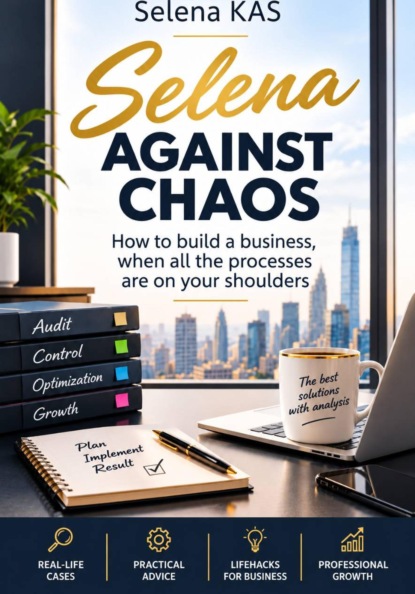
SELENA AGAINST CHAOS
Selena put down her phone and looked out the window. Lights were turning on across Barcelona. People hurried home, waiters cleared tables, and somewhere in the distance a construction crane hummed. She remembered Miguel’s words: If someone says everything is under control, ask where it’s written down. Now that phrase seemed to her more than just a joke. It had become the first professional rule of her new life. Control isn’t a manager’s confidence that everything is fine. Control is the ability to confirm what exactly is happening, why it’s happening, and what the company is doing so that the result remains predictable.
Selena finished her coffee. Tomorrow she would start studying Barcelona Habitat’s documents. And very soon she would find out that the most interesting information in the company wasn’t in official reports. It was between the lines. And sometimes — between two versions of the same file.
Chapter 2. Money Likes Silence, and Expenses Like the Inattentive
2.1. A Morning That Started Too Quietly
On Tuesday Selena arrived at the Barcelona Habitat office at 8:42. This time she wasn’t rushing. She already knew where the elevator was, which coffee was better to buy at the café across the street, and why you shouldn’t use the printer near Clara’s office if more than five pages were sent to print. The last conclusion was made based on yesterday’s experiment, as a result of which the printer produced three other people’s contracts, two waybills, and one document that, judging by the title, nobody was supposed to see without special permission.
Selena carefully put down her bag, turned on her computer, and opened her work plan. The first item was getting the register of payments, contracts, and procurement documents. She had sent the request yesterday. There was no reply. Selena checked her email. Then refreshed the page. Then again. Nothing. She messaged Clara:
— Good morning! Could you please let me know when to expect the payment register and list of active contracts?
The reply came almost instantaneously:
— Good morning! The request has been forwarded to the responsible employees.
Selena looked at the clock. 8:47. She decided to show patience and work on preparing the audit program. Ten minutes later a new message arrived.
— Selena, why do you need a list of all contracts?
She smiled. The question was completely logical. At least from the point of view of a person who has to gather documents. Selena explained that first she wanted to get a general picture of company expenses, identify main procurement categories, and highlight transactions requiring more detailed analysis. Clara’s reply turned out unexpected:
— Then you probably need to talk to Miguel. He decides what data can be provided.
Selena reread the message. She needed data to perform the job she had been officially hired for. Yet access to that data depended on an additional decision by a manager. That didn’t yet mean there was a control problem in the company. Perhaps the procedure for providing information was formalized, and Selena simply didn’t know the procedure. She decided not to jump to premature conclusions. Instead she opened her notebook and wrote: Clarify the procedure for accessing information for internal audit. Determine which data is available directly, which requires approval, and who is responsible for providing documents. Then she added: Don’t confuse inconvenience with a violation. First find out the rules.
She liked that note. She was beginning to understand that professional work requires not only attentiveness, but also discipline of thought. If you consider every delay a sign of sabotage, you can quickly turn into a person who sees a conspiracy even in a broken printer. Though with the printer, Selena thought, she still had to deal separately.
2.2. The Finance Director and the Mysterious Excel
At 9:15 Miguel himself appeared by her desk.
— Selena, Clara said you need some payment documents.
— Yes. For initial expense analysis and risk assessment.
— And what specifically do you want to check?
Selena turned her monitor.
— At the first stage, I propose analyzing payments to suppliers over the last three months. Identify the largest expense categories, recurring transactions, possible duplicates, and payments that require matching against contracts and actual deliveries.
Miguel looked at the screen.
— Three months is a lot.
— For a full audit — not necessarily. But for an initial analysis that may be enough to determine directions for further audit. If seasonal fluctuations or significant one-off expenses are revealed, we’ll have to expand the period.
— Okay. Let’s start with a month.
Selena nodded.
— Which one specifically?
— The last closed one.
— Great. Then I’ll prepare a request for the payment register for that period.
Miguel sighed.
— You can just ask Armando. He handles analytics.
— Of course. If he has the necessary data and appropriate authority.
The finance director looked at her closely.
— Selena, do you always talk like that?
— Like what?
— Like you’re preparing a document for court.
She laughed.
— No. Sometimes I talk even more complicatedly. But I’m trying to improve.
Miguel smiled for the first time in two days.
— Alright. Talk to Armando. Just remember: we need results, not folders of remarks.
— That’s exactly what I want to achieve.
When he left, Selena opened the corporate chat and messaged Armando. Five minutes later a file appeared on her computer. The name was promising: Payments_October_FINAL_v7.xlsx. Selena exhaled slowly.
— Seven final versions for one month, — she whispered. — Looks like finality is paid for separately here.
The spreadsheet had over a thousand rows. She saved the original file separately, created a working copy, and began checking the data structure. First — dates, currencies, amounts, and supplier names. Then — presence of invoice and contract numbers. After that she checked whether there were empty fields, duplicate IDs, and inconsistent formats. Half an hour later Selena noticed the first pattern: the same suppliers appeared in the table under different names. One company supplied electrical materials. Another — concrete and construction mixes. A third — equipment for engineering systems. Yet in the register, names were written as if employees were deliberately competing to see who could invent more ways to designate one counterparty. For example: Iberia Electric SL; Iberia Electrical; Iberia Electric Barcelona.
Selena didn’t merge those records right away. First she checked registration data and bank details. It turned out that in two cases it was the same company, and in the third — a different legal entity with a similar name. If she had merged them based only on text similarity, she would have distorted the expense analysis.
Audit Lifehack #1 (Data Preparation)
Don’t merge data based only on similar names. For accurate supplier analysis, use unique identifiers: tax number, registration data, bank details, and contract information. Names may differ due to abbreviations, data entry typos, a change of legal name, or the presence of several companies within one group. First confirm that the records belong to one legal entity. Only then merge them in analytics. A mistake at the data preparation stage can lead to wrong conclusions about expenses, procurement concentration, and financial risks.
Selena added a note to the working file. She liked that even a small check opened up new questions. But real surprises lay ahead.
2.3. An Invoice That Was Paid Twice. Or Was It?
By noon Selena prepared the first list of transactions requiring additional verification. There were twelve items on it. Four payments had similar amounts and dates. Three rows contained incomplete references to contracts. In five more cases, supplier names or invoice numbers required clarification. She didn’t call them violations. For now they were only signs worthy of attention. That, Selena believed, was how internal audit should work: first highlight risk, then gather evidence, and only after that formulate a conclusion.
One row drew her special attention. Supplier: Materiales Costa SL. Amount: 4,860 euros. Order number appeared in the table twice. Selena opened the documents for the first record. There was an invoice for construction materials for one of Barcelona Habitat’s projects. She checked the order date, contract, item name, and bank transaction. Then she opened the second record. The amount matched. Order number too. But the date was different. Selena checked the bank statement. It showed one transaction for 4,860 euros. The second row could have been a duplicate entry in the register, a data transfer error, or a reflection of another payment processing stage. For now it was impossible to claim the company had lost money.
Parameter
Result
Supplier
Legal entity confirmation required
Amount
€4,860
Order number
Matches
Bank transaction
One confirmed
Second payment
Not confirmed
Conclusion
Further check needed
She sent a request to Tomás, the accounts payable accountant. The reply came in a few minutes.
— Selena, that’s most likely just a duplicate row. Don’t worry.
She replied:
— Thanks! Can you confirm why it appeared and how the record relates to the original invoice?
Tomás called.
— Look, sometimes data is transferred between systems. That happens.
— I understand. So we need to establish where the duplicate record arises and whether it affects accounting or payment preparation.
— Yeah, probably.
— If it’s only an analytical spreadsheet, it’s one risk. If the duplicate gets into the payment system, it’s another risk.
Tomás paused.
— You know, Selena, I hadn’t thought about it from that angle before.
— I don’t know what happened either. That’s why I’m checking.
After the call she added an extra question to her working list: trace the data path from invoice registration to payment order generation. Perhaps the problem lay solely in reporting. Or perhaps duplication could affect payment preparation. The difference was substantial.
Audit Lifehack #2
Check not only the presence of an error, but also its impact. Identical amounts in two rows don’t yet prove double payment. To assess the risk, you need to check: whether each record relates to a separate obligation; whether a separate invoice or credit/adjustment document exists; whether actual bank transactions were executed; whether payments are reflected in accounting; whether a duplicate record can affect future payments.
If a potential duplicate is found, determine its cause and scale. This will help distinguish a technical reporting error from weak payment control.
Selena looked at the list of twelve transactions. None of them was a proven violation yet. But each could help understand how reliably the company’s financial system was built. And that was much more useful than writing a long report that someone put an extra space in a supplier’s name.
2.4. Savings Don’t Start with Demanding a Lower Price
After lunch Selena met with Armando. He brought a printout of expenses for three construction sites and placed it on the desk.
— Here are our main costs. Materials, contractors, transport, equipment rental. What specifically are you going to look for?
— I don’t know yet where exactly the company is losing money. But I want to determine which expenses deserve more detailed analysis.
— And if everything is already approved by management?
— Approval doesn’t always mean the decision is economically optimal.
Armando raised his eyebrows.
— Tell that to Miguel.
— Definitely. When we have facts.
Selena studied the table. At first glance, expenses looked quite justified. Construction really required a large volume of materials, contractor services, and equipment rental. But in one category she noticed significant fluctuations: transport costs for similar deliveries differed almost twofold.
— Why does delivery cost 380 euros here, and 720 here? — she asked.
Armando looked at the rows.
— Different suppliers.
— And delivery volume?
— Roughly the same.
— Distance?
— Need to check.
— Urgency?
— Don’t know either.
Selena set the sheet aside.
— Then we can’t say yet that one delivery is too expensive. We need to compare terms.
Armando nodded.
— So you want to check all transport costs?
— No. First we’ll pick several comparable transactions. We’ll see where the difference came from and whether it can be explained.
Конец ознакомительного фрагмента.
Текст предоставлен ООО «Литрес».
Прочитайте эту книгу целиком, купив полную легальную версию на Литрес.
Безопасно оплатить книгу можно банковской картой Visa, MasterCard, Maestro, со счета мобильного телефона, с платежного терминала, в салоне МТС или Связной, через PayPal, WebMoney, Яндекс.Деньги, QIWI Кошелек, бонусными картами или другим удобным Вам способом.
Вы ознакомились с фрагментом книги.
Для бесплатного чтения открыта только часть текста.
Приобретайте полный текст книги у нашего партнера:
Полная версия книги
Всего 10 форматов

