Полная версия:
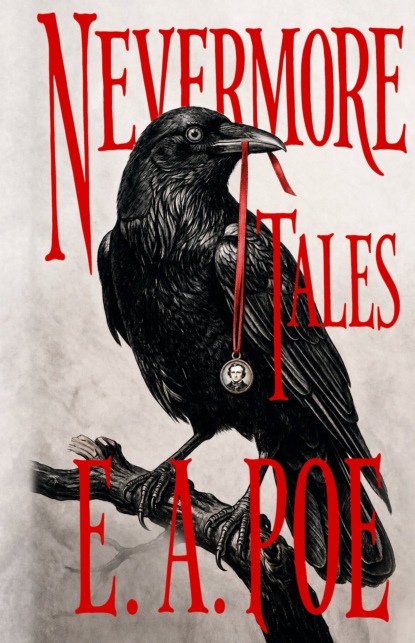
Nevermore Tales / Сказания Невермора
An hour thus elapsed when (could it be possible?) I was a second time aware of some vague sound issuing from the region of the bed. I listened – in extremity of horror. The sound came again – it was a sigh. Rushing to the corpse, I saw – distinctly saw – a tremor upon the lips. In a minute afterward they relaxed, disclosing a bright line of the pearly teeth. Amazement now struggled in my bosom with the profound awe which had hitherto reigned there alone. I felt that my vision grew dim, that my reason wandered; and it was only by a violent effort that I at length succeeded in nerving myself to the task which duty thus once more had pointed out. There was now a partial glow upon the forehead and upon the cheek and throat; a perceptible warmth pervaded the whole frame; there was even a slight pulsation at the heart. The lady lived; and with redoubled ardor I betook myself to the task of restoration. I chafed and bathed the temples and the hands, and used every exertion which experience, and no little medical reading, could suggest. But in vain. Suddenly, the color fled, the pulsation ceased, the lips resumed the expression of the dead, and, in an instant afterward, the whole body took upon itself the icy chilliness, the livid hue, the intense rigidity, the sunken outline, and all the loathsome peculiarities of that which has been, for many days, a tenant of the tomb.
And again I sunk into visions of Ligeia – and again, (what marvel that I shudder while I write?), again there reached my ears a low sob from the region of the ebony bed. But why shall I minutely detail the unspeakable horrors of that night? Why shall I pause to relate how, time after time, until near the period of the gray dawn, this hideous drama of revivification was repeated; how each terrific relapse was only into a sterner and apparently more irredeemable death; how each agony wore the aspect of a struggle with some invisible foe; and how each struggle was succeeded by I know not what of wild change in the personal appearance of the corpse? Let me hurry to a conclusion.
The greater part of the fearful night had worn away, and she who had been dead, once again stirred – and now more vigorously than hitherto, although arousing from a dissolution more appalling in its utter hopelessness than any. I had long ceased to struggle or to move, and remained sitting rigidly upon the ottoman, a helpless prey to a whirl of violent emotions, of which extreme awe was perhaps the least terrible, the least consuming. The corpse, I repeat, stirred, and now more vigorously than before. The hues of life flushed up with unwonted energy into the countenance – the limbs relaxed – and, save that the eyelids were yet pressed heavily together, and that the bandages and draperies of the grave still imparted their charnel character to the figure, I might have dreamed that Rowena had indeed shaken off, utterly, the fetters of Death. But if this idea was not, even then, altogether adopted, I could at least doubt no longer, when, arising from the bed, tottering, with feeble steps, with closed eyes, and with the manner of one bewildered in a dream, the thing that was enshrouded advanced boldly and palpably into the middle of the apartment.
I trembled not – I stirred not – for a crowd of unutterable fancies connected with the air, the stature, the demeanor of the figure, rushing hurriedly through my brain, had paralyzed – had chilled me into stone. I stirred not – but gazed upon the apparition. There was a mad disorder in my thoughts – a tumult unappeasable. Could it, indeed, be the living Rowena who confronted me? Could it indeed be Rowena at all – the fair-haired, the blue-eyed Lady Rowena Trevanion of Tremaine? Why, why should I doubt it? The bandage lay heavily about the mouth – but then might it not be the mouth of the breathing Lady of Tremaine? And the cheeks – there were the roses as in her noon of life – yes, these might indeed be the fair cheeks of the living Lady of Tremaine. And the chin, with its dimples, as in health, might it not be hers? – but had she then grown taller since her malady? What inexpressible madness seized me with that thought? One bound, and I had reached her feet! Shrinking from my touch, she let fall from her head, unloosened, the ghastly cerements which had confined it, and there streamed forth, into the rushing atmosphere of the chamber, huge masses of long and dishevelled hair; it was blacker than the raven wings of the midnight! And now slowly opened the eyes of the figure which stood before me. “Here then, at least,” I shrieked aloud, “can I never – can I never be mistaken – these are the full, and the black, and the wild eyes – of my lost love – of the Lady – of the LADY LIGEIA.”
Morella
Itself, by itself, solely, one everlasting, and single.
– PLATO – Sympos.With a feeling of deep yet most singular affection I regarded my friend Morella. Thrown by accident into her society many years ago, my soul from our first meeting, burned with fires it had never before known; but the fires were not of Eros, and bitter and tormenting to my spirit was the gradual conviction that I could in no manner define their unusual meaning or regulate their vague intensity. Yet we met; and fate bound us together at the altar; and I never spoke of passion nor thought of love. She, however, shunned society, and, attaching herself to me alone rendered me happy. It is a happiness to wonder; it is a happiness to dream.
Morella's erudition was profound. As I hope to live, her talents were of no common order – her powers of mind were gigantic. I felt this, and, in many matters, became her pupil. I soon, however, found that, perhaps on account of her Presburg education, she placed before me a number of those mystical writings which are usually considered the mere dross of the early German literature. These, for what reason I could not imagine, were her favourite and constant study – and that in process of time they became my own, should be attributed to the simple but effectual influence of habit and example.
In all this, if I err not, my reason had little to do. My convictions, or I forget myself, were in no manner acted upon by the ideal, nor was any tincture of the mysticism which I read to be discovered, unless I am greatly mistaken, either in my deeds or in my thoughts. Persuaded of this, I abandoned myself implicitly to the guidance of my wife, and entered with an unflinching heart into the intricacies of her studies. And then – then, when, poring over forbidden pages, I felt a forbidden spirit enkindling within me – would Morella place her cold hand upon my own, and rake up from the ashes of a dead philosophy some low, singular words, whose strange meaning burned themselves in upon my memory. And then, hour after hour, would I linger by her side, and dwell upon the music of her voice, until at length its melody was tainted with terror, and there fell a shadow upon my soul, and I grew pale, and shuddered inwardly at those too unearthly tones. And thus, joy suddenly faded into horror, and the most beautiful became the most hideous, as Hinnom became Ge-Henna.
It is unnecessary to state the exact character of those disquisitions which, growing out of the volumes I have mentioned, formed, for so long a time, almost the sole conversation of Morella and myself. By the learned in what might be termed theological morality they will be readily conceived, and by the unlearned they would, at all events, be little understood. The wild Pantheism of Fichte; the modified Palingenesia of the Pythagoreans; and, above all, the doctrines of Identity as urged by Schelling, were generally the points of discussion presenting the most of beauty to the imaginative Morella. That identity which is termed personal, Mr. Locke, I think, truly defines to consist in the saneness of rational being. And since by person we understand an intelligent essence having reason, and since there is a consciousness which always accompanies thinking, it is this which makes us all to be that which we call ourselves – thereby distinguishing us from other beings that think, and giving us our personal identity. But the principium individuationis, the notion of that identity which at death is or is not lost forever – was to me, at all times, a consideration of intense interest; not more from the perplexing and exciting nature of its consequences, than from the marked and agitated manner in which Morella mentioned them.
But, indeed, the time had now arrived when the mystery of my wife's manner oppressed me as a spell. I could no longer bear the touch of her wan fingers, nor the low tone of her musical language, nor the lustre of her melancholy eyes. And she knew all this, but did not upbraid; she seemed conscious of my weakness or my folly, and, smiling, called it Fate. She seemed, also, conscious of a cause, to me unknown, for the gradual alienation of my regard; but she gave me no hint or token of its nature. Yet was she woman, and pined away daily. In time the crimson spot settled steadily upon the cheek, and the blue veins upon the pale forehead became prominent; and one instant my nature melted into pity, but in, next I met the glance of her meaning eyes, and then my soul sickened and became giddy with the giddiness of one who gazes downward into some dreary and unfathomable abyss.
Shall I then say that I longed with an earnest and consuming desire for the moment of Morella's decease? I did; but the fragile spirit clung to its tenement of clay for many days – for many weeks and irksome months, until my tortured nerves obtained the mastery over my mind, and I grew furious through delay, and, with the heart of a fiend, cursed the days and the hours and the bitter moments, which seemed to lengthen and lengthen as her gentle life declined – like shadows in the dying of the day.
But one autumnal evening, when the winds lay still in heaven, Morella called me to her bedside. There was a dim mist over all the earth, and a warm glow upon the waters, and amid the rich October leaves of the forest, a rainbow from the firmament had surely fallen.
“It is a day of days,” she said, as I approached; “a day of all days either to live or die. It is a fair day for the sons of earth and life – ah, more fair for the daughters of heaven and death!”
I kissed her forehead, and she continued:
“I am dying, yet shall I live.”
“Morella!”
“The days have never been when thou couldst love me – but her whom in life thou didst abhor, in death thou shalt adore.”
“Morella!”
“I repeat that I am dying. But within me is a pledge of that affection – ah, how little! – which thou didst feel for me, Morella. And when my spirit departs shall the child live – thy child and mine, Morella's. But thy days shall be days of sorrow – that sorrow which is the most lasting of impressions, as the cypress is the most enduring of trees. For the hours of thy happiness are over and joy is not gathered twice in a life, as the roses of Paestum twice in a year. Thou shalt no longer, then, play the Teian with time, but, being ignorant of the myrtle and the vine, thou shalt bear about with thee thy shroud on the earth, as do the Moslemin at Mecca.”
“Morella!” I cried, “Morella! how knowest thou this?” but she turned away her face upon the pillow and a slight tremor coming over her limbs, she thus died, and I heard her voice no more.
Yet, as she had foretold, her child, to which in dying she had given birth, which breathed not until the mother breathed no more, her child, a daughter, lived. And she grew strangely in stature and intellect, and was the perfect resemblance of her who had departed, and I loved her with a love more fervent than I had believed it possible to feel for any denizen of earth.
But, ere long the heaven of this pure affection became darkened, and gloom, and horror, and grief swept over it in clouds. I said the child grew strangely in stature and intelligence. Strange, indeed, was her rapid increase in bodily size – but terrible, oh! terrible were the tumultuous thoughts which crowded upon me while watching the development of her mental being. Could it be otherwise, when I daily discovered in the conceptions of the child the adult powers and faculties of the woman? – when the lessons of experience fell from the lips of infancy? and when the wisdom or the passions of maturity I found hourly gleaming from its full and speculative eye? When, I say, all this became evident to my appalled senses – when I could no longer hide it from my soul, nor throw it off from those perceptions which trembled to receive it – is it to be wondered at that suspicions, of a nature fearful and exciting, crept in upon my spirit, or that my thoughts fell back aghast upon the wild tales and thrilling theories of the entombed Morella? I snatched from the scrutiny of the world a being whom destiny compelled me to adore, and in the rigorous seclusion of my home, watched with an agonizing anxiety over all which concerned the beloved.
And as years rolled away, and I gazed day after day upon her holy, and mild, and eloquent face, and poured over her maturing form, day after day did I discover new points of resemblance in the child to her mother, the melancholy and the dead. And hourly grew darker these shadows of similitude, and more full, and more definite, and more perplexing, and more hideously terrible in their aspect. For that her smile was like her mother's I could bear; but then I shuddered at its too perfect identity – that her eyes were like Morella's I could endure; but then they, too, often looked down into the depths of my soul with Morella's own intense and bewildering meaning. And in the contour of the high forehead, and in the ringlets of the silken hair, and in the wan fingers which buried themselves therein, and in the sad musical tones of her speech, and above all – oh! above all – in the phrases and expressions of the dead on the lips of the loved and the living, I found food for consuming thought and horror – for a worm that would not die.
Thus passed away two lustra of her life, and as yet my daughter remained nameless upon the earth. “My child,” and “my love,” were the designations usually prompted by a father's affection, and the rigid seclusion of her days precluded all other intercourse. Morella's name died with her at her death. Of the mother I had never spoken to the daughter;– it was impossible to speak. Indeed, during the brief period of her existence, the latter had received no impressions from the outward world, save such as might have been afforded by the narrow limits of her privacy. But at length the ceremony of baptism presented to my mind, in its unnerved and agitated condition, a present deliverance from the terrors of my destiny. And at the baptismal font I hesitated for a name. And many titles of the wise and beautiful, of old and modern times, of my own and foreign lands, came thronging to my lips, with many, many fair titles of the gentle, and the happy, and the good. What prompted me then to disturb the memory of the buried dead? What demon urged me to breathe that sound, which in its very recollection was wont to make ebb the purple blood in torrents from the temples to the heart? What fiend spoke from the recesses of my soul, when amid those dim aisles, and in the silence of the night, I whispered within the ears of the holy man the syllables – Morella? What more than fiend convulsed the features of my child, and overspread them with hues of death, as starting at that scarcely audible sound, she turned her glassy eyes from the earth to heaven, and falling prostrate on the black slabs of our ancestral vault, responded —“I am here!”
Distinct, coldly, calmly distinct, fell those few simple sounds within my ear, and thence like molten lead rolled hissingly into my brain. Years – years may pass away, but the memory of that epoch – never! Nor was I indeed ignorant of the flowers and the vine – but the hemlock and the cypress overshadowed me night and day. And I kept no reckoning of time or place, and the stars of my fate faded from heaven, and therefore the earth grew dark, and its figures passed by me like flitting shadows, and among them all I beheld only – Morella. The winds of the firmament breathed but one sound within my ears, and the ripples upon the sea murmured evermore – Morella. But she died; and with my own hands I bore her to the tomb; and I laughed with a long and bitter laugh as I found no traces of the first in the charnel where I laid the second, Morella.
Berenice
Dicebant mihi sodales, si sepulchrum amicae visitarem, curas meas aliquar tulum fore levatas.
– Ebn Zaiat.Misery is manifold. The wretchedness of earth is multiform. Overreaching the wide horizon as the rainbow, its hues are as various as the hues of that arch – as distinct too, yet as intimately blended. Overreaching the wide horizon as the rainbow! How is it that from beauty I have derived a type of unloveliness? – from the covenant of peace, a simile of sorrow? But as, in ethics, evil is a consequence of good, so, in fact, out of joy is sorrow born. Either the memory of past bliss is the anguish of to-day, or the agonies which are, have their origin in the ecstasies which might have been.
My baptismal name is Egaeus; that of my family I will not mention. Yet there are no towers in the land more time-honored than my gloomy, gray, hereditary halls. Our line has been called a race of visionaries; and in many striking particulars – in the character of the family mansion – in the frescos of the chief saloon – in the tapestries of the dormitories – in the chiselling of some buttresses in the armory – but more especially in the gallery of antique paintings – in the fashion of the library chamber – and, lastly, in the very peculiar nature of the library's contents – there is more than sufficient evidence to warrant the belief.
The recollections of my earliest years are connected with that chamber, and with its volumes – of which latter I will say no more. Here died my mother. Herein was I born. But it is mere idleness to say that I had not lived before – that the soul has no previous existence. You deny it? – let us not argue the matter. Convinced myself, I seek not to convince. There is, however, a remembrance of aerial forms – of spiritual and meaning eyes – of sounds, musical yet sad – a remembrance which will not be excluded; a memory like a shadow – vague, variable, indefinite, unsteady; and like a shadow, too, in the impossibility of my getting rid of it while the sunlight of my reason shall exist.
In that chamber was I born. Thus awaking from the long night of what seemed, but was not, nonentity, at once into the very regions of fairy land – into a palace of imagination – into the wild dominions of monastic thought and erudition – it is not singular that I gazed around me with a startled and ardent eye – that I loitered away my boyhood in books, and dissipated my youth in reverie; but it is singular that as years rolled away, and the noon of manhood found me still in the mansion of my fathers – it is wonderful what stagnation there fell upon the springs of my life – wonderful how total an inversion took place in the character of my commonest thought. The realities of the world affected me as visions, and as visions only, while the wild ideas of the land of dreams became, in turn, not the material of my every-day existence, but in very deed that existence utterly and solely in itself.
Berenice and I were cousins, and we grew up together in my paternal halls. Yet differently we grew – I, ill of health, and buried in gloom – she, agile, graceful, and overflowing with energy; hers, the ramble on the hill-side – mine the studies of the cloister; I, living within my own heart, and addicted, body and soul, to the most intense and painful meditation – she, roaming carelessly through life, with no thought of the shadows in her path, or the silent flight of the raven-winged hours. Berenice! – I call upon her name – Berenice! – and from the gray ruins of memory a thousand tumultuous recollections are startled at the sound! Ah, vividly is her image before me now, as in the early days of her light-heartedness and joy! Oh, gorgeous yet fantastic beauty! Oh, sylph amid the shrubberies of Arnheim! Oh, Naiad among its fountains! And then – then all is mystery and terror, and a tale which should not be told. Disease – a fatal disease, fell like the simoon upon her frame; and, even while I gazed upon her, the spirit of change swept over her, pervading her mind, her habits, and her character, and, in a manner the most subtle and terrible, disturbing even the identity of her person! Alas! the destroyer came and went! – and the victim – where is she? I knew her not – or knew her no longer as Berenice.
Among the numerous train of maladies superinduced by that fatal and primary one which effected a revolution of so horrible a kind in the moral and physical being of my cousin, may be mentioned as the most distressing and obstinate in its nature, a species of epilepsy not unfrequently terminating in trance itself – trance very nearly resembling positive dissolution, and from which her manner of recovery was in most instances, startlingly abrupt. In the mean time my own disease – for I have been told that I should call it by no other appellation – my own disease, then, grew rapidly upon me, and assumed finally a monomaniac character of a novel and extraordinary form – hourly and momently gaining vigor – and at length obtaining over me the most incomprehensible ascendancy. This monomania, if I must so term it, consisted in a morbid irritability of those properties of the mind in metaphysical science termed the attentive. It is more than probable that I am not understood; but I fear, indeed, that it is in no manner possible to convey to the mind of the merely general reader, an adequate idea of that nervous intensity of interest with which, in my case, the powers of meditation (not to speak technically) busied and buried themselves, in the contemplation of even the most ordinary objects of the universe.
To muse for long unwearied hours, with my attention riveted to some frivolous device on the margin, or in the typography of a book; to become absorbed, for the better part of a summer's day, in a quaint shadow falling aslant upon the tapestry or upon the floor; to lose myself, for an entire night, in watching the steady flame of a lamp, or the embers of a fire; to dream away whole days over the perfume of a flower; to repeat, monotonously, some common word, until the sound, by dint of frequent repetition, ceased to convey any idea whatever to the mind; to lose all sense of motion or physical existence, by means of absolute bodily quiescence long and obstinately persevered in: such were a few of the most common and least pernicious vagaries induced by a condition of the mental faculties, not, indeed, altogether unparalleled, but certainly bidding defiance to anything like analysis or explanation.
Yet let me not be misapprehended. The undue, earnest, and morbid attention thus excited by objects in their own nature frivolous, must not be confounded in character with that ruminating propensity common to all mankind, and more especially indulged in by persons of ardent imagination. It was not even, as might be at first supposed, an extreme condition, or exaggeration of such propensity, but primarily and essentially distinct and different. In the one instance, the dreamer, or enthusiast, being interested by an object usually not frivolous, imperceptibly loses sight of this object in a wilderness of deductions and suggestions issuing therefrom, until, at the conclusion of a day-dream often replete with luxury, he finds the incitamentum, or first cause of his musings, entirely vanished and forgotten. In my case, the primary object was invariably frivolous, although assuming, through the medium of my distempered vision, a refracted and unreal importance. Few deductions, if any, were made; and those few pertinaciously returning in upon the original object as a centre. The meditations were never pleasurable; and, at the termination of the reverie, the first cause, so far from being out of sight, had attained that supernaturally exaggerated interest which was the prevailing feature of the disease. In a word, the powers of mind more particularly exercised were, with me, as I have said before, the attentive, and are, with the day-dreamer, the speculative.
My books, at this epoch, if they did not actually serve to irritate the disorder, partook, it will be perceived, largely, in their imaginative and inconsequential nature, of the characteristic qualities of the disorder itself. I well remember, among others, the treatise of the noble Italian, Coelius Secundus Curio, “De Amplitudine Beati Regni Dei;” St. Austin's great work, the “City of God;” and Tertullian's “De Carne Christi,” in which the paradoxical sentence “Mortuus est Dei filius; credible est quia ineptum est: et sepultus resurrexit; certum est quia impossibile est,” occupied my undivided time, for many weeks of laborious and fruitless investigation.