Полная версия:
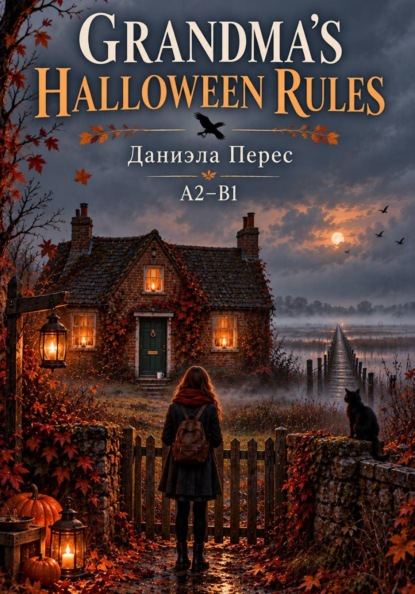
Grandma's Halloween Rules
1. Mr. Pratt stood behind the ______ and read a magazine.
2. There was a yellow notice on the ______ by the door.
3. Kate walked round the ______ and read every stone.
4. Her grandmother had no ______ yet, only a wooden marker.
5. The ______ of St. Botolph’s was called Alice Sandoe.
6. The burial ______ for 1963 listed nine names.
7. Three people had ______ 1963 and then stopped speaking.
8. Mr. Pratt was polite but he clearly wanted to ______ the question.
2. Match the words
1. a parish 2. awkward 3. a stranger 4. local 5. to avoid 6. polite
a. незнакомец b. приход c. местный d. избегать e. неловкий f. вежливый
3. Choose the correct answer
1. A vicar works in: a) a shop b) a church c) a school
2. If a conversation is awkward: a) it is comfortable b) it is uncomfortable c) it is very funny
3. To change the subject means to: a) start talking about something else b) speak louder c) leave the room
4. A record is: a) a written note of something that happened b) a person c) a room
5. A local person is somebody who: a) is visiting b) lives in that place c) works far away
4. Answer the questions
1. How does Mr. Pratt know who Kate is?
2. What does the yellow notice in the shop say?
3. What does Kate find, and not find, in the churchyard?
4. What did Iris say to Reverend Sandoe about 1963?
5. What do people in the village do on the Quiet Night?
5. True, false or not given
1. The shop is open on Sunday.
2. There are eleven Mercers buried in the churchyard.
3. There is a gravestone for Nell Mercer.
4. Nine people were buried in Wraycombe in 1963.
5. Children from Wraycombe go trick or treating in Barford.
Грамматика
Past Continuous и Past Simple
Past Continuous описывает действие, которое длилось в определённый момент прошлого. Оно как бы рисует фон.
Форма: was / were + глагол с -ing
Лицо — Форма:
I / he / she / it — was walking
you / we / they — were walking
Отрицание: She wasn’t listening. · They weren’t talking.
Вопрос: Was he reading? · Were you waiting?
Как два времени работают вместе
Это главное, ради чего нужен Past Continuous. Длинное действие идёт фоном в Past Continuous, а короткое действие врывается в него в Past Simple.
Kate was walking round the churchyard when the vicar appeared.
Her mother was talking on the phone when Kate left the house.
Обрати внимание на союзы:
Союз — Какое время после него:
when — обычно Past Simple (короткое действие)
while — обычно Past Continuous (длинное действие)
as — Past Continuous
She went out while her mother was talking on the phone.
She was reading the stones when somebody spoke behind her.
Два одновременных длинных действия
Оба глагола в Past Continuous, обычно с while:
Mr. Pratt was reading a magazine while Kate was looking at the notice board.
Когда Past Continuous не используется
С глаголами состояния: know, understand, believe, want, need, like, remember, mean, seem, belong.
Правильно: She knew the answer.
Неправильно: She was knowing the answer.
Ещё одно применение: описание обстановки
В начале главы или сцены Past Continuous часто задаёт фон, а затем повествование переходит в Past Simple.
The wind was moving in the yew trees. Somebody was working at the far end with a wheelbarrow. Kate walked round the churchyard slowly.
Grammar exercises
1. Past Simple or Past Continuous
1. Kate (walk) ______ into the shop while Mr. Pratt (read) ______ a magazine.
2. She (look) ______ at the stones when somebody (speak) ______ behind her.
3. Her mother (talk) ______ on the phone when Kate (leave) ______.
4. The wind (move) ______ in the trees and the sun (shine) ______.
5. While the vicar (make) ______ tea, Kate (read) ______ the register.
2. Choose when or while
1. She was reading the notice ______ he came in.
2. ______ they were working in the kitchen, the phone rang.
3. Kate found the tin ______ she was clearing the dresser.
4. ______ the vicar was looking for 1963, Kate looked out of the window.
5. He stopped speaking ______ she asked the question.
3. Correct the mistakes
1. She was knowing the answer.
2. While she read the register, the vicar made tea.
3. They was waiting outside.
4. What did you doing at six o’clock?
5. He was write a letter when I arrived.
4. Complete the paragraph
It (1. be) ______ a cold bright morning. The wind (2. blow) ______ across the fen and a few leaves (3. move) ______ along the path. Kate (4. read) ______ the names on the stones when she (5. hear) ______ a wheelbarrow behind her. She (6. turn) ______ round. A woman in muddy boots (7. stand) ______ there and (8. look) ______ at her.
Ответы
Vocabulary 1: 1. counter 2. notice board 3. churchyard 4. gravestone 5. vicar 6. record / register 7. mentioned 8. avoid
Vocabulary 2: 1-b, 2-e, 3-a, 4-c, 5-d, 6-f
Vocabulary 3: 1-b, 2-b, 3-a, 4-a, 5-b
Vocabulary 4: 1. Because there are only four hundred and ten people in the village and he knows all of them. 2. THE QUIET NIGHT, 31 October, candles from six, please keep to the usual arrangements. 3. She finds eleven Mercers, including Iris and her parents, but no Nell and no child who died in the sixties. 4. That Kate’s family did not need to know about it, that it was a village thing and they managed it. 5. They put a candle in every window facing the road at six and stay indoors; nobody goes trick or treating.
Vocabulary 5: 1. Not given 2. True 3. False 4. True 5. True
Grammar 1: 1. walked / was reading 2. was looking / spoke 3. was talking / left 4. was moving / was shining 5. was making / read
Grammar 2: 1. when 2. While 3. while 4. While 5. when
Grammar 3: 1. She knew the answer. 2. While she was reading the register, the vicar made tea. 3. They were waiting outside. 4. What were you doing at six o’clock? 5. He was writing a letter when I arrived.
Grammar 4: 1. was 2. was blowing 3. were moving 4. was reading 5. heard 6. turned 7. was standing 8. was looking
Chapter 4. Ten Instructions
Key vocabulary
an order — приказ
advice — совет
a command — команда, приказ
sensible — разумный
practical — практичный
superstition — суеверие
a custom — обычай
harmless — безобидный
to obey — подчиняться
to break a rule — нарушить правило
to protect — защищать
a threat — угроза
specific — конкретный
odd — странный
the point (of something) — смысл, суть
Ten Instructions
The walk down Fen Lane took eleven minutes and she did it in eight, because the wind had got up and because she had a great deal to say.
Kate got back at half past twelve and found her mother sitting on the stairs with the phone in her hand and an expression that suggested the solicitor had won.
—Any bread? Helen said.
—I have bread.
—Then I forgive everything.
The bread was two days old and neither of them mentioned it.
They had lunch. Kate waited until her mother had eaten most of a sandwich, because she had learned that too, and then she put the list of rules on the table between them.
—I want to talk about this properly.
—Kate.
—Ten minutes. Then we can go back to the shed and I won’t mention it again today.
Helen put down her sandwich and looked at the piece of paper for a moment, and Kate watched her do the thing she had been doing all week, which was to decide to be reasonable about something she did not want to discuss.
—Go on then.
—Right. Rules one to four. Lock the back door and leave the key in the lock. Candles in every window facing the road at six. Food on the front step, bring the plate in before morning. Don’t go to the churchyard after sunset. Those are all completely sensible and I can explain every single one of them.
—Explain them.
—The back door, Kate said. This house is four hundred metres from the village on a dark lane. Lock it. Obviously lock it. And if you leave the key in the lock, nobody can push a key out from outside and nobody can get a hand through and open it, and also you can find it in the dark.
—Fine.
—Candles in the windows facing the road. That’s a lighthouse. There are no street lights. If somebody is walking back from the pub on a night with no moon and there’s fog off the fen, a line of lit windows tells them where the road is and where the ditch isn’t.
Helen said nothing.
—Food on the step. If it’s the one night of the year when everybody’s out walking, you feed people. And don’t look at what’s left is not spooky, it just means don’t be nosy about who took it, because in a village of four hundred people, being hungry is embarrassing.
—All right, her mother said slowly.
—And don’t go to the churchyard after sunset, because it is full of stone edges and holes and there are no lights and you will break your leg.
—Kate, why do you know all this?
—Because I read a lot and there’s no internet here, said Kate. Rule five.
—Count the knocks.
—Count the knocks. Three is a neighbour, more than three is not. And that one is odd, but it’s still practical if you think about it. Somebody who lives here knocks three times because that’s what everybody does. A stranger, or somebody drunk, or somebody in a panic, knocks a lot. So it’s a code. It tells you who’s outside before you open the door.
—That is genuinely clever.
—Rule six, Kate said, cover the mirror. That’s a custom. Loads of cultures cover mirrors after a death, and the reasons people give for it are all different and all made up afterwards. Mrs. Pratt did it in August, you said so yourself.
—I did.
—So that one isn’t even hers. That one is just the village.
—Unless she wrote it down because the village did it, said Helen, in which case it is the only rule on this list that came from outside her own head.
Kate stopped and looked at her mother.
—That is a really good point.
—I have my moments, said Helen Mercer. That’s a custom. Loads of cultures cover mirrors after a death. Mrs. Pratt did it in August, you said so yourself.
—I did.
—Rule seven. If a voice asks for water, take it out and go back in. If a voice asks to come in, say nothing.
Kate stopped, with her finger on the line.
She had read the list perhaps thirty times since Saturday afternoon, on the stairs, in bed, once in the bath, and she had read it as ten things. Sitting at the table with her mother opposite her and the paper the right way up, she saw for the first time that it was not ten things at all. It was six things and then four things, and something happened in the middle of it.
—That one changes, she said.
—What do you mean?
—Rules one to six are about things. Doors, candles, plates, mirrors. Rule seven is about a person. And it’s not don’t let them in. It’s say nothing at all. Which is a very strange thing to write down.
Helen turned the paper round and read it again.
—Rule eight, Kate said. Stay in the kitchen until the church clock has finished striking twelve. And you remember doing that.
—I remember doing that.
—Rule nine. Whatever you hear in the garden, do not answer it.
—Yes.
—And rule ten.
Neither of them said rule ten out loud, and both of them looked at it. It sat at the bottom of the page in the same brown ink as the other nine, in the same careful capitals, taking up exactly one line.
—Here’s the thing, Kate said. Nine of them are village sense. You could write nine of them for anywhere in the country in nineteen sixty and nobody would blink. But ten is not general advice. Ten is about one specific thing that somebody expects to happen.
—You don’t know that.
—Mum, look at the language, Kate said. All the other rules are about categories. Somebody. A voice. Anybody walking past. Rule ten says: anyone who calls you by your name. That is not a category. That is a description.
Helen was quiet for a while. She got up and filled the kettle and did not switch it on, and stood at the sink looking out at the garden and at the flat grey line of the fen behind it.
—She wrote this when she was frightened, she said finally.
—Yes.
—Not once. Look at the creases. She folded and unfolded this for years.
They sat with it.
The kitchen clock, which was electric and which neither of them had switched off, made its small click on the half hour. Outside the window a bird landed on the fence, decided against it, and left.
—I’m going to try something, Kate said. Don’t be annoyed.
—That is a terrible way to start a sentence.
—I want to do it. All ten. On Friday.
Helen looked up.
—Absolutely not.
—Why not?
—Because it’s ghoulish, Helen said, and because I do not want to spend Halloween in my dead mother’s kitchen performing a ritual I don’t understand. And because I have spent two months being extremely sensible about all of this and I would quite like to keep going.
—It’s not a ritual. It’s a to do list. Lock a door, light some candles, put a plate out, stay in the kitchen. We were going to stay in the kitchen anyway, there’s nothing else in this house except one armchair and a broken television.
—Kate.
—And if nothing happens, said Kate, then we know it’s nothing. And if we don’t do it, we will both be sitting here on Friday night thinking about it anyway, and we will not sleep, and you know that’s true.
Her mother opened her mouth and closed it again.
—I hate that argument, she said.
—I know.
—I hate it because it’s correct.
—One condition, her mother said.
—Anything.
—We don’t do rule ten as a game. If somebody genuinely knocks on that door on Friday night, and it is a real person who is cold and needs help, we open it. I am not standing in a hallway ignoring a human being because of a piece of paper.
—Agreed.
—Say it properly.
—Agreed, Kate said. A real person gets the door.
They compromised in the end, in the way that families compromise, which is that Helen said she would think about it and then did not mention it again, which Kate correctly understood as yes.
They went back to work. The shed took the rest of the afternoon and produced a lawnmower that did not work, nine flowerpots, a bicycle from about 1975 and a box of jam jars, all of them washed, all of them stacked upside down, all of them empty and waiting for a summer that was not going to happen.
Kate carried the jars out to the bin pile, and then she stood holding one of them for slightly too long, and put it in the KEEP box instead, and did not explain why, and her mother did not ask.
At four o’clock somebody knocked on the door.
They both went very still, and then both felt extremely stupid, because it was four o’clock in the afternoon and the sun was out.
Kate counted the knocks afterwards, in her head, without meaning to, and there had been three of them.
There was a girl on the step. She was about Kate’s age, with short hair, a puffa jacket and a bicycle lying on its side on the path behind her.
—Are you Kate?
—Yes.
—Ruby Vance. My gran wants to meet you.
She said it the way you deliver a message you have been told to deliver word for word, and then she waited.
—Sorry, who’s your gran?
—Edna Vance. She’s eighty-eight and she lives at number four on the green and she has been talking about you since Friday.
Kate looked back into the hall. Her mother had appeared at the kitchen door with a tea towel.
—Why does your gran want to meet me? Kate said.
Ruby put her hands in her pockets.
—Because you went to the churchyard yesterday and asked the vicar about 1963, she said, and Alice told my gran, and my gran hasn’t sat down since. She’s made a cake. That’s a serious sign. She hasn’t made a cake since my brother’s wedding and she doesn’t like my brother.
There was a short silence on the step.
—Ruby, Helen said from the hall. Does your grandmother know what happened in 1963?
—Yeah, Ruby said. She was eleven.
She said it in the completely flat way that teenagers say enormous things, and then she added, more carefully:
Конец ознакомительного фрагмента.
Текст предоставлен ООО «Литрес».
Прочитайте эту книгу целиком, купив полную легальную версию на Литрес.
Безопасно оплатить книгу можно банковской картой Visa, MasterCard, Maestro, со счета мобильного телефона, с платежного терминала, в салоне МТС или Связной, через PayPal, WebMoney, Яндекс.Деньги, QIWI Кошелек, бонусными картами или другим удобным Вам способом.
Вы ознакомились с фрагментом книги.
Для бесплатного чтения открыта только часть текста.
Приобретайте полный текст книги у нашего партнера:
Полная версия книги
Всего 10 форматов