Полная версия:
The City to Love

Сергей Огольцов
The City to Love
The City to Love…
By Sehrguey Ogoltsoff
AI + SO © Sehrguey Ogoltsoff, 2026
The third planet from the sun, the eastern hemisphere, up from the Cancer tropic… long story shirt, here I am, face to face with my PC, the keyboard, and the mouse…
Sehrguey Ogoltsoff
The City to Love…
2026
1 Explanatory
What is the Stepanakert Saga? It is a book series by an eyewitness, an independent writer. And what exactly is an independent writer?
Someone who writes what is permitted, moral, correct, true, or profitable?
Hell no! With zero regard for conventional standards, he chronicles what he saw, what he felt, and the things that burned him over and over until he finally said, "To hell with all that!…"
He’s a bastard with no party affiliation, no ideals, and no homeland—this independent son of a bitch…
The Stepanakert Saga is a literary chronicle spanning thirty-seven years, from the hope-filled dawn to the tragic twilight of the Mountainous Karabakh Armenians' struggle for the independence of their native land.
Sounds like the campaign trail word-salad of some populist little prick, doesn't it? Or a speech by a high school military instructor. It is what it is, no getting around it. Kyanga, li! It's a mix of sin and laughter—a tragedy so absurd you'll die laughing, a comedy that will follow you straight to the grave.
In other words, it’s a highly entertaining read for a wide audience of every stripe, and streak, and interest.
And that includes serious researchers diving into ultra-deep questions, like: how and why did Armenians worldwide—those from Karabakh included, though these were the last to be asked—lose this historic homeland of theirs, the one of ultimate significance?
2 Synopsis
The third book of Stepanakert Saga is much more kaleidoscopic and richer in characters than the previous two put together. Structurally, it has two parts:
1. "The Provincial Summer of '98", which depicts Stepanakert four years after events of The Ficus period. Now, it's time for those who stayed alive under bombardments to fight, as hard as they could, for survive in the post-war space. This part is made up of a series of essays published in the summer indicated in its title in the press of the Republic of Mountainous Karabakh. Yep, both organs scrambled for the stuff and turned it out in space of a couple of days after each other.
2. Part Two: Beyond the City Limits mostly justifies its name, yet
the city to love still remains the center of gravity.
3 Sincere Gratitude
As before yet more so I'm grateful to my editor, translator, co-author and — what's more — my gossip, and my tutor. Thank you, partner, for polishing the clumsy heap of my clunky blabber into something readable.
Part One: The Provincial Summer of '98
4 Public Manifestation of Unfalling Gratitude
(A thing or two about cataclysms, like, for an epigraph)
The fourth Pharaoh of the seventeenth dynasty, Akhulidzalupón Pti-Psi—ruler of Upper and Lower Egypt, et cetera, et cetera…—slipped up in a fog conjured by the vile, seductive trickery of sorcerers from perfidious Mesopotamia.
And oh, how his brains got muddled, thoroughly scammed by those wizardly swindlers, until his loyalty to the state religion—which had survived all seventeen dynasties without a single schism or collapse—went completely to hell. But this Akhulidzalupón, acting like the absolute gull he was, took them at their word, those Chaldean mages making mug of him, swallowed the bait of a quirk idea as if everything present in the Universe abides in an undeniable (though not traceable at a glance) interconnectedness.
Long story short: breathe through your nose and keep it clean, don't play Jesus, and never meddle with the natural course of evolution—lest you trigger a chain of unexpected and, quite possibly, horrific events…
His wife, Queen Naphthalínti, on the other hand, didn't give a flying damn from the top of any and all Egyptian pyramids about the mind-boggling dogmas of abstract theorizing. And when the most beloved of her cats (the bottomless abyss of millennia, having greedily swallowed the beast, refused to spit back a single bone, let alone a name—though even to this day, especially in the evenings, bizarre legends go on spinning about its awesome tail both stiff and springy) suddenly fell ill, the Queen was definitely not in the mood to wait around for the feline critter to drop dead the decent natural way of adequate quality…
She paid complete zero attention to the tight indignant pucker on the Pharaoh’s royal mug but commanded the priests of gods with medical tilts to be summoned. Gathering in full council, they unanimously prescribed a thorough flushing of the cat’s bowels through his rear pucker.
The very next morning, at the absolute crack of dawn, Akhulidzalupón Pti-Psi burst into Naphthalínti’s chambers, waving a broad sheet of papyrus in his right hand. Fresh printer's ink was practically splattering off it in every direction of the compass, and he bellowed at the top of his pharaonic lungs:
"You’ve done it now! Here’s your cat’s enema for you! Atlantis is poof… Sunk to the sea bottom goddamn bestiaries! All because of your interconnected bastard furball!..”
. . .
This piece (acting as an epigraph to what is basically a preface) surfaced back in ’89, right after a natural cataclysm—the Great Armenian Earthquake—and shortly before a political one: the Karabakh War.
Mind you, the roads of Mountainous Karabakh were already hosting a full-blown "stone war"—rock-showering any passing car or bus…
Next came four years of modern warfare, implementing the upscale means reached by the current civilization for the purpose, which spared no expense when it came to artillery, rocket, and aerial bombardments.
The world barely noticed that war; it had plenty of other noise to worry about—the clumsy Russian Empire was bursting at the seams and (once again) squeezing itself into a new outfit.
All in all, the international community never quite figured out who on earth these Karabakhers actually were. Rumor had it they were the indigenous population of the region, yet giving ear to the leadership of the former Soviet republic to which Comrade Stalin had hitched them—absolutely not. Supposedly, those Christian shrines from the first half of the millennium before last were built by a completely different ethnicity that later dissolved into thin air. (Frankly, it wouldn't have hurt to dissolve the shrines themselves, too).
My well-bred nose is above poking into these or any squabbles, but if ever asked, I have nothing to conceal: Karabakhers are a root nation of this planet.
Why think small? Just like any other folks who managed to survive until now…
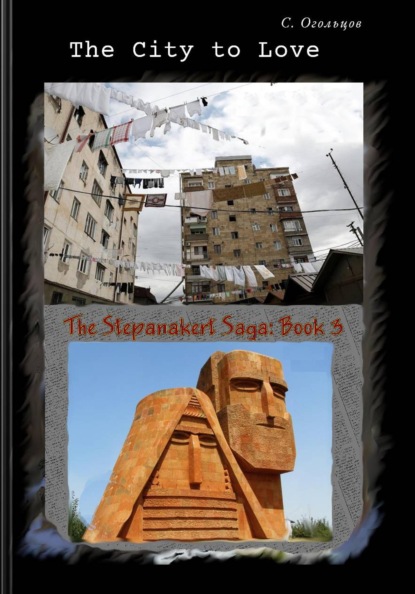
On a grassy knoll at the entrance to Stepanakert stands a monument by sculptor Sarkis Baghdasaryan: a couple of huge man-made crags, side by side. On the right sticks up the bald head of a bearded fellow; on the right is a woman's head, wrapped in a shawl. The locals dubbed this creation Dedo-Babo ("Grandpa and Grandma"), though officially it's translated We And Our Mountains.
Yet the interepretations miss a vital point though; it really should be: We Are Our Mountains.
Old mountains registered in Old Testament. An ancient people. Conquerors marched through here, establishing their reigns. Enforcing their faiths. For millennia, rulers, empires, and religions replaced one another…
And after all that, Gurgen—a KRAZ truck driver whose house is just one door down from mine in Stepanakert—pointed at the slope of the opposite mountain (they call them tumbs around here) while introducing me to his native village and casually remarked:
"Back in the Stone Age, our village stood right over there, but now we've moved across the valley to live here."
He wasn't bragging; it was just a piece of information for the record. But you’ll hardly find a blue-blooded aristocrat with family roots running deep into the centuries who could point out an ancestral nest of comparable antiquity.
The roots of humanity are right here. Living roots.
And that, perhaps, is the key to how a populace of 180,000 managed to hold its ground against an empire of seven million. Humanity of this planet, not exactly in the know what's what in that Rfrabakh issue, felt it—not with its brain, but with something deeper: you cannot tear out roots, especially your own…
But generally speaking, Karabakhers are people just like anyone else. Which means you can love them, or get mad at them, or write about them.
I can already hear the critics: You set out to write about Karabakhers, yet look at how much you drone with that 'I-I-I' of yours!
But first of all, I didn’t just become a Karabakher yesterday. And second of all, it’s not what you write, it’s how you write it. My storytelling style is natively Karabakhi—pounded into me during my stint as a translator for the local rag.
The front-page editorials of its editor, Maksim Ovanisyan, taught me that readers love it when a friendly hand drops onto their shoulder, and you just talk to them casually, like a brother: "Akhper, you and me, why, we’re in this together…"
The feature pieces by Susan Atanesyan showed me in practice how a story comes alive the moment you drop in a single, sharp detail of everyday life.
And the thoughtful articles of Naira Hayrumyan instilled a taste for contemplation—leisurely and somewhat philosophical.
For a graduate of such a school, it would be a sin not to erect a monument to this unique Karabakhi style. So here it is, brother—a monument not made by human hands!
The artifact of two parts (no, not about Dedo-Babo already) the first one's title is a bit long, but it gets straight to the point: Provincial Summer of ’98.
It is precluded by this very epigraph, though it’s long enough to pass for a preface, don’t you think?
And right on the heels of the epigraph, already on its way, are a couple of quasi-introductions and seven essays, hammered out during the long summer of the year stated in the aforementioned title. The second part's name can be found out by any big boy or girl.
And that’s enough explaining: my job here is done—Lyav kats1, my dear reader partner!
'98\11\02
* * *
5 Students Today: Goals and Outlook
(by way of an introduction to Part One in "The City to Love")
Space and time are delicate matters—at least here in the East, an area that doesn’t exactly boast about excess fat in its constitution. I wouldn’t call it entirely skeletal, but it is running a bit lean. Statistically speaking.
Anyway, we can send the nutritionists to buzz off for now—we’ve got weightier (even if delicate) concepts waiting for us. The aforementioned space and time can sometimes tangle themselves into Gordian knots of mind-boggling complexity around here. The loops of so labyrinthine twists that even a compass would drop its jaw in utter confusion: holy cow, what on earth is this? An entrance or an exit?
Space still hesitates about what outfit it really wants to wear; every single day it tries on new epithets for its runway walk—one moment it’s a "buffer zone," the next it’s "living space," and then it's "autochthonous-ethnic territory."
Time kicks a dust of its own in quirky leaps around like a frisky goat, back and forth and back again. One second it skips out of the time zone of its legitimate geophysical affiliation to land straight into the realm of "economic expediency." Yet a moment later (before it can even bleat baa or mee), its little hooves carry it off toward the "political realities of the regional situation," ensuring that the hours and minutes keep ticking in perfect synchronization with Big Brother’s clock.
Oh, the local leadership faces a tortuous choice: whose daylight saving time is the correct one to switch to, after all? Yerevan’s or Moscow’s?
Both options offer plenty of pros and cons; it’s enough to make your head spin from the sheer complexity of the layout.
Amid such intricately entwined matters, you’d better keep your ears pinned back and your eyes wide open. No, this game of leapfrog is no joke! It's just impossible to guess what you’ll step into over the very next threshold. Good luck if there's another room waiting for you on the other side; while a desert would be noticeably worse—just pray you don't drop straight into a crater whose volcano has been fired up already.
. . .
Whew!… Looks like we lucked out this time. Having withstood the final yards of space—thoroughly drenched in an Arabian heat where even the smell of dust radiates fire—you step onto a boot-scraper of rattling iron strips. Left foot first, then the right.
(Though it doesn't really matter; you can do it the other way around. Just on principle, to test and make it sure, take two steps back—you don't even have to turn around. Now switch feet and step back onto the iron contraption. See? Told you so: absolutely no difference… But I admire your scientific dedication! In a heatwave like this, and you actually bothered!…)
Next, you ascend (with a proper dignity) three incredibly long steps tiled with half-inch marble slabs and pass through the wide-open glass doors of the entrance airlock. Finally, you plunge into the quiet chill and the refreshingly soft semi-twighlight, styled like at the royal courts of the Reformation era.
Your eyes, still blind after the glare of the sun left outside, are sort of befuddled—pretty disoriented: is this the Spanish Escorial or, after all, the Louvre in Paris?
Beneath the shade of mighty misty vaults there flows the murmuring ceremonial of courtly life. The beauties of the court weave their cunning intrigues. Huddled here and there in chattering flocks between the massive, square columns, they deliver verdicts (at half-glance yet with deadly clinical precision) on the ornate outfits of their friends (who double as their rivals—don't argue, there's no fighting c'est la vie) who happened hanging in another flock.
They know real value of everything brought in for their abundant whims by the caravans of dauntless "shuttle-traders" from Persia (otherwise known as Iran) and other nearby oriental lands.
Ah, how miraculously irresistible these outfits are—globally identical!
It calls for a good deal of sorcery and magic to dress in a way that leaves everything perfectly obvious, emphasizing, expressing, and impressing with close contouring the fullness of shapes, the captivating flow of lines, and all the other luxurious baits of goods draped in semi-transparent wrappers!
The witchcraft wafts of perfume aromas and sweet fragrances spellbind your nose at once with both delight and wild elation—the poor thing, filled to the brim, is on the verge of losing its mind from overdose. Stop breathing, you fool! The fail-safe limit is too dangerously close!
Why, if N. V. Gogol found himself amid this flowerbed—surrounded by this unthinkable cross between a rose garden and a columbarium—the great classic would have to choke on his own saliva. And if they somehow managed to revive him with mouth-to-mouth resuscitation, he—within than very half-second—would burn the first part of Dead Souls too just to redraw The Carriage story into a three-volume sequel by the still smoldering paper on its ashes…
Figures in fatigue stroll across the stone tiles of the hall, flaunting their military posture (though without swords—Richelieu banned duelling, you know).
The rest of the courtly youth of the male persuasion (no less dashing, even without uniforms) completely ignore the military. Mind you, they might still fraternize now and then—to plan a feast or strike a wager on… well, they know best.
The military breed is the backbone of any merry company, risky venture, or, for that matter, palace coup…
There hangs a vague, ceaseless hum in the air—a mashup of stomping heels, thin creaks leather belts, the castanet-like click-clack of thick black eyelashes in a stealthy wink, light palm-slaps at biceps, the jingle of cheap jewelry, tempting chuckle, elusive giggles, exclusive briefings: "…oh, you’re so brave… and him? Vuy!… and what he said after? Really?!… ” —until your mind begins to slowly lose you : is this Madrid, for crying out loud, or Paris, or did I smack banged into some wrong goddamn Vienna?
And your gaze, shinning upward just in case, scrambles past the grand staircase with its stained-glass windows at the landing until it locks onto the digitally greenish shimmer on the square face of a black electronic clock box—hitting it dead-center, Robin Hood-style, right in the middle of the ceiling beam.
And whew! Relief… Everything is fine: no Madrids, no Viennas! You are exactly where you need to be—at Artsakh State University, and all this beauty and dashing posture belongs to the youth who have shown up to scoop their ken from the knowledge accumulated here…
But what on earth brought us here, sir?
I don't exactly have time to classify the needs of every present one—except for myself who has a specific assignment from the editor-in-chief of the MK Republic newspaper: to check and present a report on:
1. What is the goal of today’s student youth; and (simultaneously, hitched back to back;
2. What is their outlook on their own present and future…
. . .
On the second floor, not a shred of recollection of the lobby's gloomy chill has the slimmest chance to persevere in tagging along any longer.
On the second floor, every classroom is celebrating the day of open-door and wide-open windows. However, the air, grown brazenly lazy in the heat, has no inclination to budge even symbolically. It just hangs there (the bastard!)—waiting to be tickled into motion by paper fans torn out of notebooks.
Doors wide open, window wings flung apart, but there isn't a hint of corridor drafts. You can safely stroll down the hallways and—through doors that look ready for a hug—study the outlook of the student body.
The picture inside the auditoriums is pretty much selfsame.
At the desk closest to the open door, back to a pristine chalkboard, sits a professor, half-melted by the heat. Facing that same idle board is a thinned-out handful of students. Their gazes stuck motionless at various points in space.
And only one student, who has pushed himself forward to sit directly opposite the prof, keeps his loyal stare glued to his mentor’s face.
A wise move: finals are right around the corner, the examiner’s mind needs to be impregnated with positive emotions towards the smart-ass' mug.
Yet even his devoted gaze is noticeably glassy. Even he is clearly not here right now: he’s staring into the future…
. . .
Well, of course, the goal of modern students is the same as it has been in all eras—to finish this… university. It’s just that these days, you have to choose your words a bit more carefully. If you blurt out that their goal is to get an education, the professors will laugh you out of the room.
What education, what knowledge! They showed up to buy a diploma. To trade paper for paper. They look at the university as a marriage market. Coming here to flaunt their outfits (and who would spurn the opportunity?), and to hunt down just about anyone (not me! I'm straight! It's just my mission!).
Basically, it’s like walking into a store, buying a box of chocolates, dumping the chocolates out, and walking away with the empty cardboard box.
The dean of the N-th department resolutely and loudly denies that students have any right to think they are only here to buy a diploma… (Though in private, she admits that’s exactly how it is).
But her opinion is a view from outside the task set before me. How does the student body itself look at its own present?
They look at it with a bitter note of disappointment. Look at how much energy was spent in high school on electives and cramming with tutors or mugging on one's own. How passionately boiled emotions: OMG, just let me get in! Oh, how I will start studying!
The dream came true…
In the first month, the student bought a bunch of notebooks, went to lectures, scribbled down some notes, and dropped by the library a time or two, just like everyone else.
And then came the debunking of illusions. The lecturers mumble God knows what, or simply regurgitate the exact same stuff that can be found in textbooks without them. And the process of academic growth looks an awful lot like prepping for an elementary school pageant: memorize a poem, recite it at the exam—and collect your grade.
And this happens to a seventeen-year-old! A person ready to turn the whole world upside down and make everyone happy, who entered the university for that exact purpose—to ascend the glittering peaks of knowledge, to obtain the keys and access to the secrets and control panels of the adult world.
And this is the person you ask to participate in elementary school pageants? To listen to the tedious mumbling of a lecturer? For four years?! For what?!
Disappointment, like any emotion, seeks an outlet…
Madam A. A. Badalova, a well-known figure in the local educational vineyard when it comes to psychological sciences, recently visited regions that have, for some time now, become "foreign countries." From there, she brought back tidings that for professors over there, the main problem is also the students' don't-give-a-damn attitude toward their studies—which, according to those same foreign educators, sometimes escalates into horrific excesses.
On our end, when it comes to this matter, we have nothing but smooth sailing and heavenly bliss. Apparently, the provincial solid toughness of patriarchal foundations plays its part. Our youth know how to restrain themselves.
Well, sure, a thing or two might happen sometimes, nothing is 101 % proof.
Take Chernyshevsky on that his portrait—someone doodled a chalk pirate patch over his eye, but to compensate, they used that same chalk to sketch a medal on the guy's chest so as not to leave too hard feelings by the moody dude.
Yes. they stuck a cigarette butt under Maxim Gorky’s mastoush. Back in his day, the old man mostly puffed on Belomorkanal, so why not let grandpa treat himself to a Camel for once?
Come on, what kind of vandalism is that? Just horseplay, the innocent pranks of juveniles.
Yet these jokes clearly reveal the students' outlook on their own present: they are dissatisfied with it; they didn't sign up for this. They do not accept it, and they express their protest in such a half-baked, immature form.
But what if, since the student now pays for tuition, he isn't just a student anymore, but a customer to boot? What if it's actually true—as the far-abroad lands noticed way before us, having stepped onto the path of market relationships much earlier—that revelation as if the customer is always right?
And even when he dumps my chocolates all over the floor, all that's left for me to do is submissively nod along and wear a blissfully shining smile.
What is to be done?
It’s useless to look for an answer in the same-named Chernyshevsky's work—look at him up there, sulking under his Kutuzov eye-patch, and even that Suvorov medal didn't butter him up.
And the author of My Universities, bribed with a Camel, is also on their side.
Despairing, I address the students directly:
"What is it you guys actually want around here?"
And I get a concrete, surprisingly mature response:
"A smart professor who will teach us our future profession."
So much for the vandals!…
(My dear, sweet children! Where on earth am I going to find you any answering the description for fifteen thousand AMD a month?)
. . .
"Norik, what exactly has this university given you personally over your two years of study?"
Norik casually leans back, resting his spine all the way against the desktop edge behind him. His elbows languidly thrown up, his fingers laces behind his head.
"Here, I have known woman," he modestly shares.
Ah, the greenness of youth! Oh, sancta simplicitas! The naive self-assurance of youth. Oh!… Why, to truly know such a subject… or rather, such matter… well, for a bulletproof notion… a whole lifetime wouldn't be enough!…