Полная версия:
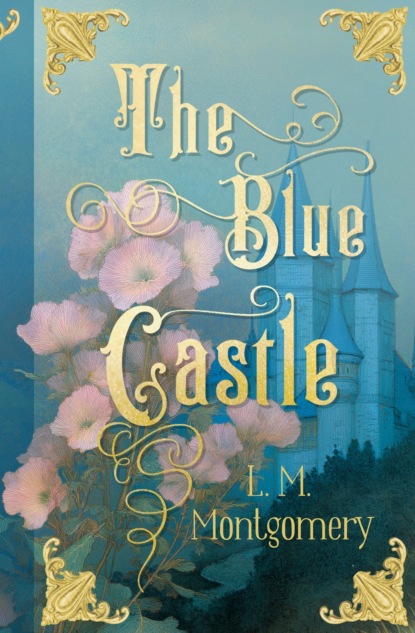
The Blue Castle / Лазоревый замок
She turned from her unfriendly mirror and looked out. The ugliness of the view always struck her like a blow; the ragged fence, the tumble-down old carriage-shop in the next lot, plastered with crude, violently coloured advertisements; the grimy railway station beyond, with the awful derelicts that were always hanging around it even at this early hour. In the pouring rain everything looked worse than usual, especially the beastly advertisement, “Keep that schoolgirl complexion.” Valancyhad kept her schoolgirl complexion. That was just the trouble. There was not a gleam of beauty anywhere —”exactly like my life,” thought Valancy drearily. Her brief bitterness had passed. She accepted facts as resignedly as she had always accepted them. She was one of the people whom life always passes by. There was no altering that fact.
In this mood Valancy went down to breakfast.
Chapter III
Breakfast was always the same. Oatmeal porridge, which Valancy loathed, toast and tea, and one teaspoonful of marmalade. Mrs. Frederick thought two teaspoonfuls extravagant – but that did not matter to Valancy, who hated marmalade, too. The chilly, gloomy little dining-room was chillier and gloomier than usual; the rain streamed down outside the window; departed Stirlings, in atrocious, gilt frames, wider than the pictures, glowered down from the walls. And yet Cousin Stickles wished Valancy many happy returns of the day!
“Sit up straight, Doss,” was all her mother said.
Valancy sat up straight. She talked to her mother and Cousin Stickles of the things they always talked of. She never wondered what would happen if she tried to talk of something else. She knew. Therefore she never did it.
Mrs. Frederick was offended with Providence for sending a rainy day when she wanted to go to a picnic, so she ate her breakfast in a sulky silence for which Valancy was rather grateful. But Christine Stickles whined endlessly on as usual, complaining about everything – the weather, the leak in the pantry, the price of oatmeal and butter – Valancy felt at once she had buttered her toast too lavishly – the epidemic of mumps in Deerwood.
“Doss will be sure to ketch them,” she foreboded.
“Doss must not go where she is likely to catch mumps,” said Mrs. Frederick shortly.
Valancy had never had mumps – or whooping cough – or chicken-pox – or measles – or anything she should have had – nothing but horrible colds every winter. Doss' winter colds were a sort of tradition in the family. Nothing, it seemed, could prevent her from catching them. Mrs. Frederick and Cousin Stickles did their heroic best. One winter they kept Valancy housed up from November to May, in the warm sitting-room. She was not even allowed to go to church. And Valancy took cold after cold and ended up with bronchitis in June.
“None ofmy family were ever like that,” said Mrs. Frederick, implying that it must be a Stirling tendency.
“The Stirlings seldom take colds,” said Cousin Stickles resentfully.She had been a Stirling.
“I think,” said Mrs. Frederick, “that if a person makes up her mindnot to have colds she will not have colds.”
So that was the trouble. It was all Valancy's own fault.
But on this particular morning Valancy's unbearable grievance was that she was called Doss. She had endured it for twenty-nine years, and all at once she felt she could not endure it any longer. Her full name was Valancy Jane. Valancy Jane was rather terrible, but she liked Valancy, with its odd, out-land tang. It was always a wonder to Valancy that the Stirlings had allowed her to be so christened. She had been told that her maternal grandfather, old Amos Wansbarra, had chosen the name for her. Her father had tacked on the Jane by way of civilising it, and the whole connection got out of the difficulty by nicknaming her Doss. She never got Valancy from any one but outsiders.
“Mother,” she said timidly, “would you mind calling me Valancy after this? Doss seems so – so – I don't like it.”
Mrs. Frederick looked at her daughter in astonishment. She wore glasses with enormously strong lenses that gave her eyes a peculiarly disagreeable appearance.
“What is the matter with Doss?”
“It – seems so childish,” faltered Valancy.
“Oh!” Mrs. Frederick had been a Wansbarra and the Wansbarra smile was not an asset. “I see. Well, it should suityou then. You are childish enough in all conscience, my dear child.”
“I am twenty-nine,” said the dear child desperately.
“I wouldn't proclaim it from the house-tops if I were you, dear,” said Mrs. Frederick. “Twenty-nine!I had been married nine years when I was twenty-nine.”
“I was married at seventeen,” said Cousin Stickles proudly.
Valancy looked at them furtively. Mrs. Frederick, except for those terrible glasses and the hooked nose that made her look more like a parrot than a parrot itself could look, was not ill-looking. At twenty she might have been quite pretty. But Cousin Stickles! And yet Christine Stickles had once been desirable in some man's eyes. Valancy felt that Cousin Stickles, with her broad, flat, wrinkled face, a mole right on the end of her dumpy nose, bristling hairs on her chin, wrinkled yellow neck, pale, protruding eyes, and thin, puckered mouth, had yet this advantage over her – this right to look down on her. And even yet Cousin Stickles was necessary to Mrs. Frederick. Valancy wondered pitifully what it would be like to be wanted by some one – needed by some one. No one in the whole world needed her, or would miss anything from life if she dropped suddenly out of it. She was a disappointment to her mother. No one loved her. She had never so much as had a girl friend.
“I haven't even a gift for friendship,” she had once admitted to herself pitifully.
“Doss, you haven't eaten your crusts,” said Mrs. Frederick rebukingly.
It rained all the forenoon without cessation. Valancy pieced a quilt. Valancy hated piecing quilts. And there was no need of it. The house was full of quilts. There were three big chests, packed with quilts, in the attic. Mrs. Frederick had begun storing away quilts when Valancy was seventeen and she kept on storing them, though it did not seem likely that Valancy would ever need them. But Valancy must be at work and fancy work materials were too expensive. Idleness was a cardinal sin in the Stirling household. When Valancy had been a child she had been made to write down every night, in a small, hated, black notebook, all the minutes she had spent in idleness that day. On Sundays her mother made her tot them up and pray over them.
On this particular forenoon of this day of destiny Valancy spent only ten minutes in idleness. At least, Mrs. Frederick and Cousin Stickles would have called it idleness. She went to her room to get a better thimble and she openedThistle Harvest guiltily at random.
“The woods are so human,” wrote John Foster, “that to know them one must live with them. An occasional saunter through them, keeping to the well-trodden paths, will never admit us to their intimacy. If we wish to be friends we must seek them out and win them by frequent, reverent visits at all hours; by morning, by noon, and by night; and at all seasons, in spring, in summer, in autumn, in winter. Otherwise we can never really know them and any pretence we may make to the contrary will never impose on them. They have their own effective way of keeping aliens at a distance and shutting their hearts to mere casual sightseers. It is of no use to seek the woods from any motive except sheer love of them; they will find us out at once and hide all their sweet, old-world secrets from us. But if they know we come to them because we love them they will be very kind to us and give us such treasures of beauty and delight as are not bought or sold in any market-place. For the woods, when they give at all, give unstintedly and hold nothing back from their true worshippers. We must go to them lovingly, humbly, patiently, watchfully, and we shall learn what poignant loveliness lurks in the wild places and silent intervals, lying under starshine and sunset, what cadences of unearthly music are harped on aged pine boughs or crooned in copses of fir, what delicate savours exhale from mosses and ferns in sunny corners or on damp brooklands, what dreams and myths and legends of an older time haunt them. Then the immortal heart of the woods will beat against ours and its subtle life will steal into our veins and make us its own forever, so that no matter where we go or how widely we wander we shall yet be drawn back to the forest to find our most enduring kinship.”
“Doss,” called her mother from the hall below, “what are you doing all by yourself in that room?”
Valancy droppedThistle Harvest like a hot coal and fled downstairs to her patches; but she felt the strange exhilaration of spirit that always came momentarily to her when she dipped into one of John Foster's books. Valancy did not know much about woods – except the haunted groves of oak and pine around her Blue Castle. But she had always secretly hankered after them and a Foster book about woods was the next best thing to the woods themselves.
At noon it stopped raining, but the sun did not come out until three. Then Valancy timidly said she thought she would go uptown.
“What do you want to go uptown for?” demanded her mother.
“I want to get a book from the library.”
“You got a book from the library only last week.”
“No, it was four weeks.”
“Four weeks. Nonsense!”
“Really it was, Mother.”
“You are mistaken. It cannot possibly have been more than two weeks. I dislike contradiction. And I do not see what you want to get a book for, anyhow. You waste too much time reading.”
“Of what value is my time?” asked Valancy bitterly.
“Doss! Don't speak in that tone tome.”
“We need some tea,” said Cousin Stickles. “She might go and get that if she wants a walk – though this damp weather is bad for colds.”
They argued the matter for ten minutes longer and finally Mrs. Frederick agreed rather grudgingly that Valancy might go.
Chapter IV
“Got your rubbers on?” called Cousin Stickles, as Valancy left the house.
Christine Stickles had never once forgotten to ask that question when Valancy went out on a damp day.
“Yes.”
“Have you got your flannel petticoat on?” asked Mrs. Frederick.
“No.”
“Doss, I really do not understand you. Do you want to catch your death of coldagain?” Her voice implied that Valancy had died of a cold several times already. “Go upstairs this minute and put it on!”
“Mother, I don'tneed a flannel petticoat. My sateen one is warm enough.”
“Doss, remember you had bronchitis two years ago. Go and do as you are told!”
Valancy went, though nobody will ever know just how near she came to hurling the rubber-plant into the street before she went. She hated that grey flannel petticoat more than any other garment she owned. Olive never had to wear flannel petticoats. Olive wore ruffled silk and sheer lawn and filmy laced flounces. But Olive's father had “married money” and Olive never had bronchitis. So there you were.
“Are you sure you didn't leave the soap in the water?” demanded Mrs. Frederick. But Valancy was gone. She turned at the corner and looked back down the ugly, prim, respectable street where she lived. The Stirling house was the ugliest on it – more like a red brick box than anything else. Too high for its breadth, and made still higher by a bulbous glass cupola on top. About it was the desolate, barren peace of an old house whose life is lived.
There was a very pretty little house, with leaded casements and dubbed gables, just around the corner – a new house, one of those houses you love the minute you see them. Clayton Markley had built it for his bride. He was to be married to Jennie Lloyd in June. The little house, it was said, was furnished from attic to cellar, in complete readiness for its mistress.
“I don't envy Jennie the man,” thought Valancy sincerely – Clayton Markley was not one of her many ideals —“but Ido envy her the house. It's such a nice young house. Oh, if I could only have a house of my own – ever so poor, so tiny – but my own! But then,” she added bitterly, “there is no use in yowling for the moon when you can't even get a tallow candle.”
In dreamland nothing would do Valancy but a castle of pale sapphire. In real life she would have been fully satisfied with a little house of her own. She envied Jennie Lloyd more fiercely than ever today. Jennie was not so much better looking than she was, and not so very much younger. Yet she was to have this delightful house. And the nicest little Wedgwood teacups – Valancy had seen them; an open fireplace, and monogrammed linen; hemstitched tablecloths, and china-closets. Why dideverything come to some girls and nothing to others? It wasn't fair.
Valancy was once more seething with rebellion as she walked along, a prim, dowdy little figure in her shabby raincoat and three-year-old hat, splashed occasionally by the mud of a passing motor with its insulting shrieks. Motors were still rather a novelty in Deerwood, though they were common in Port Lawrence, and most of the summer residents up at Muskoka had them. In Deerwood only some of the smart set had them; for even Deerwood was divided into sets. There was the smart set – the intellectual set – the old-family set – of which the Stirlings were members – the common run, and a few pariahs. Not one of the Stirling clan had as yet condescended to a motor, though Olive was teasing her father to have one. Valancy had never even been in a motorcar. But she did not hanker after this. In truth, she felt rather afraid of motorcars, especially at night. They seemed to be too much like big purring beasts that might turn and crush you – or make some terrible savage leap somewhere. On the steep mountain trails around her Blue Castle only gaily caparisoned steeds might proudly pace; in real life Valancy would have been quite contented to drive in a buggy behind a nice horse. She got a buggy drive only when some uncle or cousin remembered to fling her “a chance,” like a bone to a dog.
Конец ознакомительного фрагмента.
Текст предоставлен ООО «Литрес».
Прочитайте эту книгу целиком, купив полную легальную версию на Литрес.
Безопасно оплатить книгу можно банковской картой Visa, MasterCard, Maestro, со счета мобильного телефона, с платежного терминала, в салоне МТС или Связной, через PayPal, WebMoney, Яндекс.Деньги, QIWI Кошелек, бонусными картами или другим удобным Вам способом.
Вы ознакомились с фрагментом книги.
Для бесплатного чтения открыта только часть текста.
Приобретайте полный текст книги у нашего партнера:
Полная версия книги
Всего 10 форматов