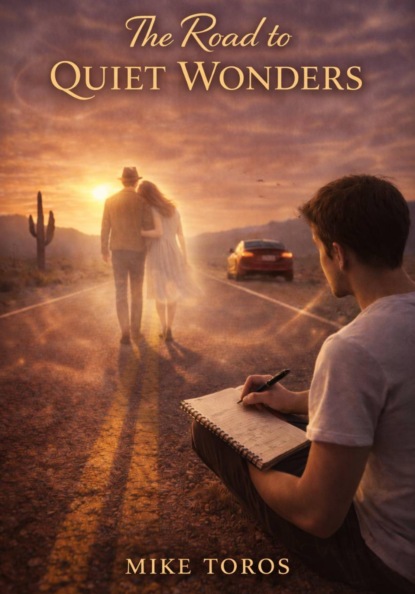
Полная версия:
The Road to Quiet Wonders

Mike Toros
The Road to Quiet Wonders
Dedication
Dedicated to my parents – the architects of my understanding of love that love is a language spoken in decades, not words.
Acknowledgment
I express my gratitude to Christopher Sanborn and my sister Katharina Röllich for inspiring me to immerse in work, my father for his guidance in creating the piece, my mother for her attention to detail in the book, and my editor, Sam Neilson, and his team (Eric Wilson, Martin Garret and others) for their quality and meticulous work!
Chapter 1: Mornings with Tibetan bowls and no-obligation coffee
This was my third year living in Portland.
The city turned out to be kind, not in the sense of hugging in the street and going to visit, but in its restraint: no one prying into your soul, everyone smiles just enough so that you don't feel like a stranger, but you don't have to get close either. People have enough tact to leave you alone. That was exactly what I needed.
I rented an apartment in a neighborhood where my neighbor downstairs meditated to the screams of his cat, which, judging by the sounds, regularly lost fights with the vacuum cleaner.
And here lived I, a man who just wanted to drink beer on Fridays and watch the mold on the windowsill leisurely take over the area, as if conducting its own quiet expansion.
On weekends, I went to the same café around the corner, where they had long known my order but never asked my name. It's the perfect relationship—warm, but without commitment.
The barista with a ‘Carpe Diem’ tattoo on his neck would always ask, “How’s it going?” but never listen to the response. Once, I tried to say, “A stray raccoon hung itself in my fridge,” and he just nodded and asked, “With syrup?”
That morning, I was awakened by the sound of Tibetan singing bowls. It was my downstairs neighbor—the same one who was meditating to the screams of his cat. It seems he decided to finally move to a new level of spiritual awareness—on Saturday at 6 a.m.
I lay there, staring at the ceiling, thinking that maybe this was a sign—it was time to get up and go to that café. Getting ready took me two or three hours.
The rain outside was falling with just the right intensity—not enough to say “just drizzling,” but not quite “we need to build an ark!” Perfect for putting on jeans that had been damp for the second day in a row and pretending it was a “vintage effect.”
I decided to go closer to the city center after all, introducing a minimum of variety into the routine I had already become accustomed to.
I'm parked. A girl with a cactus tattoo on her wrist and a cup of latte in her hands sat in the café across the street. She was looking out the window, and I thought: “Here it is, typical Portland romance.”
I went inside, ordered a coffee with milk but no foam. Without taking his eyes off the laptop, the barista muttered, “Name?”
“Thomas,” I blurted out for a change, tired of being called Mike.
We sat in the café, watching as the rain turned the street into a river, and cyclists, like water bugs, skated across the puddles. Portland is a city where rain is not just weather; it’s more of a lifestyle.
“You're not from around here?” she asked without raising her eyes from the menu.
“No,” I replied.
“Me neither,” she said, finally looking at me. “I just moved here.”
I nodded, realizing that in Portland, this is almost a mandatory statement.
“What do you think of the city?” I asked.
“Rainy,” she replied with a smile.
We both laughed.
“You know,” she said, setting the cup aside, “I always thought Portland is a place where people live in harmony with nature, ride bikes, and drink coffee without milk.”
“And now you think it’s a place where people live in harmony with rain, ride bikes, and drink coffee with oat milk?” I asked with a smile.
She nodded. “Yeah,” she replied, smiling broad.
We laughed again.
We sat in that café for another hour, maybe two. The girl with the cactus tattoo on her wrist introduced herself as “Izzy.”
“Easy?” I asked because I hadn't met any easy women yet, except for those who sell their souls for a new iPhone, a trip to Dubai, or just, plainly, for money.
“Yes, Izzy. Short for ‘Elizabeth,’” she said, interrupting my dark thoughts. Then she confessed she’d moved here from Phoenix because she was “tired of the sun.” She wasn’t the least bit surprised when I told her I preferred rainy Oregon to cold Siberia.
“Can you imagine,” she said, “waking up every day and knowing it's going to be clear again? It's like living under the curse of some ancient god who hates drama.”
I nodded, though I had no idea what she was talking about. The sun has long been something of an ancient myth for me, retold in our town from generation to generation! Legend had it that it had once shone over the city, but whether it would rise again and whether its rays would break through the clouds, no one in Portland knew for sure.
“Why a cactus?” I asked, pointing to her tattoo.
“Oh, it’s a long story,” she sighed. “Short version: I wanted to remind myself that even in the driest places, you can survive. Then I moved here, and now it’s just irony.”

“Tell me, what did you do in Russia?” Izzy asked.
“I worked in an office where the main corporate motto was: ‘We’re like family here.’ That means the boss can yell at you like an alcoholic father, but if you quit, he gives you the sad eyes and says you’ve let him down,” I joked.
She laughed.
“What about you?” I inquired.
“I’m writing a dissertation on ‘The Impact of Sunny Days in Oregon on the Mental Health of Urban Dwellers,’” she replied humorously. “Though I haven’t been able to start for a month because every time I sit down to work, it’s raining outside.”
“So you're not only the subject of the study, but also the control group,” I remarked.
“Exactly!” she burst out laughing. “Science demands sacrifice!”
We talked about nothing and everything at once. About how this city has too many cyclists who’ve adopted the “faster than the rain” philosophy and now think they’re invulnerable, about how local cats are true survivalists in the eternal damp apocalypse. And oat milk is someone's insidious plot. And about how maybe rain isn't a curse, but just a way of slowing down time.
We talked until closing and left the café together, but didn’t exchange numbers—a beautiful incompleteness of the moment.
By then, the rain had turned into something between a sparse drizzle and a hint of the apocalypse.
Izzy pulled out a foldable umbrella with a “Keep Portland Weird” print (the city’s motto), which, judging by its condition, had already surrendered to the elements.
“Maybe we’ll do this again sometime?” she asked.
“If you survive this downpour,” I replied.
“Deal,” she smiled and turned the corner, where a passing cyclist in a plastic poncho nearly knocked her over.
I went home, thinking about how Portland is a city where even encounters begin with rain and end with a hint of a second meeting that probably won't happen. But if it does, it would make a good story for the next coffee shop conversation.
Or maybe not. After all, even the coffee here sometimes turns out to be just coffee.
Chapter 2:
Sunday market and notebook for forgotten thoughts
The next day, it seemed the rain had decided to take a break. The silence was the first thing I noticed. No blood-curdling yowls, no screeching protest from the downstairs neighbor’s cat battling another philosophical round with the vacuum cleaner. Just… absence. A vacuum of its own kind.
I sat up in bed slowly, waiting for the usual scream to cut through the floorboards. Nothing. This was unsettling, not because I missed its screams, but because the absence of cat wails created a kind of emptiness, as if the television you don't watch suddenly turned off by itself.
It felt wrong. Not in a horror-movie way. More like the wrongness of a missing background hum—like when the fridge stops running and you realize it’s been your soundtrack all along.
I rubbed my eyes and said aloud to no one, “He’s either achieved inner peace or eaten the vacuum.”
I padded barefoot into the kitchen, the floor cold under my feet. The apartment still held the smell of yesterday’s coffee and something else—something faintly metallic and damp, like regret left overnight on a plate.
The mold on the windowsill had advanced. Again. The tiny green-black constellation now stretched into a new outpost in the left corner, its territory growing bolder with every rain-drenched morning.
“Congratulations,” I murmured to it. “You’re officially a republic now.”
I opened the fridge, hoping for inspiration. The only thing that greeted me was a near-empty beer bottle and half a lemon that looked like it had seen better wars.
I poured myself the last of yesterday's beer into a glass, looked at it, and poured it down the drain.
I watched the amber liquid swirl, catch light in the glass, and then disappear down the drain.
That’s when it hit me.
There was nothing extraordinary about the moment—no angel chorus, no cinematic swell of music. Just a thought so quiet it barely made a ripple.
Something had changed.
It wasn’t the cat. Or the coffee. Or the beer. It was me.
Yesterday had done something—twisted a small knob somewhere inside me. Something about yesterday's meeting with Izzy had shifted the gears—the familiar mechanism of daily life creaked.
It wasn’t dramatic. More like an itch somewhere under the surface, reminding me that repetition wasn’t the same as rhythm.I looked out the window. The sky was gray, but it wasn't crying today. Portland’s version of mercy.
I dressed and went out. This time, without a clear plan. Not to that café. Not on schedule.
My left-side neighbor’s door was ajar. From inside drifted the gentle pluck of a sitar and a sharp voice saying something in Sanskrit—or possibly just very stoned English.
“Hey, Mike!” the neighbor called as I passed.
“Hey, Arun,” I nodded, pausing.
“You want to join morning yoga session? Very cleansing. I have kombucha too. Freshly fermented. Very enlightened.”
I smiled politely. “Thanks, but I’m trying to quit enlightenment this week.”
He grinned. “Suit yourself, brother. Enlightenment will wait.”
“That's what worries me,” I muttered as I moved on.
Outside, the air was brisk, fresh in that Portland way—like the city had showered but forgot to dry its hair.
I walked without aim. Not to the usual café. Not to the usual bench. Not on the usual route.
Something had shifted. Maybe it was nothing. Maybe it was everything.
The streets felt different when you weren’t trying to be somewhere. People rushed around me—commuters with their heads down, earbuds in, focused on battles I wasn’t part of. For once, I wasn’t competing. I wasn’t late. I wasn’t expected. I was just there.
I wandered into a small alley I had passed a hundred times but never noticed. It was lined with murals—portraits of strangers who probably lived lives louder than mine. One of them, a woman in a wide-brimmed hat, seemed to follow me with her eyes as I walked past. I imagined her saying, “Finally taking a detour, huh?”
I ended up by a food cart where an old man sold hand-rolled pretzels. His cart was rusted, the umbrella faded beyond its original color. He greeted me like I was a regular, though I’d never seen him before.
“First time’s always free,” he said, handing me a warm pretzel. “But only if you eat it while walking. No sitting allowed.”
I smiled, thanked him, and obeyed. The pretzel was absurdly good, better than it had any right to be. And as I chewed, I realized this unscheduled morning had already given me more than many of my planned ones.
Sometimes, not having a destination is the only way to arrive somewhere new.

Downtown was living its Sunday life—the farmers' market, the smell of roasted coffee and pastries, women in olive-colored coats, and men with beards who looked like they could carve a canoe from a log and read Brodsky aloud at the same time. It smelled like roasted almonds, fresh pastries, and vaguely of rain that had changed its mind.
Locals wandering between stalls like they were browsing not just for produce, but for lost parts of themselves. A man in a leather vest sold pickled asparagus next to a poet hawking handmade zines titled Thoughts That Should've Stayed in the Shower. There was a stall entirely dedicated to mushrooms—every kind, shape, and myth. A child stared in awe at a lion’s mane specimen while her dad whispered, “No, sweetie, that one doesn’t roar.”
I wandered through it all like someone had dropped me into a collage. My feet moved without a destination. My hands were jammed into my coat pockets. The world, for once, didn’t seem to expect anything of me.
Then I saw it—the bench.
Wooden. Half-wet. Wedged between a lavender soap vendor and a woman selling jewelry made from old typewriter keys.
I sat. For a while, I just watched. An older woman with a patchy wool hat argued passionately with a vendor about the price of garlic.
“I’m not saying it’s not worth $4,” she insisted, “I’m saying my ancestors would weep if I paid it.”
The vendor, a man with brilliant red mustaches, leaned in with theatrical gravity.
“Madam, this garlic is blessed by the morning mist of the Willamette Valley. If you bite it raw, your sins evaporate.”
“Ha! I’ve got decades of sins, young man. This better come with a cleansing chant.”
I laughed. Quietly. The kind of laugh that slips out without asking permission.
Then I reached into my coat and pulled out the notebook.
It was worn. A gift from a friend back in Moscow who once said, “You'll start writing again someday. Probably when you least expect it.”
At the time, I had chuckled and said, “I’ll start writing again when garlic is worth four dollars.”
Apparently, we’d both been right.
I flipped it open. The first page was blank. Stark and expectant.
It felt like facing a mirror after years of not looking.
The pen was in my hand before I realized it. I didn’t think. I just… started.
“The man with red mustaches looks like he once dated a flamenco dancer and never got over it.”
“The woman in the patchy hat walks like each of her steps is negotiating a peace treaty.”
“The city smells like burnt sugar and delayed decisions.”
Nothing profound. No flowery metaphors. Just… nonsense. And yet, I couldn’t stop.
Each line was like turning on a faucet that hadn’t worked in months. Rusty at first. Then clearer. Then steady.
A wind passed, lifting a loose page from someone’s nearby booth and pinning it to my foot. I didn’t even notice. I was too lost in motion.
My hand moved like it remembered something my mind hadn’t caught up to yet.
I paused only when I noticed a shadow in front of me.
Across from the bench, holding a to-go cup and a familiar smirk, stood Izzy.
Her blonde curls were pinned loosely, a few strands escaping to dance in the wind. She wore the same denim jacket, and yes—there it was again—that cactus tattoo.
She didn’t speak. Just sat. Pulled out her own notebook—smaller, paperback, a corner slightly chewed like it had been mistaken for a snack.
She gave me a quick glance and a half-smile, as if to say, Told you this city doesn’t let things be one-time things.
I looked at her, then at my notebook, then back.
She sipped her coffee, raised an eyebrow, and went back to scribbling.
And for a few moments, maybe more, we just sat there—two strange people scribbling on a gray Sunday, surrounded by the scent of cinnamon, the sounds of barter, and the quiet miracle of rediscovering the act of noticing.
Izzy didn’t say hello right away. She didn’t need to.
She simply sat down on the other end of the bench like it had been saved for her. Like she’d always been meant to appear again—only waiting for the right sentence to be written before she entered the page.
I glanced at her over the top of my notebook.
“You again,” I said.
“You were hoping for someone else?” she replied, not looking up as she sipped her coffee.
“Not hoping. Just not expecting.”
She smirked, eyes still on her own notebook. “You thought this was a one-time thing too, didn’t you?”
“I always think that,” I said, shrugging. “I just get it wrong sometimes.”
The wind rustled through the market, carrying the scent of rosemary bread and woodsmoke. People buzzed around us—laughing, buying, tasting—but it all felt muted, as if the world had turned its volume down just for our corner of the bench.
Izzy looked up at me then, her gray eyes clear and oddly gentle.
“Did you write about me?” she asked.
I blinked. “You’re going straight for it, huh?”
She tilted her head, “I’m curious. I don’t get featured in people’s notebooks often. Or, well… ever.”
I tapped the closed cover. “You made a cameo. Nothing dramatic. No monologues.”
She raised her coffee cup in mock salute. “I’ll take a cameo. That’s better than most first impressions.”
There was a pause—comfortable, quiet.
“You looked… different,” I said. “At the café yesterday. More… cactus-y.”
She laughed, shaking her head. “That’s my superpower. I’m the same person, but mildly altered depending on the beverage in my hand.”
“You weren’t planning to come here, were you?” I asked.
She gave a little shrug. “Nope. I was walking home from a friend’s and took a left instead of a right. Ended up at the market. And then… there you were. Looking like someone mid-paragraph.”
I smiled.
“I thought I’d be more surprised to see you again,” I said. “But it feels… normal.”
“That’s because Portland is a city of half-ghosts and repeated strangers,” she replied. “We all just drift around each other until one day we happen to share a bench.”
Her words landed softer than I expected—like someone handing you a warm scarf you didn’t realize you needed.
I studied her for a moment. She wasn’t glamorous, not in the way movies paint it. But there was something magnetic about her casual intensity—the way she looked at the world like she was underlining it with her eyes.
“Do you always carry a notebook?” I asked.
She tapped it. “Of course. What else am I supposed to do while eavesdropping on the world?”
“And what do you write?” I leaned in slightly.
“Snippets. Impressions. Half-thoughts. Mostly stuff I never reread,” she admitted. “But if I don’t write it down, it vanishes. And I start feeling… hollow.”
I nodded. “I know that feeling.”
We sat back, our shoulders not touching but close enough that the warmth of presence started to bleed across the space between us.
A busker began playing something low and slow on a steel guitar nearby. Izzy closed her eyes for a second, absorbing it like sunlight.
“I like this,” she said suddenly.
“The music?”
“No,” she replied, opening her eyes again. “This. Sitting here. With someone who doesn’t ask too many questions but gets it anyway.”
She looked at me for a beat longer than expected, then went back to scribbling something in her notebook.
And in that moment, I realized: it wasn’t just the act of running into someone again that mattered.
It was that rare, quiet comfort of seeing a familiar face—and knowing that the moment didn’t need to be anything more than what it already was.
We had both gone quiet again.
Not the awkward kind. The sort that settles between people like a shared blanket—soft, a little heavy, and comforting.
I jotted something down without thinking. A sentence about a woman buying too many pears and calling it “emotional compensation.” It wasn’t clever, but it made me smile.
From the corner of my eye, I saw Izzy watching my hand move. She didn’t try to hide it. She studied the page the way some people study a stranger’s shoes—curious, not invasive.
“Are you writing?” she asked suddenly.
Her voice was gentle. Not demanding, just interested. Like she was asking if I was humming a tune or building a sandcastle—something small and private, but not shameful.
I paused, mid-sentence, and looked over.
“Sometimes,” I said.
She raised an eyebrow. “That’s a yes disguised as a maybe.”
I chuckled. “I guess it’s safer than saying ‘yes’ and having to prove it.”
She nodded in understanding. “Do you ever let anyone read it?”
I hesitated. Then shook my head. “Not really. Not yet.”
“That’s fair,” she said, casually opening her own notebook. “I don’t either. Not the real stuff, anyway.”
I leaned back against the bench. “Schoolwork is one thing. But the rest of it…”
She looked over at me, finishing the thought. “It’s like showing someone your messy room before you’ve shoved all the clothes under the bed.”
I laughed. “Exactly. And the laundry talks back.”
She smiled. “Mine swears.”
We both went quiet for a beat, then she said, “I always thought writing should be like breathing. Natural. Necessary. But then someone asks to read it, and suddenly it feels like surgery.”
“That’s because writing is breathing,” I replied. “But letting someone read it is like asking them to judge how you breathe.”
She grinned. “You’re full of metaphors, huh?”
“Side effect of mild insomnia and too many coffee dates with myself.”
She tapped the spine of her notebook and looked out at the market. “I write things that I don’t even understand until weeks later. Like my subconscious is leaving me Post-its.”
I nodded. “Or like the birds that leave feathers behind, and you only realize they were nesting once they’re gone.”
She turned to me, eyes bright. “That’s actually beautiful. You should write that down.”
I looked down at my notebook. “Maybe I already did.”
She smiled, then looked at her own page. “Mine are more like feral birds. Noisy. Full of typos. Occasionally vicious.”
“I think everyone’s early drafts are like birds with broken wings,” I said. “But they’re still yours. Still alive.”
She glanced at me, more serious now. “Do you think it’s okay to keep things just for yourself?”
I met her gaze. “I think it’s necessary.”
She exhaled like she’d been holding something in. “Sometimes I worry I’m selfish for not sharing more. That maybe art’s supposed to be seen.”
I considered that. “Maybe. But maybe some things aren’t made to be displayed. Maybe some are just proof that we felt something deeply—once—and didn’t want to forget it.”
She looked down, running her fingers along the edge of her notebook. “That’s how I feel about most of my writing. Like it’s evidence I existed.”
I smiled softly. “Then we’re both in good company.”
We didn’t need to say anything after that. Just kept writing. Quietly.
Letting our imperfect birds fly messy loops across the pages, uncaged and unseen—proof that we were still here, noticing.
The rhythm of the market had started to slow.
The morning chaos gave way to something gentler. Fewer footsteps. More pauses. As if the whole street had taken a breath and decided it didn’t need to rush toward anything.
Izzy had stopped writing.
Her pen was resting on the page, still uncapped, but unmoving. She was staring at a food stall across the street—one of those carts that looked like it was built from repurposed barn wood and dreams.
“You ever think about leaving?” she asked suddenly.
I blinked, pulled out of whatever sentence I had been failing to finish.
“Leaving… Portland?” I asked, cautiously.
“Leaving everything,” she said. “The schedule. The grind. The bike lanes. The mold.”
I smiled faintly at the last one. “You forgot the coffee snobs and therapeutic tattoos.”
She smirked but didn’t look at me. “I mean it, though. Don’t you ever want to just… go?”
I leaned back and exhaled slowly. “I’ve thought about it. But then I think—go where? Wherever you go, there you are. And eventually, you unpack all the same boxes.”