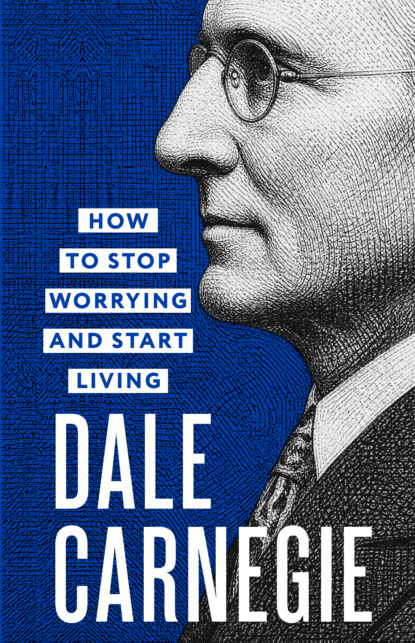
Полная версия:
How to Stop Worrying and Start Living / Как перестать беспокоиться и начать жить
What can we do about it? We have to keep our emotions out of our thinking; and, as Dean Hawkes put it, we must secure the facts in “an impartial, objective” manner.
That is not an easy task when we are worried. When we are worried, our emotions are riding high. But here are two ideas that I have found helpful when trying to step aside from my problems, in order to see the facts in a clear, objective manner.
1. When trying to get the facts, I pretend that I am collecting this information not for myself, but for some other person. This helps me to take a cold, impartial view of the evidence. This helps me eliminate my emotions.
2. While trying to collect the facts about the problem that is worrying me, I sometimes pretend that I am a lawyer preparing to argue the other side of the issue. In other words, I try to get all the facts against myself – all the facts that are damaging to my wishes, all the facts I don’t like to face.
Then I write down both my side of the case and the other side of the case – and I generally find that the truth lies somewhere in between these two extremities.
Here is the point I am trying to make. Neither you nor I nor Einstein nor the Supreme Court of the United States is brilliant enough to reach an intelligent decision on any problem without first getting the facts. Thomas Edison knew that. At the time of his death, he had two thousand five hundred notebooks filled with facts about the problems he was facing.
So Rule 1 for solving our problems is:
Get the facts. Let’s do what Dean Hawkes did: let’s not even attempt to solve our problems without first collecting all the facts in an impartial manner.
However, getting all the facts in the world won’t do us any good until we analyse them and interpret them. I have found from costly experience that it is much easier to analyse the facts after writing them down. In fact, merely writing the facts on a piece of paper and stating our problem clearly goes a long way toward helping us to reach a sensible decision. As Charles Kettering puts it: “A problem well stated is a problem half solved.”
Let me show you all this as it works out in practice. Since the Chinese say one picture is worth ten thousand words, suppose I show you a picture of how one man put exactly what we are talking about into concrete action.
Let’s take the case of Galen Litchfield – a man I have known for several years; one of the most successful American business men in the Far East. Mr. Litchfield was in China in 1942, when the Japanese invaded Shanghai. And here is his story as he told it to me while a guest in my home:
“Shortly after the Japs took Pearl Harbour,” Galen Litchfield began, “they came swarming into Shanghai. I was the manager of the Asia Life Insurance Company in Shanghai. They sent us an ‘army liquidator’ – he was really an admiral – and gave me orders to assist this man in liquidating our assets. I didn’t have any choice in the matter. I could cooperate – or else. And the ‘or else’ was certain death.
“I went through the motions of doing what I was told, because I had no alternative. But there was one block of securities, worth $750,000, which I left off the list I gave to the admiral. I left that block of securities off the list because they belonged to our Hong Kong organisation and had nothing to do with the Shanghai assets. All the same, I feared I might be in hot water if the Japs found out what I had done. And they soon found out.
“I wasn’t in the office when the discovery was made, but my head accountant was there. He told me that the Jap admiral flew into a rage, and stamped and swore, and called me a thief and a traitor! I had defied the Japanese Army! I knew what that meant. I would be thrown into the Bridge house!
“The Bridge house! The torture chamber of the Japanese Gestapo! I had had personal friends who had killed themselves rather than be taken to that prison. I had had other friends who had died in that place after ten days of questioning and torture. Now I was slated for the Bridge house myself!
“What did I do? I heard the news on Sunday afternoon. I suppose I should have been terrified. And I would have been terrified if I hadn’t had a definite technique for solving my problems. For years, whenever I was worried I had always gone to my typewriter and written down two questions – and the answers to these questions:
“1. What am I worrying about?
“2. What can I do about it?
“I used to try to answer those questions without writing them down. But I stopped that years ago. I found that writing down both the questions and the answers clarifies my thinking. So, that Sunday afternoon, I went directly to my room at the Shanghai Y.M.C.A. and got out my typewriter. I wrote:
“I. What am I worrying about? I am afraid I will be thrown into the Bridge house tomorrow morning.
“Then I typed out the second question:
“2. What can I do about it?
“I spent hours thinking out and writing down the four courses of action I could take – and what the probable consequence of each action would be.
“1. I can try to explain to the Japanese admiral. But he “no speak English”. If I try to explain to him through an interpreter, I may stir him up again. That might mean death, for he is cruel, would rather dump me in the Bridge house than bother talking about it.
“2. I can try to escape. Impossible. They keep track of me all the time. I have to check in and out of my room at the Y.M.C.A. If I try to escape, I’ll probably be captured and shot.
“3. I can stay here in my room and not go near the office again. If I do, the Japanese admiral will be suspicious, will probably send soldiers to get me and throw me into the Bridge house without giving me a chance to say a word.
“4. I can go down to the office as usual on Monday morning. If I do, there is a chance that the Japanese admiral may be so busy that he will not think of what I did. Even if he does think of it, he may have cooled off and may not bother me. If this happens, I am all right. Even if he does bother me, I’ll still have a chance to try to explain to him. So, going down to the office as usual on Monday morning, and acting as if nothing had gone wrong gives me two chances to escape the Bridge house.
“As soon as I thought it all out and decided to accept the fourth plan – to go down to the office as usual on Monday morning – I felt immensely relieved.
“When I entered the office the next morning, the Japanese admiral sat there with a cigarette dangling from his mouth. He glared at me as he always did; and said nothing. Six weeks later – thank God – he went back to Tokyo and my worries were ended.
“As I have already said, I probably saved my life by sitting down that Sunday afternoon and writing out all the various steps I could take and then writing down the probable consequences of each step and calmly coming to a decision. If I hadn’t done that, I might have floundered and hesitated and done the wrong thing on the spur of the moment. If I hadn’t thought out my problem and come to a decision, I would have been frantic with worry all Sunday afternoon. I wouldn’t have slept that night. I would have gone down to the office Monday morning with a harassed and worried look; and that alone might have aroused the suspicion of the Japanese admiral and spurred him to act.
“Experience has proved to me, time after time, the enormous value of arriving at a decision. It is the failure to arrive at a fixed purpose, the inability to stop going round and round in maddening circles, that drives men to nervous breakdowns and living hells. I find that fifty per cent of my worries vanishes once I arrive at a clear, definite decision; and another forty per cent usually vanishes once I start to carry out that decision.
“So I banish about ninety per cent of my worries by taking these four steps:
“1. Writing down precisely what I am worrying about.
“2. Writing down what I can do about it.
“3. Deciding what to do.
“4. Starting immediately to carry out that decision.”
Galen Litchfield is now the Far Eastern Director for Starr, Park and Freeman, Inc., III John Street, New York, representing large insurance and financial interests.
In fact, as I said before, Galen Litchfield today is one of the most important American business men in Asia; and he confesses to me that he owes a large part of his success to this method of analysing worry and meeting it head-on.
Why is his method so superb? Because it is efficient, concrete, and goes directly to the heart of the problem. On top of all that, it is climaxed by the third and indispensable rule: Do something about it. Unless we carry out our action, all our fact-finding and analysis is whistling upwind – it’s a sheer waste of energy.
William James said this: “When once a decision is reached and execution is the order of the day, dismiss absolutely all responsibility and care about the outcome.” In this case, William James undoubtedly used the word “care” as a synonym for “anxiety”. He meant – once you have made a careful decision based on facts, go into action. Don’t stop to reconsider. Don’t begin to hesitate worry and retrace your steps. Don’t lose yourself in self-doubting which begets other doubts. Don’t keep looking back over your shoulder.
I once asked Waite Phillips, one of Oklahoma’s most prominent oil men, how he carried out decisions. He replied: “I find that to keep thinking about our problems beyond a certain point is bound to create confusion and worry. There comes a time when any more investigation and thinking are harmful. There comes a time when we must decide and act and never look back.” Why don’t you employ Galen Litchfield’s technique to one of your worries right now?
Here is question 1 – What am I worrying about? (Please pencil the answer to that question in the space below.)
_____________
_____________
_____________
Question 2 – What can I do about it? (Please write your answer to that question in the space below.)
_____________
_____________
_____________
Question 3 – Here is what I am going to do about it.
_____________
_____________
_____________
Question 4 – When am I going to start doing it?
_____________
_____________
_____________
5 – How to Eliminate Fifty Per Cent of Your Business Worries
If you are a business man, you are probably saying to yourself right now: “The title of this chapter is ridiculous. I have been running my business for nineteen years; and I certainly know the answers if anybody does. The idea of anybody trying to tell me how I can eliminate fifty per cent of my business worries – it’s absurd!”
Fair enough – I would have felt exactly the same way myself a few years ago if I had seen this title on a chapter. It promises a lot – and promises are cheap.
Let’s be very frank about it: maybe I won’t be able to help you eliminate fifty per cent of your business worries. In the last analysis, no one can do that, except yourself. But what I can do is to show you how other people have done it – and leave the rest to you!
You may recall that in Chapter 3 of this book I quoted the world-famous Dr. Alexis Carrel as saying: “Business men who do not know how to fight worry die young.”
Since worry is that serious, wouldn’t you be satisfied if I could help you eliminate even ten per cent of your worries?… Yes?… Good! Well, I am going to show you how one business executive eliminated not fifty per cent of his worries, but seventy-five per cent of all the time he formerly spent in conferences, trying to solve business problems.
Furthermore, I am not going to tell you this story about a “Mr. Jones” or a “Mr. X” or “or a man I know in Ohio” – vague stories that you can’t check up on. It concerns a very real person – Leon Shimkin, a partner and general manager of one of the foremost publishing houses in the United States: Simon and Schuster, Rockefeller Centre, New York 20, New York.
Here is Leon Shimkin’s experience in his own words:
“For fifteen years I spent almost half of every business day holding conferences, discussing problems. Should we do this or that – do nothing at all? We would get tense; twist in our chairs; walk the floor; argue and go around in circles. When night came, I would be utterly exhausted. I fully expected to go on doing this sort of thing for the rest of my life. I had been doing it for fifteen years, and it never occurred to me that there was a better way of doing it. If anyone had told me that I could eliminate three-fourths of all the time I spent in those worried conferences, and three-fourths of my nervous strainl would have thought he was a wild-eyed, slap-happy, armchair optimist. Yet I devised a plan that did just that. I have been using this plan for eight years. It has performed wonders for my efficiency, my health, and my happiness
“It sounds like magic – but like all magic tricks, it is extremely simple when you see how it is done.
“Here is the secret: First, I immediately stopped the procedure I had been using in my conferences for fifteen years – a procedure that began with my troubled associates reciting all the details of what had gone wrong, and ending up by asking: ‘What shall we do?’ Second, I made a new rule – a rule that everyone who wishes to present a problem to me must first prepare and submit a memorandum answering these four questions:
“Question 1: What is the problem?
(“In the old days we used to spend an hour or two in a worried conference without anyone’s knowing specifically and concretely what the real problem was. We used to work ourselves into a lather discussing our troubles without ever troubling to write out specifically what our problem was.)
“Question 2: What is the cause of the problem?
(“As I look back over my career, I am appalled at the wasted hours I have spent in worried conferences without ever trying to find out clearly the conditions which lay at the root of the problem.)
“Question 3: What are all possible solutions of the problem?
(“In the old days, one man in the conference would suggest one solution. Someone else would argue with him. Tempers would flare. We would often get clear off the subject, and at the end of the conference no one would have written down all the various things we could do to attack the problem.)
“Question 4: What solution do you suggest?
(“I used to go into a conference with a man who had spent hours worrying about a situation and going around in circles without ever once thinking through all possible solutions and then writing down: ‘This is the solution I recommend.’)
“My associates rarely come to me now with their problems. Why? Because they have discovered that in order to answer these four questions they have to get all the facts and think their problems through. And after they have done that they find, in three-fourths of the cases, they don’t have to consult me at all, because the proper solution has popped out like a piece of bread popping out from an electric toaster. Even in those cases where consultation is necessary, the discussion takes about one-third the time formerly required, because it proceeds along an orderly, logical path to a reasoned conclusion.
“Much less time is now consumed in the house of Simon and Schuster in worrying and talking about what is wrong; and a lot more action is obtained toward making those things right.”
My friend, Frank Bettger, one of the top insurance men in America, tells me he not only reduced his business worries, but nearly doubled his income, by a similar method.
“Years ago,” says Frank Bettger, “when I first started to sell insurance, I was filled with a boundless enthusiasm and love for my work. Then something happened. I became so discouraged that I despised my work and thought of giving it up. I think I would have quit – if I hadn’t got the idea, one Saturday morning, of sitting down and trying to get at the root of my worries.
“1. I asked myself first: ‘Just what is the problem?.’ The problem was: that I was not getting high enough returns for the staggering amount of calls I was making. I seemed to do pretty well at selling a prospect, until the moment came for closing a sale. Then the customer would say: ‘Well, I’ll think it over, Mr. Bettger. Come and see me again.’ It was the time I wasted on these follow-up calls that was causing my depression.
“2. I asked myself: ‘What are the possible solutions?’ But to get the answer to that one, I had to study the facts. I got out my record book for the last twelve months and studied the figures.
“I made an astounding discovery! Right there in black and white, I discovered that seventy per cent of my sales had been closed on the very first interview! Twenty-three per cent of my sales had been closed on the second interview! And only seven per cent of my sales had been closed on those third, fourth, fifth, etc., interviews, which were running me ragged and taking up my time. In other words, I was wasting fully one half of my working day on a part of my business which was responsible for only seven per cent of my sales!
“3. ‘What is the answer?’ The answer was obvious. I immediately cut out all visits beyond the second interview, and spent the extra time building up new prospects. The results were unbelievable. In a very short time, I had almost doubled the cash value of every visit I made from a call!”
As I said, Frank Bettger is now one of the best-known life-insurance salesmen in America. He is with Fidelity Mutual of Philadelphia, and writes a million dollars’ worth of policies a year. But he was on the point of giving up. He was on the point of admitting failure – until analysing the problem gave him a boost on the road to success.
Can you apply these questions to your business problems? To repeat my challenge – they can reduce your worries by fifty per cent. Here they are again:
1. What is the problem?
2. What is the CAUSE of the problem?
3. What are all possible solutions to the problem?
4. What solution do you suggest?
Part Two In A Nutshell
RULE 1: Get the facts. Remember that Dean Hawkes of Columbia University said that “ half the worry in the world is caused by people trying to make decisions before they have sufficient knowledge on which to base a decision.”
RULE 2: After carefully weighing all the facts, come to a decision.
RULE 3: Once a decision is carefully reached, act! Get busy carrying out your decision – and dismiss all anxiety about the outcome.
RULE 4: When you, or any of your associates are tempted to worry about a problem, write out and answer the following questions:
a. What is the problem?
b. What is the cause of the problem?
c. What are all possible solutions?
d. What is the best solution?
Nine Suggestions on How to Get the Most Out of This Book
1. If you wish to get the most out of this book, there is one indispensable requirement, one essential infinitely more important than any rules or technique. Unless you have this one fundamental requisite a thousand rules on how to study will avail little. And if you do have this cardinal endowment, then you can achieve wonders without reading any suggestions for getting the most out of a book.
What is this magic requirement? Just this: a deep, driving desire to learn, a vigorous determination to stop worrying and start living.
How can you develop such an urge? By constantly reminding yourself of how important these principles are to you. Picture to yourself how their mastery will aid you in living a richer, happier life.
Say to yourself over and over: “My peace of mind, my happiness, my health, and perhaps even my income will, in the long run, depend largely on applying the old, obvious, and eternal truths taught in this book.”
2. Read each chapter rapidly at first to get a bird’s-eye view of it. You will probably be tempted then to rush on to the next one. But don’t. Unless you are reading merely for entertainment. But if you are reading because you want to stop worrying and start living, then go back and re-read each chapter thoroughly. In the long run, this will mean saving time and getting results.
3. Stop frequently in your reading to think over what you are reading. Ask yourself just how and when you can apply each suggestion. That kind of reading will aid you far more than racing ahead like a whippet chasing a rabbit.
4. Read with a red crayon, pencil, or fountain-pen in your hand; and when you come across a suggestion that you feel you can use, draw a line beside it. If it is a four-star suggestion, then underscore every sentence, or mark it with “XXXX”. Marking and underscoring a book make it more interesting, and far easier to review rapidly.
5. I know a man who has been office manager for a large insurance concern for fifteen years. He reads every month all the insurance contracts his company issues. Yes, he reads the same contracts over month after month, year after year. Why? Because experience has taught him that that is the only way he can keep their provisions clearly in mind.
I once spent almost two years writing a book on public speaking; and yet I find I have to keep going back over it from time to time in order to remember what I wrote in my own book. The rapidity with which we forget is astonishing.
So, if you want to get a real, lasting benefit out of this book, don’t imagine that skimming through it once will suffice. After reading it thoroughly, you ought to spend a few hours reviewing it every month. Keep it on your desk in front of you every day. Glance through it often. Keep constantly impressing yourself with the rich possibilities for improvement that still lie in the offing. Remember that the use of these principles can be made habitual and unconscious only by a constant and vigorous campaign of review and application. There is no other way.
6. Bernard Shaw once remarked: “If you teach a man anything, he will never learn.” Shaw was right. Learning is an active process. We learn by doing. So, if you desire to master the principles you are studying in this book, do something about them. Apply these rules at every opportunity. If you don’t you will forget them quickly. Only knowledge that is used sticks in your mind.
You will probably find it difficult to apply these suggestions all the time. I know, because I wrote this book, and yet frequently I find it difficult to apply everything I have advocated here. So, as you read this book, remember that you are not merely trying to acquire information. You are attempting to form new habits. Ah yes, you are attempting a new way of life. That will require time and persistence and daily application.
So refer to these pages often. Regard this as a working handbook on conquering worry; and when you are confronted with some trying problem – don’t get all stirred up. Don’t do the natural thing, the impulsive thing. That is usually wrong.
Instead, turn to these pages and review the paragraphs you have underscored. Then try these new ways and watch them achieve magic for you.
7. Offer your wife a shilling every time she catches you violating one of the principles advocated in this book. She will break you!
8. Please turn to the pages of this book where how the Wall Street banker, H.P. Howell, and old Ben Franklin corrected their mistakes is written. Why don’t you use the Howell and Franklin techniques to check up on your application of the principles discussed in this book? If you do, two things will result.
First, you will find yourself engaged in an educational process that is both intriguing and priceless.
Second, you will find that your ability to stop worrying and start living will grow and spread like a green bay tree.
9. Keep a diary – a diary in which you ought to record your triumphs in the application of these principles. Be specific. Give names, dates, results. Keeping such a record will inspire you to greater efforts; and how fascinating these entries will be when you chance upon them some evening, years from now!
In A Nutshell
1. Develop a deep, driving desire to master the principles of conquering worry.
2. Read each chapter twice before going on to the next one.
3. As you read, stop frequently to ask yourself how you can apply each suggestion.
4. Underscore each important idea.