Полная версия:
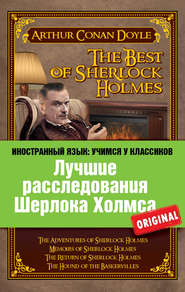
Лучшие расследования Шерлока Холмса / The Best of Sherlock Holmes
“Well, to come to an end of the matter, Mr. Holmes, and not to abuse your patience, there came a night when he made one of those drunken sallies from which he never came back. We found him, when we went to search for him, face downward in a little green-scummed pool, which lay at the foot of the garden. There was no sign of any violence, and the water was but two feet deep, so that the jury, having regard to his known eccentricity, brought in a verdict of ‘suicide.’ But I, who knew how he winced from the very thought of death, had much ado to persuade myself that he had gone out of his way to meet it. The matter passed, however, and my father entered into possession of the estate, and of some 14,000 pounds, which lay to his credit at the bank.”
“One moment,” Holmes interposed, “your statement is, I foresee, one of the most remarkable to which I have ever listened. Let me have the date of the reception by your uncle of the letter, and the date of his supposed suicide.”
“The letter arrived on March 10, 1883. His death was seven weeks later, upon the night of May 2d.”
“Thank you. Pray proceed.”
“When my father took over the Horsham property, he, at my request, made a careful examination of the attic, which had been always locked up. We found the brass box there, although its contents had been destroyed. On the inside of the cover was a paper label, with the initials of K. K. K. repeated upon it, and ‘Letters, memoranda, receipts, and a register’ written beneath. These, we presume, indicated the nature of the papers which had been destroyed by Colonel Openshaw. For the rest, there was nothing of much importance in the attic save a great many scattered papers and note-books bearing upon my uncle’s life in America. Some of them were of the war time and showed that he had done his duty well and had borne the repute of a brave soldier. Others were of a date during the reconstruction of the Southern states, and were mostly concerned with politics, for he had evidently taken a strong part in opposing the carpet-bag politicians who had been sent down from the North.
“Well, it was the beginning of ’84 when my father came to live at Horsham, and all went as well as possible with us until the January of ’85. On the fourth day after the new year I heard my father give a sharp cry of surprise as we sat together at the breakfast-table. There he was, sitting with a newly opened envelope in one hand and five dried orange pips in the outstretched palm of the other one. He had always laughed at what he called my cock-and-bull story about the colonel, but he looked very scared and puzzled now that the same thing had come upon himself.
“ ‘Why, what on earth does this mean, John?’ he stammered.
“My heart had turned to lead. ‘It is K. K. K.,’ said I.
“He looked inside the envelope. ‘So it is,’ he cried. ‘Here are the very letters. But what is this written above them?’
“ ‘Put the papers on the sundial,’ I read, peeping over his shoulder.
“ ‘What papers? What sundial?’ he asked.
“ ‘The sundial in the garden. There is no other,’ said I; ‘but the papers must be those that are destroyed.’
“ ‘Pooh!’ said he, gripping hard at his courage. ‘We are in a civilized land here, and we can’t have tomfoolery of this kind. Where does the thing come from?’
“ ‘From Dundee,’ I answered, glancing at the postmark.
“ ‘Some preposterous practical joke,’ said he. ‘What have I to do with sundials and papers? I shall take no notice of such nonsense.’
“ ‘I should certainly speak to the police,’ I said.
“ ‘And be laughed at for my pains. Nothing of the sort.’
“ ‘Then let me do so?’
“ ‘No, I forbid you. I won’t have a fuss made about such nonsense.’
“It was in vain to argue with him, for he was a very obstinate man. I went about, however, with a heart which was full of forebodings.
“On the third day after the coming of the letter my father went from home to visit an old friend of his, Major Freebody, who is in command of one of the forts upon Portsdown Hill[50]. I was glad that he should go, for it seemed to me that he was farther from danger when he was away from home. In that, however, I was in error. Upon the second day of his absence I received a telegram from the major, imploring me to come at once. My father had fallen over one of the deep chalk-pits which abound in the neighbourhood, and was lying senseless, with a shattered skull. I hurried to him, but he passed away without having ever recovered his consciousness. He had, as it appears, been returning from Fareham in the twilight, and as the country was unknown to him, and the chalk-pit unfenced, the jury had no hesitation in bringing in a verdict of ‘death from accidental causes.’ Carefully as I examined every fact connected with his death, I was unable to find anything which could suggest the idea of murder. There were no signs of violence, no footmarks, no robbery, no record of strangers having been seen upon the roads. And yet I need not tell you that my mind was far from at ease, and that I was well-nigh certain that some foul plot had been woven round him.
Конец ознакомительного фрагмента.
Текст предоставлен ООО «Литрес».
Прочитайте эту книгу целиком, купив полную легальную версию на Литрес.
Безопасно оплатить книгу можно банковской картой Visa, MasterCard, Maestro, со счета мобильного телефона, с платежного терминала, в салоне МТС или Связной, через PayPal, WebMoney, Яндекс.Деньги, QIWI Кошелек, бонусными картами или другим удобным Вам способом.
Примечания
1
Cocaine was a legal drug at that time.
2
Trincomalee – a port in Sri Lanka
3
a spirit case and a gasogene– a spirit case (aka tantalus) was a Victorian locked cabinet to store spirits. A gasogene was a special decanter for making carbonated water.
4
Bohemia – a historical region in Central Europe; now it’s a part of Czech Republic. By the end of the 19th century Bohemia was a part of Austro-Hungarian Empire.
5
von Wallenstein, Albrecht Wenzel Eusebius (1583–1634) – Bohemian military leader who headed the armies of emperor Ferdinand II during the Thirty Years’ War (1618–1648). He was assassinated in Cheb (Eger) in 1634. The name “Egria” (mentioned above) is a variation from Eger.
6
brougham – a closed horse-drawn four-wheeled carriage with the driver’s seat outside in the front. It was named after Henry Peter Brougham, 1st Baron Brougham and Vaux who is believed to invent it.
7
Boswell, James (1740–1795) – a biographer of famous English writer and lexicographer Samuel Johnson. Boswell’s “Life of Samuel Johnson” is claimed to be the greatest life story ever written in English. The name of Boswell has become a household name for a very scrupulous diarist.
8
Astrakhan – a karakul lambskin. King’s clothes looked exotic and vulgar in Victorian Britain.
9
Langham– a luxury hotel founded in 1865 as the largest and most modern hotel in London. It still exists as a luxury hotel.
10
bijou villa – “bijou” is a French term for “jewel.” Bijou villa is a French-style small pretty cottage.
11
Chubb lock – a prominent British brand of locks. In the 19th century Chubb locks were widely known for their high security and were used by General Post Office and Her Majesty’s Prison Service.
12
ostlers– it’s a cockney pronunciation of “hostlers”
13
half-and-half– a cocktail, consists of half ale half bitter beer
14
Inner Temple– The Honourable Society of the Inner Temple is one of four London professional associations for barristers providing education and training for its members. The headquarters of the Society are situated near the Temple Church. The area surrounding the Temple church is known as the Temple.
15
Hansom cab– a closed horse-drawn two-wheeled carriage with the driver’s seat above and behind the passengers. Hansom cab had a low centre of gravity to provide safer cornering. It was named after Joseph Hansom who patented it in 1834.
16
license– marriage license, a document issued by ecclesiastical or civil authorities permitting a couple to get married
17
John Hare (1844–1921) – a famous stage actor
18
Ulster – a long loose overcoat made of heavy fabric (tweed, herringbones etc), its name refers to Ulster where it was originally produced. In Victorian Britain it was an informal daytime overcoat.
19
Charing Cross– Charring Cross railway station, a railway terminus opened in 1864 in the City of Westminster. Now it is one of the busiest railway terminals in London.
20
née– born (French). The word is put before maiden name mentioned after the surname of a married woman.
21
shepherd’s check trousers – trousers made of fabric (usually wool) woven in small black-and-white checks
22
Albert chain– a kind of watch chain named after Prince Albert, Queen Victoria’s husband
23
Freemason (or Mason) – a member of the secret fraternal order of Free and Accepted Masons. Originated in the Middle Ages from the guilds of stonemasons that built cathedrals and castles, Freemasonry is now the largest worldwide “secret” society.
24
Omne ignotum pro magnifico – Everything unknown is taken for magnificent. (Latin)
25
The Morning Chronicle– a daily newspaper famous for having among the staff Charles Dickens and Henry Mayhew.
26
foolscap (folio)– a traditional large size of paper (8½ in x 13½ in)
27
de Sarasate y Navascués, Pablo Martín Melitón (1844–1908) – a famous Spanish violinist and composer who toured a lot and performed at the best stages
28
St. James’s Hall– a concert hall opened in 1858; till the 1900s it was the principal concert hall of London.
29
Aldersgate– one of the 25 wards of the City of London (about 3 miles from Baker Street)
30
Scotland-yard– a household name of the Metropolitan Police headquarters. When founded in 1829, the Metropolitan Police occupied the building 4 Whitehall Place which backed onto Great Scotland Yard Street.
31
napoleons– an informal name of French golden coins. In different periods of time their value varied from from 5 to 100 francs.
32
partie carrée— foursome (French)
33
L’homme c’est rien – l’œuvre c’est tout – The man is nothing, the work is everything! (French)
34
as Gustave Flaubert wrote to Georges Sand– it is really a quotation from the letter of famous author Gustave Flaubert (1821–1880) to another famous author, Georges Sand (1804–1876, real name Aurore Dupin), though the original phrase was “L’homme n’est rien, l’oeuvre – tout.”
35
affaire de coeur – love affair (French)
36
King’s Cross – an area of central London. The name of the district is due to a monument to George IV erected there in the 1830s. The monument was demolished in 1845, but the area still keeps its name. In 1852 there was opened King’s Cross railway station.
37
four-wheeler (aka the growler or the Clarence) – a closed four-wheeled carriage that seated four passengers. It was a standard cab in Victorian London.
38
Harris tweed– a type of tweed cloth woven from pure virgin wool on the Outer Hebrides of Scotland: Lewis, Harris, Uist and Barra. Harris tweed is handwoven and produced only of the wool dyed and spun on the Islands.
39
an action for breach of promise – in Victorian Britain it meant court proceedings when a man who had promised to marry changed his mind afterwards
40
Paddington = Paddington Railway station (aka London Paddington); it was opened in 1838. It served the eastern terminus for the Great Western Railway (from Bristol to London). In 1863 the first underground passenger-carrying railway (the Metropolitan Railway) was opened between Paddington and Farrington.
41
Herefordshire is a county in Western England
42
(The Courts of) Assizes were courts held by visiting judges at the principal towns of each county not to make the litigators travel to London. The Assizes dealt mainly with serious crime cases transferred by local county courts.
43
coroner’s jury — coroner is an official whose duty is to discover the cause of individual’s death in criminal or possibly criminal cases. In the 19th century British coroners conducted inquests with the help of a jury.
44
The River Severn is the longest river in the UK (about 354 km). It flows from Plynlimon, Wales through Shropshire, Worcestershire, Gloucestershire, Monmouthshire, and discharges into the Bristol Channel.
45
Bermuda Dockyard — Her/His Majesty’s Dockyard on Ireland Island, Bermuda was established after the defeat of the UK in the American War of Independence. It served as an important strategic base of Royal Navy for about 150 years. In the 19th century the Dockyard was employing about 1000 Bermudians as well as using the labour of convicted criminals from the UK.
46
George Meredith (1828–1909) was an English Victorian poet and novelist.
47
Clark Russell’s– William Clark Russell (1844–1911) was a popular Anglo-American nautical and horror novels author.
48
Jackson’s army, and afterwards under Hood– Henry Rootes Jackson and John Bell Hood were Confederate generals during the American Civil War.
49
Lee – Robert Edward Lee commanded the Confederate Army. His surrender to Union General Ulysses S. Grant at Appomattox Court House on April 9, 1865 ended the American Civil War.
50
Portsdown Hill is a chalk hill about 430 ft. high to the north of Portsmouth. In the 1860s along the crest of the Hill 6 forts were constructed to prevent an enemy from capturing the heights of the Hill and bombarding Portsmouth and the British fleet in Portsmouth harbour.
Вы ознакомились с фрагментом книги.
Для бесплатного чтения открыта только часть текста.
Приобретайте полный текст книги у нашего партнера:
Полная версия книги
Всего 10 форматов