Полная версия:
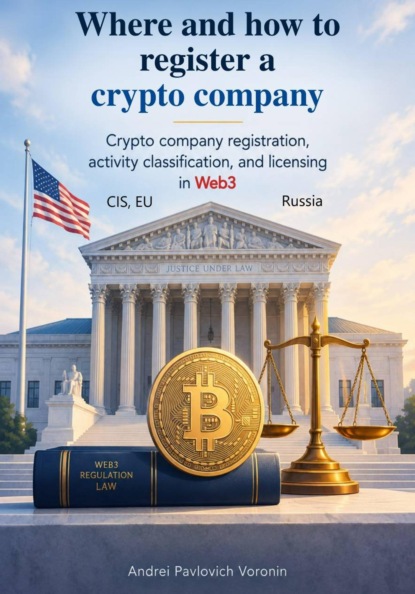
Where and how to register a crypto company

Андрей Воронин
Where and how to register a crypto company
Where and how to register a crypto company
Crypto company registration, activity classification,
and licensing in Web3
Andrei Voronin
About this book
A crypto company does not start with a country. It starts with a clear answer to one question: what will the company actually do every day? For example, will it exchange crypto for money, hold the crypto of its clients, run a trading platform, or issue its own token?
This book is a practical guide for founders of crypto projects, for their lawyers, and for their investors. It explains, step by step and in plain language, three connected decisions. First, the type of activity decides which license the company needs. Second, the license decides in which country the company should register. Third, at each stage, a regulator, a bank, an exchange, and a tax authority check the company, and the book explains what each of them looks at.
The book covers the licensing rules of Kazakhstan, Uzbekistan, the European Union, the United Arab Emirates, the United States, Russia, and Tajikistan. It also explains the legal status of tokens, legal ways to raise money, listing a token on an exchange, the duties of a company after it receives a license, taxes, the protection of personal data, the team and the brand, DAOs, tokenized real-world assets, sanctions and banking risks, disputes, and control over the company. A DAO, or decentralized autonomous organization, is a project in which token holders vote on decisions.
Each chapter starts with a short answer, explains each step in simple words, and ends with a checklist.
Contents
Part I. Start
Chapter 1. Where and how to register a crypto company
Chapter 2. Structure and substance of a crypto company: what the regulator checks
Chapter 3. Banking for a crypto company: why banks say no, and how to open an account
Part II. Token and money
Chapter 4. Security token or utility token: legal status of your crypto token
Chapter 5. How to raise money for a crypto project legally: SAFT and token sales
Chapter 6. Crypto token listing on an exchange: legal requirements
Part III. Compliance
Chapter 7. AML and KYC for crypto companies: compliance requirements after licensing
Chapter 8. Crypto company taxes: a complete guide for founders
Chapter 9. GDPR for a crypto platform: user data protection
Chapter 10. Crypto advertising laws: what you can promote and what you cannot
Part IV. Team and special models
Chapter 11. Crypto team and brand: hiring, token pay, trademarks, and domain ownership
Chapter 12. DAO legal status: who is liable if there is no legal entity
Chapter 13. RWA tokenization licenses and risks: who is liable if the asset falls or disappears
Part V. Risks and strategy
Chapter 14. Sanctions and banking risk for CIS founders: correspondent banking and account closure
Chapter 15. Crypto company redomiciliation: how to change jurisdiction without killing the token
Chapter 16. Crypto license revocation and regulator review: what a founder should do
Chapter 17. Crypto company bankruptcy and client assets: segregation, wind-down, and license sale
Chapter 18. Common crypto founder mistakes: real cases, a self-check list, and how to read this book
Part VI. Document, dispute and control
Chapter 19. Smart contract legal enforceability: code, offer, and court
Chapter 20. Crypto terms of use for retail clients: withdrawal rights, complaints, and unfair clauses
Chapter 21. Crypto dispute resolution and enforcement: governing law, courts, arbitration, and on-chain assets
Chapter 22. Crypto company outsourcing: KYC vendor, cloud, custodian, and market maker risk
Chapter 23. Crypto white paper disclosure after launch: updates, liability, and misleading statements
Chapter 24. Crypto company change of control and qualifying holdings
Supplement
Chapter 25. Crypto licensing laws: Kazakhstan, Uzbekistan, MiCA, Dubai VARA, and UAE CMA rules
Chapter 26. Crypto license checklist before you file: activity, jurisdiction, white paper, and charter
After the chapters
Conclusion. Where and how to register a crypto company
About the author
Copyright and legal notice
Introduction
This book is for founders of crypto projects, for their lawyers, and for their investors. It helps them decide where and how to register a crypto company, and how to keep the company legal after the launch.
The book explains the legal side of a crypto business in the same order in which a founder usually meets it. First comes the choice of the type of activity, the license, and the country. Then come the token and the money. After that come the daily legal duties of the company, the team, special business models, and risks. The book ends with documents, disputes, and control over the company.
How is the book organized?
The book has six parts and a supplement.
Part I. Start explains where and how to register a crypto company. It also explains what a regulator checks when it asks for “substance,” meaning real people, a real office, and real management in the country, and how to open a bank account.
Part II. Token and money explains the legal status of a token, legal ways to raise money for a project, and listing a token on an exchange.
Part III. Compliance explains the duties of a company after it receives a license. These duties include AML and KYC, meaning the rules against money laundering and the checks of who the clients are, as well as taxes, the protection of personal data, and the rules on advertising.
Part IV. Team and special models explains hiring and the brand, the legal status of a DAO, and the tokenization of real-world assets, such as buildings or gold.
Part V. Risks and strategy explains sanctions and banking risks, moving a company to another country, a review or a withdrawal of a license, the bankruptcy of a company, and the typical mistakes of founders.
Part VI. Document, dispute and control explains smart contracts, the terms of use for retail clients, disputes, outsourcing, the white paper after launch, and changes in the owners of a company.
The supplement lists the main laws of the countries covered in the book, and the final checks that a company should make before it files an application for a license.
How is each chapter built?
Each chapter starts with a short answer to its main question. The sections of the chapter are written as the questions that a founder usually asks.
Where it helps, a chapter gives one of three things: a hypothetical example, a real case from a court or a regulator, or a step-by-step plan. A hypothetical example is always marked as hypothetical or as a composite example, and it does not describe a real company. A real case always names the court or the regulator and the date.
Each chapter ends with a checklist. The book has no tables and no lists of links, so that it reads the same way on paper and in audio.
How current is the information?
The information in this book is current as of October 2026. Laws, the rules of regulators, and the required amounts of capital change often. Before you rely on any figure, date, or rule from this book, take three steps. First, check the official text of the law. Second, check the website of the regulator on the date of your decision. Third, talk to a local lawyer in the country where the product will work.
Where should I start?
If you are choosing a country for a new company, start with Chapter 1. Before you file an application for a license, go through the checks in Chapter 26.
If your company already has a license, start with Part III, which explains the daily duties of a licensed company.
If you want to see what usually goes wrong, read Chapter 18. That chapter also explains how to use this book.
This book is not legal, tax, or financial advice. The full legal notice is at the end of the book.
Part I. Start
Chapter 1. Where and how to register a crypto company
The short answer. Before a founder chooses a country for a crypto company, the founder needs to decide exactly what the business will do. The type of business activity decides which license the company needs. The type of license then decides which countries are realistic for the company. The country comes last, not first. This chapter explains these three steps one by one, describes the rules in each country, and ends with a comparison of the countries, a step-by-step plan, and a list of documents for a license application.
Why should I choose the business activity before the country?
Registering a crypto company does not start with choosing a country. It starts with one simple question: what will the business actually do? The answer to this question decides what type of license the company needs. The type of license then decides which countries are realistic options for the company.
Some founders reverse this order. They choose a country first because registration there looks cheap or because “everyone registers there.” Later, these founders have to change their business model to fit rules that were never written for that model. Fixing the business model in this way almost always costs more than the money the founders saved at the start.
Which types of crypto business need different licenses?
There are five common types of crypto business: an exchange, a broker, a custody provider, a platform that turns real-world assets into tokens, and a legal wrapper for a decentralized organization. These are five different activities. In almost every country, one license does not cover all five activities.
An exchange brings buyers and sellers together and runs a place where they trade. An exchange needs the most capital, and regulators check exchanges most closely, because an exchange handles the largest amount of other people’s money.
A broker carries out client orders to buy or sell, either in the broker’s own name or in the client’s name. For a broker, the regulator mainly checks how the broker handles client money before a trade is complete.
A custody provider, often called simply “custody,” holds client crypto assets in its own wallets. Custody almost always needs a separate permit with stricter rules. The reason is simple: if a custody provider is hacked or goes bankrupt, the money that is lost belongs to the clients, not to the company.
A real-world asset platform, usually shortened to RWA, turns a physical asset into a digital token. The asset can be real estate, a debt, or goods in a warehouse. An RWA platform works under two sets of rules at the same time: the rules for crypto, and the ordinary property law that applies to the real asset behind the token.
A decentralized autonomous organization, or DAO, is a group that makes decisions through votes recorded on a blockchain. In its pure form, a DAO is not a legal entity at all. For this reason, founders create a separate legal wrapper around the DAO, usually a foundation in one of the few countries that recognize this kind of structure.
A legal wrapper for a DAO is an ordinary legal entity that the members of the DAO create. The wrapper lets the DAO sign contracts, open a bank account, pay taxes, and protect its members from personal liability. Without a wrapper, a court in some countries may treat all members of the DAO as partners in a general partnership. In that case, each member can be personally responsible for the debts of the DAO. Founders most often use one of three wrappers: a foundation company in the Cayman Islands, a DAO limited liability company in the US state of Wyoming, or a DAO limited liability company in the Marshall Islands. Each wrapper has its own rules on members, voting, and taxes, so choosing a wrapper is a separate legal task. Chapter 12 compares these wrappers in detail.
A real-world asset token can also fall under securities law, not only under crypto rules. Suppose the token gives its holder a right to income from the asset, for example rent from a building or interest on a loan. In that case, many regulators treat the token as a security or as another financial instrument. Then the company needs a securities license or a license for digital financial assets, not only a crypto license. Chapter 13 explains the licenses and risks of real-world asset tokens.
One more point matters before we look at specific countries. The same token or the same platform can fall under more than one type of activity at the same time. For example, an exchange that also holds client assets is in fact two businesses: an exchange and a custody provider. Most regulators require the company to have a license for both parts, not just for one part.
A common mistake at this stage is to apply for a license that covers only the “easier” part of the business and to hope that the rest will sort itself out later. This mistake happens often. It usually ends in one of two ways: the regulator refuses the license application, or the regulator orders the company to stop part of its business after the launch.
When does a crypto business not need a license?
Not every crypto product needs a license. The main question is whether the company ever controls other people’s money or crypto assets. A company that only writes and sells software, and never holds, moves, or exchanges client assets, often falls outside the licensing rules. Two examples show where the line usually runs.
The first example is a non-custodial wallet. In a non-custodial wallet, only the user holds the private keys. Private keys are the secret codes that control the crypto in a wallet. The company that made the wallet cannot move the user’s funds. The European Union’s Markets in Crypto-Assets Regulation, known as MiCA, says in its introductory part that the regulation does not cover companies that only provide hardware or software for non-custodial wallets. In the United States, the Financial Crimes Enforcement Network, known as FinCEN, said in its 2019 guidance that a company that provides unhosted wallet software, where the user alone controls the funds, is not a money transmitter for that activity.
The second example is a fully decentralized service. MiCA says that crypto services provided in a fully decentralized way, without any intermediary, do not fall under the regulation. The word “fully” is important. A regulator may decide that a service is not fully decentralized if the company runs the website for the service, holds administrator keys that can change or stop the smart contract, or earns fees from the service. In that case, the regulator treats the company as an intermediary. This exception is narrow, and a lawyer should check it for each specific product.
Hypothetical example. A team builds a mobile wallet app. The private keys stay only on the user’s phone, and the team never sees the keys. In this version of the app, the team usually does not need a crypto license under MiCA. Then the team adds a “Buy crypto with a card” button, and the card payments go through the team’s own company account. From that moment, the team’s company takes client money and exchanges it for crypto. This is exchange activity, and exchange activity needs a license.
Which countries do founders usually compare?
The rest of this chapter looks at specific countries. It starts with the countries that founders from Russian-speaking countries usually consider first: Kazakhstan, Uzbekistan, the European Union, and the United Arab Emirates. Then it covers the United States, Russia, and Tajikistan.
Kazakhstan: which regulator licenses what?
In Kazakhstan, the main law is the Law of the Republic of Kazakhstan number 193 of February 6, 2023, “On digital assets in the Republic of Kazakhstan.” This law took effect on April 1, 2023, and has been amended since then. A new set of rules under this law took effect on May 1, 2026.
Many people think that Kazakhstan has two sets of crypto rules. In fact, Kazakhstan has three. Each set has its own regulator and its own requirements.
The first regulator is the National Bank of Kazakhstan. The National Bank licenses operators that exchange crypto. The National Bank also keeps a register of trading platforms for what the law calls “unsecured digital assets,” which means ordinary cryptocurrencies such as bitcoin. Since May 1, 2026, a company files its application for an exchange operator license, or for registration as a trading platform operator or a digital financial asset platform operator, directly with the National Bank. The National Bank publishes the requirements on its website.
The second regulator is the Agency for Regulation and Development of the Financial Market, usually shortened to ARDFM. ARDFM regulates digital financial assets. Digital financial assets mainly include tokenized claims, tokenized bonds, and similar instruments. Stablecoins are the one exception. Under the law, stablecoins backed by money also count as digital financial assets, but the National Bank supervises stablecoins, not ARDFM.
The third system is the Astana International Financial Centre, known as the AIFC. The AIFC is a separate area inside Kazakhstan with its own legal system based on common law. The AIFC has its own regulator, the Astana Financial Services Authority, known as AFSA, and its own full set of licenses. These licenses have nothing to do with the National Bank or with ARDFM.
Common law is a legal system based on English law. In a common law system, court decisions matter as much as written statutes. Inside the AIFC, disputes go to the AIFC Court, and the rules are written in English. Many foreign founders find this system more familiar than the national law of Kazakhstan. However, an AIFC license covers only activity under the AIFC rules. Activity in the rest of Kazakhstan falls under the national rules.
How much capital do I need in Kazakhstan?
Two kinds of capital are easy to confuse. Share capital is the money that the owners put into the company when they register it. The amount of share capital appears in the founding documents of the company. Regulatory capital is the money that a licensed company must keep available at all times, so that the company can cover losses and pay clients back if something goes wrong. The regulator sets the amount of regulatory capital, and the company must prove to the regulator that it actually has this money. A company can register with a small share capital. However, the company cannot get a crypto license until it shows the regulatory capital that the license requires.
In the AIFC, the amount of capital depends on the specific license. Public overviews give a capital requirement starting at about 200,000 US dollars, or twelve months of operating expenses, for a license to run a digital asset trading facility. For custody and dealing, public overviews give a requirement starting at about 250,000 US dollars. These figures are only a rough guide. The exact amount depends on the combination of activities that the company applies for, so check the current amount in the AFSA rules before you rely on it.
For the national system, the minimum capital is set in the rules of the National Bank, not in the law. One public overview gives 50 million tenge for a crypto exchanger and 100 million tenge for a digital financial asset platform. Use these amounts only as a starting point, and check them on the website of the National Bank.
There is also an easier way to start in the AIFC: the FinTech Lab, the regulatory sandbox of the AIFC. A regulatory sandbox is a special program in which a regulator lets a young company test its product with real clients for a limited time, under lighter rules and close supervision. The company does not get a full license. Instead, it gets a temporary permission. AFSA sets the limits on the number of clients and on the volume of transactions separately in the permission of each company, so there is no single standard limit. To enter the sandbox, a company must show AFSA that it has enough money and a planned base capital that covers at least twelve months of operating expenses. When the test period ends, the company must either move to a full license or stop operating.
The sandbox suits a team that wants to prove that its product works before it spends money on a full license. The sandbox does not suit a business plan that needs many clients or large volumes from the first month.
Both for a full AIFC license and for the sandbox, AFSA expects the company to have a real presence in Kazakhstan: real people and a real office. AFSA reviews the candidates for key positions in the company. The company may not start serving clients until AFSA approves the internal rules and compliance manuals of the company.
Why is a bank account a separate problem in Kazakhstan?
In Kazakhstan, there is another difficulty that founders often underestimate: the bank account. An AFSA license, or even a letter of preliminary approval from AFSA, lets the company start talks with a bank. However, neither document guarantees that the bank will open an account.
Second-tier banks in Kazakhstan are cautious with crypto businesses. “Second-tier banks” is the official name in Kazakhstan for ordinary commercial banks. The National Bank is the first tier: it is the central bank, and it regulates the other banks. Commercial banks that serve companies and people are the second tier. These banks worry about their own reputation and about their financial monitoring duties. Financial monitoring is the legal duty of a bank to check its clients and to report suspicious transactions to the state. A crypto client adds work and risk to this duty, so many banks refuse crypto clients. Even with a complete set of documents, opening an account can take weeks, and sometimes the bank refuses without giving a reason.
Hypothetical example. A company receives its license and feels relieved. Then the company spends the next six months trying to set up its banking and payments. It applies to a second bank, a third bank, and a fourth bank, or it uses payment intermediaries. This is why the company should work on the bank account at the same time as the license application, not after the license.
Chapter 3 explains why banks refuse crypto companies and how to prepare for the bank. Chapter 2 explains what the regulator checks when it asks whether the company has “substance,” meaning real people, a real office, and real work in the country.
Uzbekistan: what does the regulator check?
In Uzbekistan, the licensing body is the National Agency of Perspective Projects, known as NAPP. The rules in Uzbekistan are noticeably stricter than in Kazakhstan. NAPP describes itself as the state body responsible for regulation, licensing, and permits in the field of crypto-asset turnover.
The main licensing document is the Regulation on the procedure for licensing service providers in crypto-asset turnover. NAPP approved this regulation by Order number 32 of July 14, 2022, and the Ministry of Justice registered it on August 15, 2022, under number 3380. The regulation names each type of provider separately, for example a crypto exchange, a mining pool, a crypto depository, and a crypto shop. Each type of provider needs its own license.
Public descriptions of the licensing rules since 2021 say that the electronic trading system of a crypto exchange must run on servers located inside Uzbekistan. The same descriptions say that the exchange must store transaction data, client identification data, and business correspondence for five years. Before you file, check that these requirements are still in force in the current version of the rules.