Полная версия:
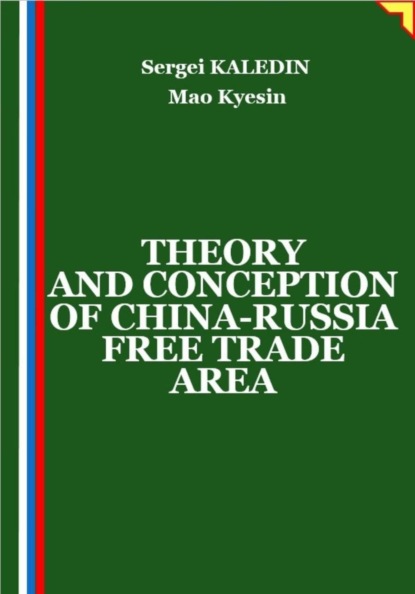
THEORY AND CONCEPTION OF CHINA-RUSSIA FREE TRADE AREA

Сергей Каледин
THEORY AND CONCEPTION OF CHINA-RUSSIA FREE TRADE AREA
1. The concept of a free trade zone
A free trade zone refers to an economic integration organization formed by two or more countries or administratively independent economies through an agreement to mutually cancel import tariffs and other measures that have the same effect as tariffs. Regarding the concept of a free trade zone, there has not yet been a unified expression in the international arena. At present, the more representative concepts are as follows: The International Convention on Simplification and Coordination of Customs Business Systems signed by the International Customs Council in 1973 China's conception of a free trade zone pointed out: a free trade zone refers to a certain area of a country, as long as the goods enter the area, they enjoy import tariffs and other tax preferences, and are not subject to customs supervision of ordinary goods.
The U.S. Tariff Commission described the free trade zone in this way: the free trade zone is an independent and closed area. Within the scope of the free trade zone, as long as the goods do not flow into the domestic market, the re-exported goods can be exempted from tariffs.
At present, both the free trade zone and the free port are special areas for a country's foreign trade. The functions of the two are basically the same. However, the free trade zone is an extension of the free port. In the free trade zone, products for export can be produced and further Develop supporting consulting, finance, insurance and other industries. With the development of free trade zones, the areas involved are becoming more and more diversified, including not only ordinary goods trade, but also trade liberalization in investment, service trade, and intellectual property rights. Free trade zones have gradually become A means for multiple countries to implement changeable strategies. The main features of the free trade zone:
1. State-led
The free trade zone is located in a country and is led and invested by the host country's government. The purpose of a series of preferential policies implemented in the zone is to promote foreign trade and accelerate the country's economic development. It is part of the host government's macroeconomic policy. Economic activities within the country are subject to the supervision and management of the host country's government. In a free trade zone, whether it is legislation to regulate economic activities or the establishment of a competent authority to perform economic supervision and administrative functions on behalf of the national government, it reflects the national will of the country where it is located. It is a national behavior. This is the first priority of the free trade zone. Features.
2. Convenient transportation
The free trade zone has an advantageous geographical location, generally connected to seaports, land border ports or large airports with large throughput, complete transportation and other infrastructure facilities, and developed domestic and foreign logistics industries. Convenient transportation and linkage to Hong Kong are essential conditions for a free trade zone.
3. Policy preferences
In the free trade zone, the government will implement more preferential policies in the zone to attract enterprises to enter the zone, such as tax reduction or exemption, provision of low-interest credit, lease of low-priced land, accelerated asset depreciation, and protection of investment safety. In the zone, the customs clearance procedures for people and goods are simple and fast, the government is efficient and efficient, and financial institutions provide strong financial support.
4. Domestic and foreign customs
A free trade zone is a non-customs jurisdiction. It is located inside the country but outside the customs. On the boundary line between the free trade zone and abroad, foreign goods can freely enter the free trade zone without customs supervision, and the goods in the free trade zone can also be freely transported abroad without customs supervision; but in free trade On the boundary line between the zone and the customs border, when goods enter the customs border from the free trade zone, or enter the free trade zone from the customs border, the customs must strictly supervise, collect tariffs, and combat smuggling. This is the most basic feature of a free trade zone.
5. Freedom in the zone
In the free trade zone, goods can be manufactured, assembled, processed, stored, exhibited, circulated, and sold in any form. These activities do not need to be approved by the customs and only need to be filed. In addition, the operation of the financial market and import and export control are all It has the characteristics of a high degree of openness, and the freedom of the zone is embodied in trade freedom, financial freedom, investment freedom, and freedom of personnel entry and exit.
The role of free trade zones in economic development: In order to achieve complementary advantages and common development of two or more countries or economies, in accordance with relevant WTO rules, certain binding agreements have been negotiated to eliminate tariffs and other trade restrictions and establish free trade zones. In this area, the government generally does not carry out administrative intervention in the operation of the regional economy. The main difference from other regions is that free trade zones have greater and broader freedoms in services, finance, and trade. It can be seen that with the establishment of a free trade zone, the country's economic development will surely be promoted, and the specific manifestations are as follows:
the competitiveness of domestic production enterprises will be improved, thereby attracting foreign investment;
increase domestic export trade, and domestic export commodities are diversified;
the country's technological innovation capabilities will be improved accordingly;
foreign exchange reserves and national income will be greatly increased;
solve the employment problems in the country, and at the same time accumulate a wealth of experience in opening up policies.
Related concepts of regional economic integration.
1. Customs Union Theory
In 1950, the American economist Wiener published the book "The Question of Customs Union", which proposed the theory of customs union and elaborated the theory in detail. The theory pointed out that two or more countries signed agreements , Cancel or reduce tariffs among member countries, realize the free flow of goods, and implement uniform tariff rates and foreign policies for non- member countries.
Customs union refers to the alliance between two (or more) countries (economy) on the basis of a free trade zone and an agreement between member countries to reduce or exempt tariffs, while for other non-member countries (economy) ) But implement other consistent tax rates. Therefore, we can see that the main difference from the free trade area is that within the customs union, each member country is not allowed to implement tariff reduction or exemption or preferential tariffs, while for non-member countries, the policy of high tariffs is implemented. Member states can realize the free flow of products without considering the certificate of origin. That is to say, the so-called customs union refers to an alliance in which member states completely eliminate tariffs or non- tariff barriers, allow free flow of goods internally, and implement uniform tariffs and common trade regulations externally. The free circulation of commodities in the full sense can be achieved within the alliance, including commodities produced in the region as well as commodities imported by a country from a third country.
The Customs Union and different free trade zones mutually cancel tariffs. It also requires the member states within the Customs Union to implement uniform external tariff rates. This means that the Customs Union has also realized the transfer of power, that is, the power to set tariffs. The economic integration organization can also be seen from here that the customs union is more binding than the free trade zone.
The customs union theory points out that whether a country can obtain greater benefits after joining a customs union mainly depends on the following points: First, after forming a customs union, the cost difference between the member states in the union is less than that of the countries outside the union. Second, countries with higher tariff barriers will gain greater benefits if tariffs are reduced after forming a customs union; third, countries within the customs union and countries outside the customs union have lower tariff barriers. The member states can still trade with external countries, and it is easier to obtain greater benefits; fourth, if there are more member states in the alliance and more low-cost member states, the more trade that occurs, the greater the gains. Benefits; Fifth, if the products between member states are more competitive and less complementary, the production cost will be lower and lower, and more benefits will be obtained. Sixth, the closer the geographical location is, the more convenient the transportation. The lower the transportation cost, the more benefits. Seventh, the member states have close trade exchanges when they have not formed a customs union. After the customs union is formed, there will be greater trade creation, and you can get Greater good. The theory of customs union includes dynamic effects of trade and static effects of trade.
2. Big market theory
The representatives of the big market theory are Sitovsky and De Niu. The theory believes that unifying the segmented narrow market into a big market and continuously extending the domestic market will bring a fierce competition environment for manufacturers. When manufacturers start mass production, economies of scale are formed and economic benefits are realized. The big market theory is proposed for the common market. The so-called common market refers to two or more countries or economies that have signed agreements to reduce or abolish trade barriers between each other and have common foreign trade barriers, which not only achieves the free flow of goods, but also realizes services ,capital, labor and other factors of production.
The degree of integration of the common market is one step further than that of free trade areas and customs unions. Although the big market theory is proposed for the common market, it is also applicable to free trade areas. The theory believes that the formation of a large market will promote a virtuous cycle of the economy: first, the expansion of the market will bring a fierce competition environment for manufacturers, which will inevitably bring about the survival of the fittest, poorly managed companies will close down, and companies that win the competition There will be large-scale production, resulting in economies of scale. Secondly, fierce competition among manufacturers and large-scale production will bring down production costs and commodity prices, which will increase the purchasing power of consumers and increase their actual income. Finally, the increase in consumption and income will promote the increase in investment, thereby once again realizing the expansion of the scale of commodity production, the reduction of prices, and the increase of consumer income. The economy thus formed a "snowball-like" expansion and continued to flourish.
The main points of the big market theory are:
the large market is generally shared by all countries, and this can also be extended to the internal market of a country, forming domestic market competition, and achieving "survival of the fittest" to promote domestic economic growth. According to the market economy plan, we know that good competition can eliminate some small-scale, low-efficiency small enterprises, promote the door-to- door production of some large enterprises, and then realize specialized division of labor;
under the background of the expansion of production scale and fierce market competition, enterprises in various countries must reduce the production and sales costs of goods. Similarly, if the price of goods drops, it will increase the purchasing power of consumers and make people's lives Quality and living standards have been effectively improved;
with the continuous improvement of the quality of life and living standards of the people, it will further stimulate consumers to increase consumption, and promote enterprises to increase production and expand investment. It can be said that the establishment of a unified large market can not only promote the economic development of the member states in the large market area, but also further stimulate the economic development of the participating countries.
3. Comparative advantage theory
The comparative advantage theory mainly includes two theories of comparative cost and factor endowment. The logical analysis of comparative cost theory is the core content, and the factor endowment theory is developed on the basis of comparative cost theory. It analyzes the causes of comparative advantage. An important sign of the final formation of the comparative advantage theory.
Adam Smith's absolute cost theory is the starting point for the comparative advantage theory. He believes that free trade can produce international division of labor. Superior natural endowments and advanced production conditions are the basis for international division of labor. These factors are conducive to international development among countries. Trade makes full use of the labor, resources and capital elements of all countries, reduces production costs, vigorously increases labor productivity, brings welfare to the country, and increases wealth. David Ricardo put forward the comparative cost theory in his book "Political Economy and Taxation Principles" in 1817. The main content is that due to differences in labor productivity between countries, a certain commodity in one country is comparable to that in another country. The two countries have a comparative advantage. The two countries implement professional division of labor based on the principle of "Choose the least of two evils and the best of two options."
Конец ознакомительного фрагмента.
Текст предоставлен ООО «Литрес».
Прочитайте эту книгу целиком, купив полную легальную версию на Литрес.
Безопасно оплатить книгу можно банковской картой Visa, MasterCard, Maestro, со счета мобильного телефона, с платежного терминала, в салоне МТС или Связной, через PayPal, WebMoney, Яндекс.Деньги, QIWI Кошелек, бонусными картами или другим удобным Вам способом.
Вы ознакомились с фрагментом книги.
Для бесплатного чтения открыта только часть текста.
Приобретайте полный текст книги у нашего партнера:
Полная версия книги
Всего 10 форматов