Полная версия:
The Call of Cthulhu / Зов Ктулху

Говард Филлипс Лавкрафт / Howard Phillips Lovecraft
Зов Ктулху / The Call of Cthulhu
Адаптация текста, комментарии и словарь С. А. Матвеева
© Матвеев С. А., адаптация текста, словарь, 2018
© ООО «Издательство АСТ», 2018
The Call of Cthulhu
I. The Horror in Clay
The most merciful thing in the world, I think, is the inability of the human mind to correlate all its contents. We live on a placid island of ignorance in the midst of black seas of infinity, andit was not meant[1] that we should voyage far. The sciences have harmed us little; but some day the piecing together[2] of dissociated knowledge will open up such terrifying views of reality, that we’ll either go mad from the revelation or flee from the light into the peace and safety of a new dark age[3].
Theosophists[4] have guessed at the awesome grandeur of the cosmic cycle where our world and human race form transient incidents. Their strange suggestions freeze the blood. Forbidden ages chill me when I think of them and madden me when I dream of them. That glimpse, like all dread glimpses of truth, appeared from an accidental piecing together of separated things: in this case, an old newspaper and the notes of a dead professor. I hope that no one else will make this piecing; certainly, if I live, I shall never add a link in that terrible chain. I think that the professor, too, intended to keep silent, and that he was going to destroy his notes but sudden death stopped him.
My first experience began in the winter of 1926-27 with the death of mygreat-uncle[5], George Gammell Angell[6], Professor Emeritus of Semitic Languages[7] in Brown University, Providence, Rhode Island[8]. Professor Angell was widely known as an authority on ancient inscriptions, and the heads of prominent museums had frequently asked him for help; so his death at the age of ninety-two was talked about. Moreover, interest was intensified by the obscurity of the cause of death. The professor had been stricken while he was returning from the Newport boat[9]. He fell suddenly; as witnesses said, after he had been jostled by a nautical-looking negro[10] who had come from one of the queer dark courts on the precipitous hillside which formed a short way from the waterfront to the professor’s home in Williams Street[11]. Physicians were unable to find any visible disorder, but concluded after perplexed debate that some obscure lesion of the heart, induced by the brisk ascent of a steep hill by so elderly a man, was responsible for the end. At the time I saw no reason to dissent from this dictum, but latterly I began to doubt.
As my great-uncle’s heir and executor, for he died a childless widower, I had to study his papers; and for that purpose I moved his files and boxes to my quarters in Boston. Much of the material will be later published by theAmerican Archaeological Society[12], but there was one box which I found very puzzling, and which I did not want to show to other eyes. It had been locked and I did not find the key till I examined the personal ring which the professor carried in his pocket. Then, indeed, I opened it, but when I did so I confronted a greater barrier. What was the meaning of the queer clay bas-relief[13] and the disjointed jottings, ramblings, and cuttings which I found? Had my uncle in his latter years become superstitious? I decided to find the eccentric sculptor responsible for this apparent disturbance of an old man’s mind.
The bas-relief was a rough rectangleless than an inch thick[14] and about five by six inches in area; obviously of modern origin. Its designs, however, were far from modern in atmosphere and suggestion. And there was writing of some kind; but my memory could not identify it.
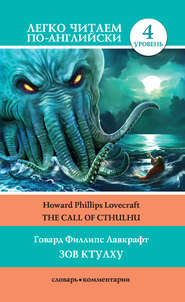
Above hieroglyphics was a figure, an impressionistic picture. It was a sort of monster, or symbol representing a monster, of a form which only a diseased fancy could conceive. If I say that my extravagant imagination offered simultaneous pictures of an octopus, a dragon, and a human caricature, I can present the spirit of it. A pulpy,tentacled head[15] surmounted a grotesque and scaly body with rudimentary wings; and the general outline of the whole monster made it most shockingly frightful. Behind the figure was a vague Cyclopean architectural background[16].
The writing was made by Professor Angell’s most recent hand; and made no pretense to literary style. The main document was headed “CTHULHU CULT” incharacters painstakingly printed[17] to avoid the erroneous reading of an unknown word. This manuscript was divided into two sections, the first of which was headed “1925 – Dream and Dream Work of H.A. Wilcox[18], 7 Thomas St., Providence, R. I.”, and the second, “Narrative of Inspector John R. Legrasse[19], 121 Bienville St., New Orleans, La., at 1908 A. A. S. Mtg. – Notes on Same, & Prof. Webb’s Acct.[20]” The other manuscript papers were brief notes, some of them were the queer dreams of different persons, some of them were citations from theosophical books and magazines (notably W. Scott-Elliot’sAtlantis and the Lost Lemuria[21]), and the rest comments on long-surviving secret societies and hidden cults, with references to passages in such mythological and anthropological source-books as Frazer’sGolden Bough[22] and Miss Murray’sWitch-Cult in Western Europe[23]. The articles were mainly about mental illness and outbreaks of group folly or mania in the spring of 1925.
The first half of the principal manuscript told a very interesting tale. On March 1st, 1925, a thin, dark young man of neurotic and excited aspect came to Professor Angell bearing the singular clay bas-relief, which was then exceedingly damp and fresh. His card bore the name ofHenry Anthony Wilcox
Конец ознакомительного фрагмента.
Текст предоставлен ООО «Литрес».
Прочитайте эту книгу целиком, купив полную легальную версию на Литрес.
Безопасно оплатить книгу можно банковской картой Visa, MasterCard, Maestro, со счета мобильного телефона, с платежного терминала, в салоне МТС или Связной, через PayPal, WebMoney, Яндекс.Деньги, QIWI Кошелек, бонусными картами или другим удобным Вам способом.
Примечания
1
it was not meant– не предполагалось
2
piecing together– соединение
3
dark age– средневековье
4
theosophists– теософы, сторонники мистического богопознания
5
great-uncle– двоюродный дед
6
George Gammell Angell– Джордж Гэммел Энджелл
7
Professor Emeritus of Semitic Languages– заслуженный профессор в отставке, специалист по семитским языкам
8
Brown University, Providence, Rhode Island– Брауновский университет в Провиденсе, Род-Айленд (один из наиболее престижных частных университетов США, основанный в 1764 г.)
9
Newport boat– ньюпортский пароход
10
nautical-looking negro– негр, похожий на моряка
11
Williams Street– Уильямc-стрит
12
American Archaeological Society– Американское археологическое общество
13
clay bas-relief– глиняный барельеф
14
less than an inch thick– толщиной менее дюйма (1 дюйм = 25,4 мм)
15
tentacled head– голова, снабжённая щупальцами
16
Cyclopean architectural background– фоновые циклопические строения
17
characters painstakingly printed– тщательно выписанные буквы
18
H. A. Wilcox– Г. Э. Уилкокс
19
John R. Legrasse– Джон Р. Леграсс
20
121 Bienville St., New Orleans, La., at 1908 A. A. S. Mtg. – Notes on Same, & Prof. Webb’s Acct.– 121 Бьенвиль-стрит, Новый Орлеан, на собрании А. А. О. – заметки о том же + сообщение проф. Уэбба
21
W. Scott-Elliot’sAtlantis and the Lost Lemuria– книга У. Скотт-Эллиота «Атлантида и исчезнувшая Лемурия»
22
Frazer’sGolden Bough– книга Фрэзера «Золотая ветвь»
23
Miss Murray’sWitch-Cult in Western Europe– книга мисс Мюррей «Культ ведьм в Западной Европе»
Вы ознакомились с фрагментом книги.
Для бесплатного чтения открыта только часть текста.
Приобретайте полный текст книги у нашего партнера:
Полная версия книги
Всего 10 форматов