Полная версия:
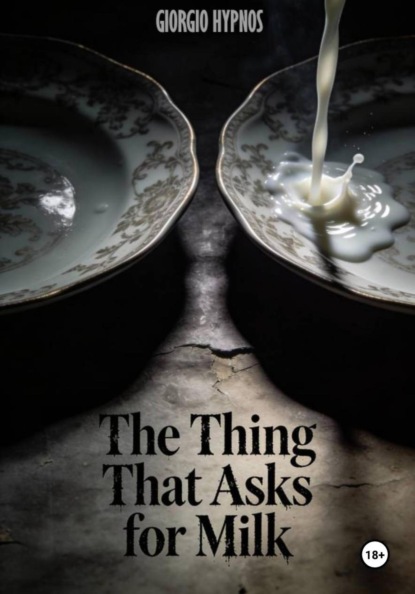
The Thing That Asks for Milk

Giorgio Hypnos
The Thing That Asks for Milk
Chapter 1
In Patchogue, autumn isn’t about golden leaves, it’s about how the darkness comes early. The light drains from the streets as if someone were switching it off on a timer, leaving wet asphalt, a few yellow streetlamps, and the smell of rot that soaks into your clothes, your skin, your thoughts.
Patchogue was home to pretty simple folks—maybe a little grim, and definitely tight-lipped. Not that they were hiding murders or cults—people just rationed words the way they rationed heat when the radiators couldn’t keep up again.
If a strange car sat in someone’s driveway for a week, it meant somebody had trouble. If a dog howled for a long time at night, it meant somebody left and didn’t come back. And if a jack-o’-lantern burned on a front porch on Halloween, it could be about the holiday—or it could be a request: let tonight be quiet.
Kate liked to leave a pumpkin on the porch not for the holiday, but for the light. The small candle inside made it feel like the house was waiting for you to come back.
Leo laughed at it, called it “cheap suburb mysticism,” but he still replaced the candles and made sure the flame didn’t smoke.
“See?” Kate would say, straightening his collar. “It’s not about being scared. It’s about not getting lost when it’s dark.”
“I don’t get lost,” he’d answer.
“You get lost all the time, Leo. You just learned how to pretend that’s where you meant to go.”
She said it lightly, like she was talking about keys or the gloves he kept forgetting in the car at night. And Leo, if he was honest, loved those small scoldings of hers—there was life in them: familiar, domestic, insignificant, and therefore real.
***
He was a fairly well-known wine critic in Manhattan. The last name King gave him certain advantages among his competing colleagues.
Leo King wasn’t the type to write copy for glossy brochures where every red was “velvety” and every white was “refreshing.” His work ran in online outlets and local guides; bloggers kept quoting him in their videos; and sometimes he’d be invited to “judge” tastings and new shipments in Manhattan—as the guy who could tell wine with a story from a story about wine.
He went into the city a few times a week on schedule, and the trip was a ritual: pulling out of the quiet neighborhood, stopping for gas at the exit where the coffee smelled like burnt caramel, getting onto Express Drive N, then the bridge over the East River—like a border between Patchogue air and New York’s dense dampness—and then the streets where somebody was always honking, always late, always in motion, so it felt like life would never stop.
Kate liked his job. She even got jealous—not of women, of the city.
“New York takes you,” she’d say.
“It feeds us,” Leo would answer.
“So what? I feed you too.”
“You guard our hearth,” he’d say, and it was truer than the other thing.
***
In recent weeks, Kate joked less and less.
The Kings had gone a long time without managing to fill their family nest with kids. But apparently the doctors’ advice—to move out of the city, to leave work at least temporarily, and to focus only on the family—had worked.
In winter, when Patchogue got buried in snow, they’d spend whole days sprawled by the fireplace, rewatching black-and-white old movies, and—without any lack of pleasure—devoting themselves to the goal of conceiving their child.
And now Kate was pregnant, and the pregnancy was hard on her—she was exhausted, slept badly, and sometimes sat in the kitchen at night with a cup of warm water, staring out the window as if she were waiting for someone to come and say, “Everything’s going to be okay.”
One day Leo came back from the city with a bottle of Amarone—rare, given their current situation. He wanted to give her a little celebration.
Kate looked at the bottle and smiled, but her eyes were not her own—wide open and wary.
“Leo…” she said, and laid a hand on her belly. “I’m scared.”
He sat beside her, took her hand, kissed the tip of each finger, then pressed her palm to his lips.
“Of what?” Leo tried to ask, as casually as he could.
“Of everything. That I won’t manage. That you won’t manage. That this…” She hesitated and nodded toward her stomach. “That it’ll happen wrong.”
He wanted to say something correct and necessary for the moment: that the doctors were good, that the hospital was close, that the outlook was good, that fear was normal.
But instead he said:
“I’ll be there, and I’ll bring the camera to film how your face changes after the birth—your happy smile. And later we’ll laugh together about how we panicked, then our kids will laugh, and then our grandkids.”
Kate gave a little snort.
“Just don’t film me when I’m… well…”
“I’ll only film your face,” he promised.
Chapter 2
Labor started at night, with rain drumming on the roof so evenly it felt like someone up there was testing the house’s strength.
At first Kate endured it in stubborn silence. Leo slept beside her. The packed hospital bag had been lying by the bed for two weeks, and he’d already stumbled over it a couple of times—afterward he limped around, rubbing the bruised spot on his leg.
Then she doubled over, grabbed the forearm of the sleeping Leo, and, already short of breath, groaned:
“Leo. Now.”
His hand jerked, closing around her palm for a couple of seconds.
“Hold on just a little, Kate,” Leo whispered, and dashed for the car with their things.
He remembered the drive to Port Jefferson as a sequence of flashes: the red traffic light, neon signs reflected in rain-slick mirrors, her broken breathing turning more and more ragged, and his own hands on the wheel, white with strain.
In the admissions area, it smelled like antiseptic and coffee. The nurses moved at first with an unhurried restraint, like people used to other people’s pain—and with no right to spill their own.
“Name?”
“Katherine King.”
“Date of birth?”
Kate, bent over, answered, and Leo stood beside her—useless, extra—feeling like a kid who’d been let into the adult world by mistake.
When they were led farther in, Leo pulled out the action camera. He always carried it in his bag—he filmed tastings and shipments, sometimes short “field” notes: the label, the color, people’s reactions, so he could sort it all out at home in his database instead of trusting his memory.
Kate saw the camera and said, “Only the face.”
“Only the face,” he repeated.
***
They took Kate into a room, helped her change, and then went to call the obstetrician.
His wife was suffering right now in front of him—the woman who had carried his flesh and blood under her heart for months, the one who clenched her teeth and took the pain while he slept. Leo shook with panic and helplessness.
Kate nodded toward Leo’s pocket where he’d put the camera. He took it out and started recording.
In the frame: her forehead, a strand of hair stuck to it, a чужая hand in a rubber glove adjusting the sheet. The metallic clatter of instruments. Short phrases from the nurses and the obstetrician that sounded to him like another language.
Leo swayed as he watched his wife, and fear kept rising in him that suddenly everything would go wrong. The camera swayed with his hand and his body, and the image kept slipping out of focus.
Then—a command. Movement. And a pause.
A pause where the first cry was supposed to arrive.
The cry came. But for some reason not fully—as if someone inhaled and changed their mind. A thin sound, broken, nothing like the movie kind of wail.
More movement.
Leo felt his legs go weak. He stepped closer because the medical staff blocked his view of Kate.
And in the next moment a nurse laid a hand on his shoulder. Not rough, but final.
“Sir. Leave the room. Now.”
“Wait, I—” He lifted the camera as if it were his right.
“Faster, sir.”
He caught Kate’s face—for one second. She turned her head and looked at him like she wanted to remember. There was more calm in her eyes than there was in him.
The door shut in front of him with a soft click, like a lock on a cage.
He was left in the corridor with the camera in his hand, and the camera kept recording—his shaking fingers, the white wall, the strip of light under the door.
He didn’t stop the recording.
After that, there were a lot of things he didn’t “turn off.”
***
After that, everything turned into mosaic fragments that wouldn’t fit into any sequence.
A doctor with a tired face. The words: “We’re sorry. We did everything.” A plastic cup of water he couldn’t bring to his mouth—he dropped it, splashing not only himself but the doctor’s blue gown.
Cold, shaking hands, and a stuttering voice that had gone suddenly hoarse. Black-and-white shorts flickered through his mind: a conversation in an office, signatures, stamps, documents being pushed into his disobedient hands.
He signed without looking, barely reading—he wanted to run from the text too badly.
All that remained in his head was: “I had a child… and he died.” And: “Kate is gone.” He repeated it to himself as if the right wording could keep the world from coming apart.
When they gave him his things back, he found the action camera in the bag. It was off; the red indicator blinked—the battery had died. He thought, I need to erase it.
***
Then there was the funeral. Then the house, where there was suddenly too much space.
Then—the first bottle.
Not for pleasure. For sleep. To close his eyes and not see that corridor outside the room, that door, that pause before the cry.
He was a wine critic, a man who could tell by smell whether a wine had been stored right, where the cork had failed, where the taste had “broken.” And now he drank cheap whiskey from the local grocery store because its taste demanded no attention—it just burned and erased whatever it could.
The first days he still tried to live “like before.” He got up, brushed his teeth, shaved, opened his laptop, pulled up his database—neat fields, sorting, and edited notes.
But all of it belonged to someone else’s life. His own life had vanished.
The action camera lay on a kitchen shelf beside its charging base. He put it on the charger because that was what he always did.
The router blinked in the corner. A radio on the windowsill muttered something about traffic and the weather. And all of it—light, electricity, sound—kept the house in a state of “normal.”
Leo’s brain tried to live normally during the day, but almost every evening his thoughts carried him into the dark, and he left the empty house for another dose of whiskey.
***
He tossed and turned, slipping in and out of dreams he couldn’t remember. And then the pain came.
Not physical. The kind that lives under your ribs like a cold piece of metal, and if you breathe too deep, it cuts you from the inside.
He sat up and swung his legs to the floor. Somewhere in the kitchen a clock ticked. Tick. Tick. Tick—like the steps of a midwife walking away down the maternity-ward corridor. In his head, flashes of that night ran again.
“We’re sorry…” the doctor had said then, and the word fell onto the tiled floor like a shattered cup.
Sorry about what? Sorry about the woman he would never see again? Or about the baby they hadn’t even had time to name?
He got up, went to the bathroom, splashed water on his face. In the mirror—stubble, red eyes, skin a shade darker from exhaustion.
On his wrist was a fresh scratch.
He didn’t remember where it came from. Maybe last night, when he was swaying around the yard, he snagged himself on a nail in the fence. Maybe he dropped a bottle and picked up the shards. The scratch was long, ragged, swollen.
“Like everything else in my life,” he thought. “Ragged.”
Near the couch he found what was left of the whiskey and took a swallow. The alcohol spread down his throat, burned, and his head got quieter—not better, but quieter, as if someone had turned down the radio that played the same word around the clock: too late.
Chapter 3
A couple of weeks later, one evening, Leo came back from the store with a grocery bag that held a lot more alcohol than groceries, and he saw a shoebox on the threshold of his house. He swayed a little from what he’d already had to drink that night.
He set the bag down on the porch beside him and bent toward the box, listening. Something moved inside.
Leo jerked back and scanned the area, trying to make out in the dark who’d decided to mess with him, and why they’d left this box.
The street was empty. Dusk lay over the scattered leaves like a dirty bluish film. Somewhere in the distance a car went by.
Конец ознакомительного фрагмента.
Текст предоставлен ООО «Литрес».
Прочитайте эту книгу целиком, купив полную легальную версию на Литрес.
Безопасно оплатить книгу можно банковской картой Visa, MasterCard, Maestro, со счета мобильного телефона, с платежного терминала, в салоне МТС или Связной, через PayPal, WebMoney, Яндекс.Деньги, QIWI Кошелек, бонусными картами или другим удобным Вам способом.
Вы ознакомились с фрагментом книги.
Для бесплатного чтения открыта только часть текста.
Приобретайте полный текст книги у нашего партнера:
Полная версия книги
Всего 10 форматов